Derrick Team Scheduling Before the Next Trip Out of Hole
The Trip That Started at 22:00
A deepwater drillship started a trip out of hole at 22:00 on day 16 of a 21-day rotation. The derrickman on the monkey board had worked the previous four night tours on stabbing and drift sequences through a long bit run. The trip — roughly 240 stands — was planned for 14 hours with a single tour change at 06:00. At 03:40, a pinch-point near-miss hit when a stand swung wider than expected during racking, and the derrickman's glove caught a fingerboard latch as the next stand arrived. No injury.
The post-incident review noted "situational awareness degradation consistent with cumulative fatigue." The trip completed on schedule. The derrick team that executed it had been on a sustained wilt for four days before the trip started. The trip schedule did not create the wilt; the four nights of stabbing work did. But the trip placed the wilt under load at exactly the wrong moment, and the scheduling system that slotted the trip into day 16 did not have the crew-state data to recognize the collision.
OSHA's eTool on drilling tripping operations catalogues the hazards the derrick team faces on every trip: pinch points, tong strikes, elevator risks, and the cumulative fatigue of a multi-hour sequence (OSHA eTool Oil and Gas Drilling Tripping Out/In). The epidemiology on fall fatalities in oil and gas extraction from 2005 to 2014 puts a sharper number on the derrickhand's height exposure across trip operations (Occupational Fatalities from Falls in Oil and Gas Extraction 2005-2014).
BSEE's technical document on swabbing and surge during tripping details the operational factors that stretch trip duration unpredictably — the same factors that push the derrick team deeper into fatigue than the plan anticipated (BSEE Effects of Tripping and Swabbing in Drilling Operations). The Drilling Manual's reference on tripping-pipe procedures sets the expected workflow and derrickman duties across the trip cycle (Drilling Manual Tripping Pipe Procedures and Rig Safety). The procedure is well-documented. The staffing of the procedure against the current garden state is not.
Sequencing the Derrick Garden
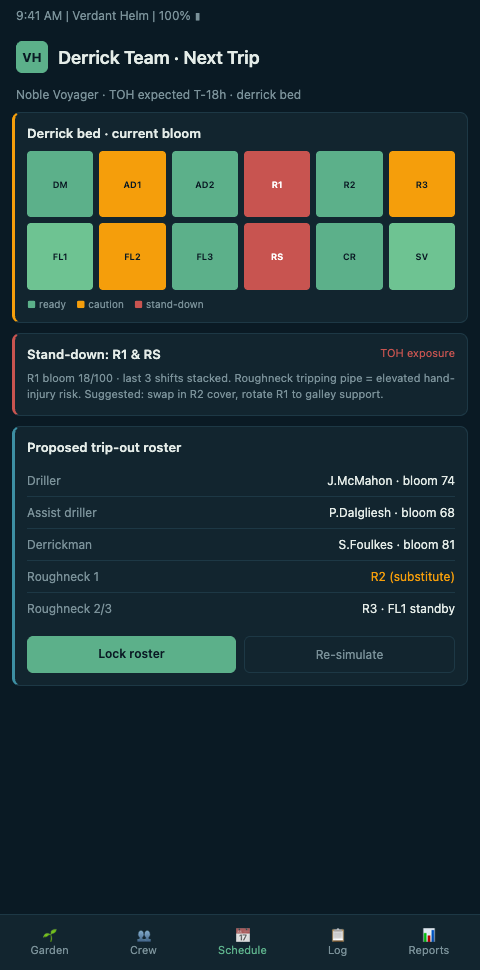
Verdant Helm treats the derrick team as a bed of perennials where each plant has specific cognitive demands: the derrickman on the monkey board, the assistant driller, the roughnecks on the floor, the mud logger in the doghouse. A trip out of hole taxes the bed unevenly. The derrickman's role demands sustained fine-motor coordination at height over hours; the roughneck role demands burst energy and timing across each stand; the driller's role demands pattern-tracking and sequence discipline. A well-scheduled trip plants each task with a perennial that can bloom through it. A poorly scheduled trip sends wilted plants into the roles with the sharpest cognitive edge. The trip does not reveal the wilt; it amplifies it across every stand and every handover between roles.
The scheduling framework has three components. First, the 72-hour pre-trip view. The drilling plan almost always signals a trip at least 48 hours ahead (casing run completion, bit change indicators, formation tops). The garden view shows the forecast state of each derrick-team role across the trip window and flags the combinations where the monkey-board plant will be deep in a wilt during the critical racking hours. The forecast is not a prediction of certainty; it is a probability distribution across the rotation data, and the toolpusher uses it the same way a captain uses a weather forecast — as input to a decision, not a replacement for it.
Second, the pre-trip swap. Where a wilt is forecast, the toolpusher considers swapping the derrickman from the other tour for the racking-intensive segment, or inserting a rest window before the trip starts. Research on human factors in drilling operations documents how the same procedural sequence can produce different outcomes depending on the cognitive state of the executing crew (SPE JPT Getting to Grips with Human Factors in Drilling Operations; OnePetro Human Factors in Drill and Well Operations).
Third, the in-trip micro-break protocol. Every 60 stands, a 3-minute hard break at the driller's shack with water, a walk, and a state-check. This is not a productivity loss; it is the pruning that keeps the plants able to bloom through the second half of the trip. Operators who have tried the micro-break protocol find that the trip overall runs at similar or better pace because the last third of the stands go smoother.
IADC's safety-meeting pack on safety while making hole is a practical reference for the hazards that re-emerge across every trip and sits alongside the garden approach rather than replacing it (IADC Safety While Making Hole). The garden layer adds the crew-state dimension to the procedural discipline. The discipline is unchanged; the supervision intensity changes with the garden view, so the same procedure runs with different levels of oversight depending on the bed's current bloom pattern.
Advanced Tactics for the Derrick Team
Three tactics turn the forecast into a scheduling discipline. The first is the role-swap cost model. Rigs are often reluctant to swap derrick personnel across tours because of training currency, rig-specific familiarity, and contractual boundaries.
The garden view quantifies the cost of not swapping — projected incident probability, projected trip duration extension, projected near-miss rate — so the decision is data-driven. The BOP test scheduling window uses the same logic for a different critical activity; both rest on the 72-hour forward view.
The model does not force a swap; it gives the toolpusher a defensible record of the decision regardless of which way it goes, which matters for post-incident review and ALARP evidence.
The second tactic is the trip-end recovery plan. A 14-hour trip ends with a crew that is functionally wilted across the whole bed, not just the derrick position. The rig schedule often slots a JSA review or equipment check into the immediately-post-trip window, and the garden flags this as the wrong moment. Instead, the post-trip 12 hours should contain minimal-cognitive-load tasks (tidy-up, routine inspections, handover) and the next critical sequence should be pushed to after a full rest cycle. This is where operator pressure to accelerate the next section collides with derrick-team reality — the garden view reframes the collision as a resource-allocation decision rather than a work-harder demand.
The third tactic is adjacent-role protection. The mud engineer split-shift rotation often overlaps with a trip, and the mud engineer's role in monitoring return flow during tripping is safety-critical. The garden view shows both the derrick team and the mud engineer state in a single picture, so the OIM can schedule around the combined load. The parallel practice on cargo vessels — bosuns rotating deck crews through garden signals — shows how the same role-aware rotation applies to deck operations.
A fourth tactic is the pre-trip medical touchpoint. A derrickman heading into a 14-hour trip deep in a hitch benefits from a short check-in with the medic for hydration, nutrition, and any niggling physical issues. The check does not need to be formal; it needs to be scheduled, and the garden view gives the medic the list. A sore shoulder on day 16 is a different input to a trip than the same shoulder on day 4, and the medic can flag the difference.
A fifth tactic is equipment-state awareness alongside crew-state awareness. The monkey board, elevators, tongs, and spinning wrench all have maintenance histories that interact with crew fatigue. A marginal piece of equipment paired with a wilted derrickman produces compound risk; the same equipment with a bloomed crew is manageable. The garden view sits alongside the equipment log so the toolpusher can see both in a single planning view before the trip starts.
Common mistakes include scheduling the trip start at the shift-change boundary (which puts both tours into the sequence under sub-optimal conditions), trusting the derrickman's self-report late in the hitch (which underestimates the wilt), and planning the trip duration on the fastest past performance rather than the realistic-for-this-crew estimate. A subtle trap: the "easy" trip — shallow section, familiar BHA, clean hole — produces a faster-than-planned completion, which tempts the driller to run a subsequent high-load task straight after. The garden view surfaces the accumulated fatigue regardless of trip duration. Another trap is anchoring on a single derrickman — rigs that depend on one person for the monkey board lose all scheduling flexibility the moment that person wilts, and the cross-training investment is the only sustainable mitigation.
Plan the Next Trip Backward
If you run toolpusher or OIM duties and a trip is in your next 72 hours, pull your derrick-team schedule and overlay each crew member's hitch day against the racking-intensive hours. The wilt-window overlap usually shows up quickly, and it tends to cluster in predictable ways — the same derrickman on the same night-tour pattern across multiple hitches. Verdant Helm gives drilling supervisors a way to re-sequence the derrick team before the trip starts, not during the post-incident review. Bring us your drilling plan and current tour rota and we will map the garden overlay for the next trip window, with two sequencing alternatives that keep the trip within its planned envelope while landing the derrick team on their stronger bloom positions.
The two alternatives are structured so the toolpusher can choose without re-planning the whole trip. Alternative one preserves the current start time and swaps the derrickman for the racking-intensive segment only, with the assistant driller stepping into a supporting role during the swap window. Alternative two shifts the trip start by four hours to land the critical racking hours on the stronger bloom side of both tours' curves, with the mud engineer's flow-check schedule adjusting to match.
Both alternatives come with a 72-hour forward garden projection so the toolpusher can see how each option shapes the post-trip recovery window. Rigs that have run this mapping across three or four consecutive trips report the derrick team's hitch-end trajectory looks visibly different from the legacy scheduling pattern — fewer late-hitch first-aid visits, cleaner handover notes into week three, and more predictable trip durations because the racking cadence matches the crew's actual bloom rather than fighting it.