Counting the Real Fatigue Cost of a Failed Transfer Attempt
Two Seconds Between a Landing and an Abort
A CTV approaches a monopile boat-landing at 08:15 on a 1.4m Hs morning with four techs on the forward deck, heading for a Siemens Gamesa 154-DD turbine on a Dogger Bank-style array. The master brings the bow to within 2 meters, holds position for 40 seconds, and aborts at a swell moment that would have bounced the transfer. He backs off, repositions upwind, and runs a second approach at 08:22. The second pass succeeds — boots on the ladder at 08:23, first tech climbing at 08:24. The daily transfer log records one successful landing. The safety log records an aborted approach flagged by the master. No incident is filed. The four techs finish their climbs, descend at 14:30, transfer back at 15:05, and the day closes clean. The post-shift logs read the same as a single-approach day. Nothing in the dispatch sheet prices the second approach.
The blade tech among the four has a leading-edge patch planned for 15:30 the next day; the arousal residue from the aborted approach is still in her shoulders when she signs the plan.
An IMCA safety flash on near-miss incidents during CTV approaches documents the specific scenario — vessels within 2 meters of the monopile at an aborted landing — and its high arousal and re-plan cost. The G+ good practice guideline on offshore wind farm transfer recognises abort protocols and transfer decision authority; G+ 2021 incident data catalogues transfer, landing, and near-miss events that include the aborted approaches the daily log often obscures. The sector has documented the safety of the abort decision. What stays invisible is the accumulated crew-side cost of the approach cycle. CTV fleet operators running mixed vessel classes — MHO-Co Apollo-class hulls, Northern Offshore Services Explorer vessels, Njord Offshore's more recent builds — each produce different abort signatures at the same Hs, and the abort cost on a catamaran with less damping reads differently than the same abort on a SWATH vessel.
An Energy Institute toolbox case study of a crew transfer incident at a turbine transition piece describes the residual impact on the tech's energy state through the remaining shift — elevated arousal, reduced fine motor precision for the first 30-45 minutes of the climb, and delayed subjective recovery. Safe aborts are the right decision. The dispatch sheet just needs to stop pretending they are free.
What the Garden Counts That the Log Misses
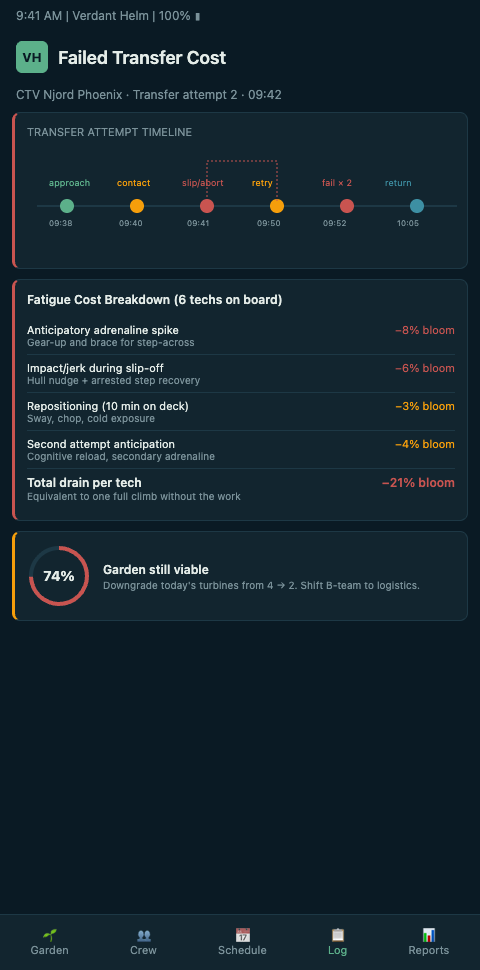
A botanical garden records the weather event as well as the harvest. A bed that survived a near-miss hailstorm shows soil compaction and root shock on the gardener's card even if the harvest came in at spec. Verdant Helm does the same for an aborted transfer approach: the attempt is logged as an event on each tech's bed, and the cost is priced against the subsequent shift work rather than zeroed out because the second approach succeeded.
The physiological cost is measurable. A peer-reviewed MDPI JMSE paper on technician welfare during transits quantifies the acceleration signature of aborted approaches — the sudden throttle-back, the repositioning chop, the 3-5 minute low-RPM motion drift while the master re-reads the swell — that each deposit a measurable load on the tech's ledger. The composite RMS acceleration of a three-attempt morning exceeds a clean-transit 1.4m day by a meaningful margin without ever breaching the Hs threshold. The bed has been hit twice.
The arousal cost is separate from the motion cost. Techs standing on the forward deck during an approach are cognitively engaged at a high alert state — watching the master's cues, bracing for the landing moment, ready to step. An abort resets the state. A second approach rebuilds the arousal. If the second attempt also aborts, the third rebuilds it again. By the time the landing succeeds on a three-attempt morning, the four techs have spent 20-30 minutes in heightened alert before their first climb. That cost lands on the gearbox inspection that follows.
Verdant Helm prices this with a two-channel model. Each aborted approach deposits a motion load (from the vessel accelerometer) and an arousal load (proxy from approach duration and abort count) onto each tech's bed on the forward deck at the moment of abort. The bloom state updates before the successful transfer even happens, and the dashboard shows the post-transfer reading with the full cost already integrated. An American Clean Power offshore marine transfer guidance document codifies the stop/abort decision logic that makes the abort data auditable, which means the garden reading rests on information the vessel is already generating; the difference is that Verdant Helm ties it to the tech bed rather than the transfer KPI.
The two-channel split also matters downstream — the motion load decays over 60-90 minutes with active movement on the turbine, while the arousal load decays slower and is still measurable in fine-motor performance 2-3 hours after the landing, which is why the heavy gearbox torque operation scheduled at 11:00 carries residual risk the vessel-level KPI does not see.
A Windpower Engineering industry analysis on vessel data and offshore wind risk notes that vessel telemetry already captures the near-miss and abort signature the crew-side ledger needs. The telemetry has been collected for years. What changes with the garden view is that it is read as a crew signal rather than a vessel metric. The tech who climbed the gearbox at 09:15 after three approaches that morning shows up on the dashboard at a pruned bloom state, and the oil top-up she was going to do at 11:30 moves to a fresher bed.
Advanced Tactics
Three practices turn the abort ledger into an assignment input rather than a retrospective statistic.
First, log the attempt count visibly on the transfer sheet itself, not buried in the vessel motion file. The most common failure mode is a campaign manager who reads the transfer log at day's end, sees 12 successful landings, and treats the day as clean.
Verdant Helm's CTV module adds an attempts-per-landing column on the daily sheet so the 12 successful landings on a three-attempt-average morning read differently from the same 12 on a first-approach morning. The visibility changes the reporting culture over the first two weeks — teams start talking about attempt counts at the 07:00 brief the same way they talk about Hs.
Second, tier the shift's first-climb assignment by arrival bloom, not dispatch plan. A tech who landed clean on the first approach can take the heavy gearbox job at 09:15. A tech who landed after three attempts should start on a lighter inspection and let the arousal cost decay for 45-60 minutes before the physical climb load peaks. The dispatch engine pushes this suggestion to the shift leader automatically once the morning's approach data comes in, and the leader reorders the first-climb sequence in 30 seconds. The reorder is particularly important for HV switching operations — a tech who landed after three attempts and is due to de-energise a string of six turbines for an array cable inspection should defer the switching sequence until the arousal load has decayed, because the consequence of a missed switching step on a live array is categorically different from a missed gearbox torque value.
Third, feed the abort ledger into the master's forecast next morning. CTV masters make sail/no-sail calls partly on Hs and partly on cumulative abort history for the approach cycle at a given site. Verdant Helm's master-view shows the last seven days of attempt counts alongside Hs and transfer duration, so the master can see whether the approach cycle has been running hot at this site even when Hs is well within cap. The signal often predicts a marginal day that the Hs forecast alone reads as clean, and the master's go/no-go decision becomes defensible against the garden view rather than the threshold alone.
A wind tidal interaction at certain East Coast UK monopile sites produces a known swell-and-tide chop signature roughly two hours either side of local high water; masters who see the seven-day attempt count spike on those windows recalibrate their approach window faster than any static forecast model could.
The transfer-cost framing sharpens when paired with adjacent reads. A 1.5-meter sea state quietly resets crew energy unpacks the transit-level version of the same accounting, and the nacelle safety playbook for borderline-energy days translates an amber bed state into concrete nacelle task restrictions. The pattern echoes in deep-sea shipping as well — scheduling crew energy around traffic separation scheme transits uses the same event-based fatigue accounting for dense-traffic transits, and the crossover calibrates what a well-priced high-arousal event looks like on a ledger.
Start Counting Attempts, Not Only Landings
Offshore Wind O&M teams can enable the attempt count on existing CTV motion feeds and get a readable abort ledger across a single rotation. Verdant Helm plots the accumulated cost against each tech's bed so the 09:15 assignment reflects the morning that actually happened rather than the morning the log describes. CTV masters and crewing managers find the two-channel model changes the first-climb sequence on three or four mornings per rotation — reliably the mornings the post-mortem would have flagged anyway.
Begin with the master's readout rather than the crew-side dashboard. The CTV master is the only person who sees every approach and every abort in real time, and the attempt count will feel familiar to him because he was already tracking it in his head. Giving him the visible column first makes the crew-side reading land on an already-endorsed signal rather than a new framework the bridge has to adopt from scratch. Two weeks of master-first data collection will usually produce the first observed case where the 07:00 brief reorders a gearbox job away from a tech who absorbed three aborts — and that case is the argument that converts the shift leader.
Keep the ledger read short at the brief. Ninety seconds on the attempt counts and the flagged beds is enough; any longer and the brief loses the rest of its agenda. The point is not to audit every abort but to catch the beds that carried the highest motion and arousal load into the day. By the end of one rotation, the attempt count column will have changed the first-climb assignment on three or four mornings, and the crewing manager will have a clean post-campaign read showing zero reportable incidents on the days the dispatch honoured the abort ledger. That comparison is the conversion artefact for the next charterer review.