Why a 1.5-Meter Sea State Quietly Resets Crew Energy
The Transfer That Looked Clean
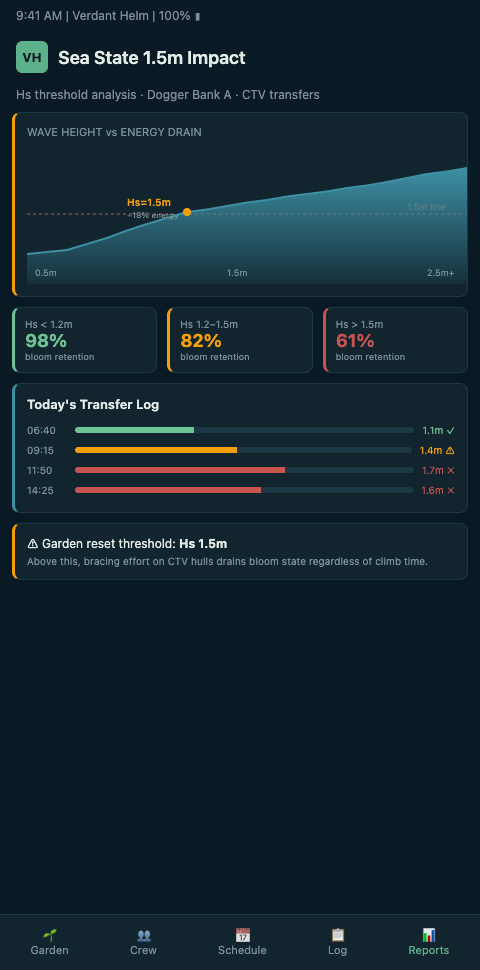
A CTV departs an East Anglia port at 06:45 with four techs on board, heading out to a Greater Gabbard-style array on Siemens Gamesa 3.6MW turbines. Significant wave height at the turbine array is 1.4m, just under the vessel's certified 1.5m workability threshold. The 90-minute transit runs on specification — bow-on hop to the monopile boat-landing at 08:35, successful transfer, first tech on the ladder at 08:40. The operations log for the day reads "clean transfer, no issues."
By the time the two nacelle techs reach the gearbox inspection platform at 09:20, their grip strength measured by the climb-assist system is 18% below their recorded baseline, and one is already quietly re-reading the gearbox torque values twice before accepting them. A blade tech who was due to start a leading-edge patch on the same day cancels her rope-access rig-up at 10:05 because her hands are still unsettled; the dispatcher notes the cancellation as a "tool unavailability" rather than a crew-energy signal.
Nothing on the dispatch sheet records the reset, because nothing in the threshold framework was designed to. A peer-reviewed review in the Journal of Marine Science and Engineering modelled Motion Sickness Incidence and composite RMS acceleration across CTV transits and showed that 1.5m Hs transfers still meaningfully degrade technician welfare — the threshold is a vessel access cap, not a crew readiness cap. A separate state-of-the-art review on CTV transfer safety in ScienceDirect confirms that vibration exposure on the transit may be intolerable even when the transfer itself is accessible by Hs. CTV fleet operators like MHO-Co, Northern Offshore Services, and Njord Offshore have documented the same pattern internally across their fleets: a vessel-certified 1.5m day is not a tech-ready 1.5m day.
Cultural factors compound the undercount. A Springer Nature mixed-methods study on coping behaviours among offshore windfarm workers found stigma around seasickness disclosure runs deep: techs under-report post-transit nausea and dizziness, which means the energy reset never reaches the O&M manager in a form they can act on. The transfer log says clean. The body says otherwise. The gap between the two is where the shift quietly loses its margin. The pattern shows up differently by role: a gearbox tech with residual motion load gets slow and cautious, which is safer but consumes more of the weather window; a blade tech with the same load is more likely to abort a rope-access job mid-climb; an HV tech is more likely to defer a switching operation and push it to the next day.
What the Garden Sees That the Log Misses
A botanical garden does not measure the health of a bed only when the gardener stops to prune. It reads the soil state continuously — moisture, root density, shade coverage, wilt pressure from the last storm. Verdant Helm treats each CTV transit as a storm event on the tech's bed, not as a neutral commute. A 1.4m transit deposits a measurable energy sink that needs to be booked against the day's climb load before the monopile ladder is touched. The sink varies by bed type. A senior gearbox tech on her 200th CTV transit has habituated hulls of resilience that a blade tech on her 30th does not; the garden reads both against their own baselines, not against a fleet-wide benchmark.
The mechanism shows up in the physiology. A peer-reviewed PMC review of occupational whole-body vibration documents how sustained exposure drives back pain, fatigue, gastrointestinal symptoms, and cognitive effects — all of which carry into the work that follows the transit, not just the transit itself. The perennial metaphor catches this well: a bed that absorbs 90 minutes of 1.4m chop arrives at the turbine visibly green but with its root water reserves partially drained. The first two hours of climb work are spent refilling, not producing.
The dispatch sheet still reads four billable techs. The reality is three-and-a-half. On a 99-turbine Orsted or SSE field, three-and-a-half effective techs across 14 days of campaign work becomes a measurable delivery gap that quietly stretches the inspection cycle by 8-10%.
Verdant Helm's CTV transit layer ingests Hs, transit duration, composite RMS acceleration from the vessel motion sensors, and a MISC-scale nausea self-report at the last mooring. The SINTEF/EERA DeepWind 2025 research on motion sickness prediction shows MISC adds granularity beyond MSI by capturing the sub-vomit fatigue band where most of the real reset lives — the tech who does not vomit but operates at 70% of baseline for the next four hours. That 70% state is what the bloom-state view colours amber on the dashboard, prompting the team leader to re-order the first climb of the shift toward a lighter inspection and defer the gearbox torque check by ninety minutes.
The 90-minute deferral rule turns out to be a well-calibrated default: techs running amber who take a 45-minute break return at 82% of baseline; techs who push straight into a gearbox torque operation recover slowly and stay at 70% through the afternoon.
The visible output looks ordinary. A green plot turns amber after the transit. An eight-tech deployment shows five green beds, two amber, and one red after a morning chop. The day plan reorders itself: the red bed gets a gangway-deck task only, the amber beds take ladder climbs below 20 meters, and the five green beds carry the nacelle work. The transit cost has been priced. The perennial has been tended. The storm has been logged. Crews running Vestas V164 or Siemens Gamesa 193-DD turbines find the reorder changes which turbine IDs go on which techs — the highest hub-height climbs shift to the beds in the best state, and the campaign's harder assignments land where they are most likely to be completed safely.
Advanced Tactics
Three refinements tighten the reset model for crews running daily CTVs through a season.
First, calibrate the reset cost per tech, not per vessel. A Windpower Engineering industry analysis on vessel telemetry and offshore wind health risk shows that individual tolerance to vessel motion varies more than the Hs reading suggests. A 1.4m transit may reset one tech to 90% of baseline and another to 60%. Verdant Helm stores the per-tech calibration curve across the first 20 transits of a deployment, then applies that curve to future days automatically. By transit 25, the amber/red flag for each tech is personalised rather than broadcast — the senior tech with good habituation keeps working while the newer tech gets the lighter task.
Second, hold the reset visible across the climb day, not just the moment of boarding. A common mistake is flagging the transit cost at 09:00, then letting the dashboard revert to baseline for the 13:00 climb assignment. The bed does not actually recover in four hours on a working turbine. A Frontiers in Marine Science decision tool for planning O&M activities models sail/no-sail decisions using technician comfort proxies rather than Hs alone, and extends the same logic past the transit to the full shift envelope. Verdant Helm carries the amber state through the day until a real recovery marker — a break longer than 45 minutes in the nacelle, a full meal on board the SOV, a pulse check — actually upgrades the plot.
Third, cross the threshold framework with transfer attempt counts, not just transit cost. A failed transfer attempt costs almost as much as a completed 1.4m transit, and the total count compounds by the third attempt of a morning. The MDPI JMSE paper on technician welfare during transits captures the acceleration signature of aborted approaches — the sudden throttle-back, the repositioning chop — that adds to the bed's wilt pressure without appearing on the transfer log as a billable event. Price those attempts explicitly so a three-attempt morning does not read as a 1.4m day; it reads as a 1.4m day plus two aborts, each carrying its own pruning debt.
Pilots at operators including Orsted and Vattenfall have found that visible attempt counts shift the CTV master's decision logic too: when the bloom impact of a third attempt is quantified alongside the Hs, the master is more willing to abort early rather than push a fourth approach that accumulates cost on the techs already staged on the forward deck.
Treating the 1.5m threshold as a readiness cap rather than an access cap reframes the sequencing question upstream. The real fatigue cost of a failed transfer attempt belongs in the same ledger as successful transits, and the early warning signs of weather-window burnout often first appear as post-transit amber states that nobody actioned. The cognitive debt patterns look familiar to deep-sea cargo crews too — 4-on-8-off watchkeeping generates cognitive debt with the same underlying physiology, and the shared framework travels between fleets.
Book the Reset Before the Climb
Offshore Wind O&M teams can test the reset model inside a single CTV rotation. Verdant Helm's transit layer connects to most vessel motion sensors within an afternoon and starts scoring the first morning. Run it over one 14-day campaign and the garden will already show which of your senior techs habituate and which newer ones need their first climb re-ordered by 09:30. Crewing managers will find the output changes the 05:30 brief decisively, because the reset finally has a number attached.
Start with a single CTV and four techs rather than the whole fleet. A one-vessel pilot surfaces the per-tech calibration curve without forcing a charterer-wide deployment conversation, and it gives the lead tech a concrete amber/green flag to test against their own read of the crew at the mooring. The first week will feel rough — the curve has not settled, and a few flags will contradict what the team leader sees on the forward deck. By the second week, the flag and the judgement start to agree, and by the third the flag is catching the reset an hour earlier than the lead tech could.
Budget a ten-minute debrief at the end of each shift during the pilot. The lead tech reviews which bed colours matched the day's actual performance and which did not, and the garden learns from the discrepancies. A gearbox tech who was flagged amber but climbed well gets her curve tightened toward green at that Hs band; a blade tech who was flagged green but aborted at 10:05 gets her curve loosened. By the end of the 14-day campaign, the model is calibrated to your actual roster on your actual vessel in your actual sea state — which is the only version of the model worth paying attention to.