Early Warning Signs of Weather-Window Burnout
The Window That Looked Free
An O&M manager on an SSE-operated East Coast field opens Monday's 14-day forecast and sees a weather-gated verdict shift: eight becalmed days followed by a 36-hour Hs 1.2m window on Wednesday-Thursday, then six days of 2.5m swell. The dispatch sheet fills in under twenty minutes. Two CTV pairs volunteer for stacked climbs across four Siemens Gamesa 8MW turbines on the far edge of the array. The newest tech, eight weeks past her GWO refresher, puts her hand up for a gearbox inspection she has only shadowed once. Nobody says no, because nobody wants to lose the window. The next high-pressure ridge is modelled seven to ten days out, and every shift of that window into rougher water costs the campaign roughly four work packs.
The warning signs had been drifting across that same sheet for six days. Missed breakfasts in the SOV mess. Three near-misses on tool drops logged in the Monday toolbox talk. One blade tech asking to swap off a nacelle climb citing "iffy knees." A gearbox specialist who usually reads torque values once and accepts, now reading twice and asking the junior to cross-check. The 2024 G+ Annual Incident Report shows this pattern at industry scale: 79 million work hours logged across the offshore wind sector, a 27% year-over-year rise, with TRIR and LTIF rates climbing in step. Hours and injury both trending up means behavioural debt is compounding faster than safety controls can absorb.
Qualitative fieldwork backs this up. A BMC Public Health study on offshore wind workforce health found that stress, fatigue, detachment difficulty, and disrupted sleep were the four most consistent themes named by technicians themselves. None of those show up on a dispatch sheet until someone makes a mistake. By then the weather has already collected its bill — a dropped torque wrench at the 85m gearbox platform, an aborted transfer attempt the CTV master now has to file, a gearbox inspection signed off under distraction that triggers an unscheduled callback three weeks later.
The Garden Way to Read Those Signs
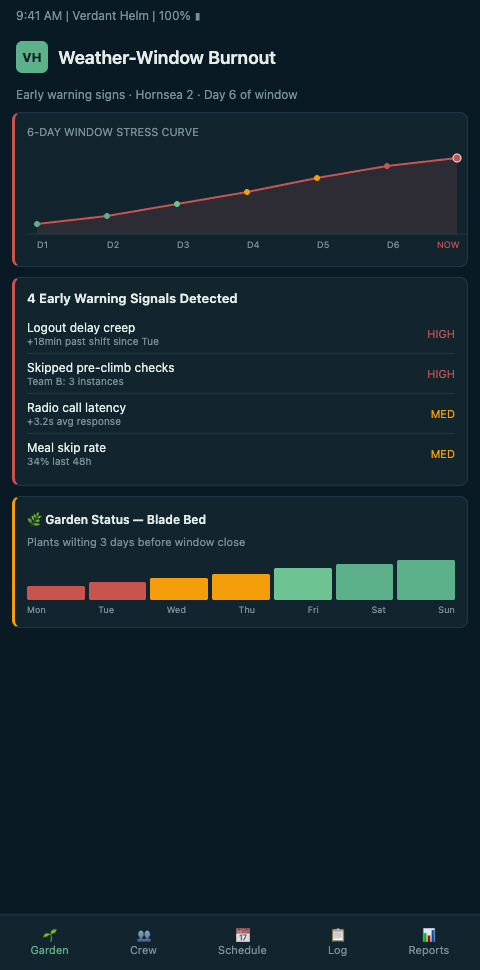
Treat each technician's resilience as a perennial bed in a working garden. Some techs bloom reliably through a 10-day hot window. Others flower bright early, then wilt hard on day six. A few are classic energy sinks — low-lying beds where moisture pools after every storm, recovering slowly, needing shade and patient tending before the next bloom. Verdant Helm renders this as a visual map where each tech is a plot, each plot has soil markers (sleep, transfer exposure, climb load, logged near-misses), and each bed shows its current bloom state alongside the forecast pressure the next window will apply.
Role colour matters: a blade rope-access tech blooms differently than a gearbox specialist, who blooms differently again from a high-voltage tech working the transition piece. A blade tech's wilt shows in shoulder and grip fatigue across a 4-hour suspended job; a gearbox tech's wilt shows in concentration drift across torque-value reads; an HV tech's wilt shows in slower switching sequence checks.
The early warning signs resolve as specific garden symptoms. Yellowing leaves are the first drift: a tech's reported sleep dropping below their personal baseline for three nights running, HRV narrowing on a chest strap, logged grip strength on a climb-assist device trending down 8%. Premature wilt shows when a bed that used to hold through a 2.5-hour blade inspection now flags a recovery request at 90 minutes. Pest spread is the contagion effect: one tech's skipped breakfast becomes two, then a whole CTV pair's, because the quiet fatigue norm has moved. The garden also tracks the difference between weather wilt and workload wilt — a 2.5m overnight swell that rattled the SOV's amidship cabins is a different signal from a fifth consecutive climb day on a Vestas V236 at 138m hub height.
Ørsted's four-pillar fatigue risk management framework already codifies much of this: pre-shift reports, recovery-day requests, and post-window debriefs act as the soil sensors that let a garden-state view pick up drift before a failed transfer announces it. A Taylor & Francis scoping review of human factors in wind found that behavioural failures account for roughly 60% of working-at-height incidents in the sector, yet psychosocial precursors remain understudied compared with technical failures. The garden metaphor is not decorative — it turns soft signals into objects that a manager can prune, water, or retire from the climb list. Pruning in the offshore wind context means a scheduled rest rotation that the dispatcher owns: a blade tech rotated to gangway-deck tool prep for a day, a gearbox tech moved to condition-monitoring review in the SOV office, an HV tech assigned shore-side HV switching practice instead of a nacelle job.
Verdant Helm pulls these signals from WINDA training records, SOV sleep logs, CTV transfer attempt counts, and optional wearable HRV streams. The dashboard marks three colours against each bed: green for bloom, amber for wilt risk, red for pruned. When the forecast surfaces the next window, it overlays the bloom state against the wave height and transfer count planned. Managers see, at a glance, whether the window they are about to fill lands on healthy soil or on a bed that needs another 36 hours of rest before it can safely carry a gearbox climb on a Siemens Gamesa 154-DD or a blade inspection at 120m on a Vestas V174.
Advanced Tactics
Three patterns move garden-state reading from nice-to-have to dispatch-critical.
First, tier the bloom signal against forecast intensity, not just headcount. A 36-hour window with 18 planned climbs on 14 techs reads very differently from the same window with 10 climbs on the same roster. The Energy Institute reports record hours worked with a steady TRIR — a flat injury rate masks rising human-factors load when hours climb faster than incidents visible to the reporting framework. Verdant Helm's intensity overlay multiplies planned climbs by forecast compression, so a stacked day carries a visible weight penalty that changes the answer on marginal assignments. This is what separates an early warning from a post-mortem. A stacked day on a jack-up deployment in the German Bight carries a different intensity signature than a CTV day on a Dogger Bank asset; the overlay absorbs that difference and shows the manager the accumulated draw in context of the specific fleet and foundation type.
Second, pair the bloom view with a recovery ledger that does not reset at shift end. A peer-reviewed review in ScienceDirect on offshore wind H&S confirms under-reported burnout precursors and recovery debt are the weakest link in wind safety reviews. Treat each becalmed day as a ledger credit only if the tech actually rested — mess hall attendance, sleep log, logged walking on deck — and debit the ledger each climb, each transfer, each night cut short by weather noise. Techs who sit in credit can take the hot-window stacking. Those sitting in debt get pruned to shore-side tasks or light gangway work until their bed recovers. The ledger travels across rotations, too: a tech disembarking a 14/14 rotation with a deficit of 30% ledger credit arrives home needing the full two-week shore cycle, not a compressed rest of five days before a crew-change slot on a neighbouring project.
Third, feed wearable signals in without building them into the disciplinary loop. A Frontiers in Physiology review of wearable fatigue monitoring shows HR, HRV, and motion signals can flag fatigue before the tech reports it subjectively — but only when the data stays between the tech, the occupational health lead, and the bloom-state signal. If the wearable becomes a timecard, techs switch it off, the garden goes dark, and you lose the early warning layer the whole framework depends on. Verdant Helm's default stores wearable aggregates on-device and only exposes the bloom colour to the dispatcher, preserving the reporting trust that makes the signal worth collecting.
Pilots that failed early in the sector's adoption cycle taught the lesson at cost: when one major operator wired heart-rate data directly into a dispatch exclusion rule without that trust layer, technician opt-in dropped to 30% in six weeks and the programme was quietly wound down. The garden view rests on voluntary honest reporting, and the data architecture has to protect that foundation or the rest of the framework collapses.
None of this works if early-warning reading is a solo discipline. Expand the view to match the real rhythm of the season: stacked good-weather weeks carry a hidden price that the 36-hour window framing hides, and a 1.5-meter sea state quietly resets crew energy in ways the dispatch sheet never shows. The offshore wind context shares deeper roots with hospitality too — emotional-labor burnout detection across cruise crew reads the same bloom, wilt, prune signals in a different maritime garden, and the crossover trains the eye for drift on your own CTV pairs.
Plant the First Bed This Week
Offshore Wind Ops teams reading this already know which two or three techs are most at risk when the next hot window opens. Start there. Verdant Helm lets a crewing manager plant the first three beds in an afternoon: import WINDA records, mark the current wilt risk colour, and set the forecast-weighted intensity overlay against the next 14 days. By the Friday forecast meeting, the dashboard will have already changed one dispatch decision. That is the only proof worth starting with.
Do not try to plant the whole roster at once. Three beds is enough because three beds will surface the shape of the signal your dispatch sheet has been hiding — one gearbox specialist who always volunteers for the far edge of the array, one blade tech whose grip log has been trending down for a fortnight, and one CTV pair who has been absorbing the edge-of-window transfers without complaint. When those three beds show colour against the next 1.2m Wednesday forecast, the conversation in the Friday meeting changes character. Somebody asks whether the stacked climb on the Siemens Gamesa 154-DD needs to move to the following window instead of piling onto a tech already in amber.
From that first afternoon, the rhythm of expanding the garden is straightforward. Add a bed each Monday for the next four weeks, starting with whichever tech the Friday meeting flagged as the closest call. By the end of the month the whole CTV roster is planted, and the lead tech has a running view of which beds are blooming into the next window and which need a prune before the weather turns. The goal is not a polished dashboard — it is one changed dispatch decision per week that a post-incident review would have named as the fork in the road. Start the bed, measure the fork, keep going.