Detecting Emotional-Labor Burnout Behind a Guest-Facing Smile
The Smile That Cost a Contract
The Hotel Director on a Caribbean-loop megaship lost three senior cabin stewards in seven days. Each of them scored "satisfied" on the last crew pulse survey. Each of them rated their supervisor 4 out of 5. And each of them walked into non-renewal conversations citing the same sentence: "I couldn't smile anymore." The guest-facing NPS for their deck segment, meanwhile, had drifted from 72 to 66 over the prior six weeks — a move slow enough to blend into weather variation and guest mix but large enough to put the season's targets out of reach.
The cost of that quiet drift was not abstract. Hospitality turnover runs roughly 73.8% annually, and each frontline exit costs around $5,864 to replace before you count the NPS damage or the training load transferred to remaining stewards. On a ship built around a 1:3 crew-to-guest ratio, three exits from one deck is not a staffing inconvenience. It is a service-score event that plays out across the next two sailings.
The gap between what crew said on the survey and what their bodies were doing during service is the problem this post addresses. A Yale and ITF Seafarers' Trust study found 25% of seafarers reported depression and 20% reported suicidal ideation within the prior two weeks — signals almost never captured by an annual engagement survey. The Hotel Director was blind not because she did not care. She was blind because emotional-labor depletion hides behind a trained smile until the contract-end conversation exposes it.
The Garden Behind the Smile
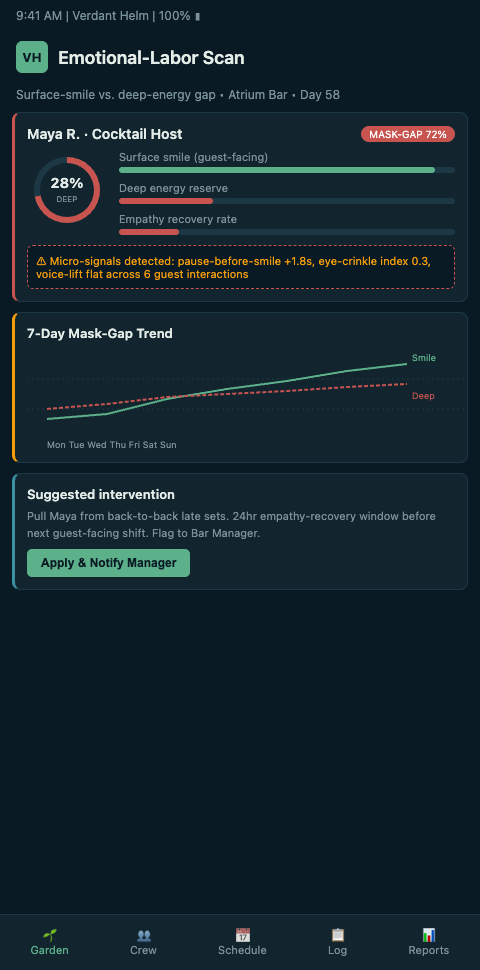
Picture the crew as a botanical garden. Each guest-facing role is a bed of perennials that bloom through cycles of service. Emotional labor is the water table. When surface acting outruns recovery, the soil stays thin; the bed still looks green from the guest side for weeks, but roots are drying. The stateroom attendant who still greets every guest by name on day 70 of a 217-day contract may be blooming on borrowed reserves. Verdant Helm is built to watch the water table, not the petals.
The botanical frame matters because it sets the right observation cadence. A garden is not audited once a season; it is tended daily, with a rhythm of prune, feed, rotate, and rest. On a cruise ship, the tending cadence should mirror the service cadence — dinner seatings, turnaround day, shore leave. The signals Verdant Helm reads are grouped into four beds: display-rule exposure (hours of guest-facing service per 24), recovery pressure (split-shift count, rest-hour violations), tension events (complaint logs, service-recovery dispatches), and botanical wilt (a composite of peer observations, mood check-ins, and voice-tone samples where legal and consented).
The foundational research on emotional labor goes back to Hochschild's 1983 The Managed Heart, which framed the sold emotional display as labor with a resource cost. Later AMJ work confirmed surface acting predicts exhaustion and lower peer-rated service quality, while deep acting cushions it. Verdant Helm's model mirrors this split: it assumes not every guest-facing hour costs the same. A waiter running deep-acted warmth at dinner is draining less than one surface-acting through a complaint escalation at the guest-services desk. When those patterns continue unpruned, what looks like a resilient perennial turns into a sink — a bed where energy pools low and stops refilling.
Three practical reads come out of the garden view. First, the wilt index tracks a composite score on each attendant, steward, and cast member by voyage week. A sharp drop between week 10 and week 12 is the earliest reliable signal that contract non-renewal is forming. Second, the bed-level view shows which decks, dining venues, and bars cluster in the yellow zone at the same time — often upstream of a specific guest complaint pattern. Third, the sink map flags the 5% of roles that consume disproportionate emotional labor and never recover in the rest window; these are schedule candidates for rotation, not reassignment. Each of these reads is derived from signals already captured on most cruise ships — they just have not been joined up before.
What to Watch From Week One
The most common mistake Hotel Directors make when turning on emotional-labor monitoring is treating it as an HR reporting layer. It is not. It belongs in the same daily review that covers housekeeping throughput and dining-venue covers. When the wilt index for the Lido buffet team climbs two weeks in a row, the intervention is operational: redistribute the complaint-escalation load, shift the most-drained cast member off greeter duty, and extend the port-day shoreside window. Those moves are invisible to guests and visible to the water table within 72 hours.
The second mistake is collapsing all guest-facing roles into one "frontline" metric. The signals look alike on paper but diverge in practice.
The same wilt reading means something different for a stateroom attendant managing 20-plus cabins in split shifts than it does for a maître d' handling disputes during the 8:30 seating.
Breaking the bed-level view out by function is what keeps Verdant Helm actionable rather than informational.
The third mistake is waiting until the month-four cliff shows up in contract non-renewals to act. By then the intent-to-leave decision has already formed; what you are doing is confirming a loss rather than preventing one.
The adjacent pattern shows up in other maritime sectors too — offshore hitch-fatigue signatures that auditors catch after the window to intervene has closed. The principle is the same across service contexts: trained smiles mask depletion until a threshold breaks.
One edge case worth calling out: the peer-observation input needs a confidentiality model that does not turn crew against each other. Verdant Helm anonymizes peer signals through rotation-window aggregation — a specific steward is never flagged by a named peer, only by a pattern across three or more anonymized observers. Without that guardrail, the signal quality collapses inside one voyage.
A second edge case is voyage-mix variance. A holiday-week sailing with three-generational family groups and anniversary cohorts produces a different emotional-labor profile than a mid-week adults-only cruise out of the same home port. Academic review of emotional labor and burnout shows that the stressor profile — interaction density, display-rule intensity, recovery interval — shapes the depletion curve. Verdant Helm calibrates the wilt thresholds against the voyage mix so the same steward's yellow reading means the same operational thing across different sailings. Without that calibration, Hotel Directors over-intervene on holiday weeks and under-intervene on deceptively quiet shoulder sailings where the slow-burn sinks are actually forming.
A third edge case is the crossover between emotional-labor signals and standard fatigue patterns — long hours, split shifts, and non-standard scheduling. Fatigue research on hotel workers documents emotional labor combined with non-standard hours producing a compounded fatigue signature that neither factor produces alone. Verdant Helm separates the two contributions in its reporting so Hotel Directors can see whether a yellow reading is driven by schedule design (fixable in the next rotation) or by surface-acting concentration (fixable by changing the guest-interaction pattern). Mistaking one for the other produces interventions that treat the symptom rather than the root. The Seafarers Happiness Index offers a complementary fleet-level benchmark Verdant Helm users can use to sanity-check their ship's trajectory against the industry.
A fourth edge case is the difference between emotional-labor wilt and general exhaustion. Long-haul crew on the back of a four-month rotation often read yellow across every bed for straightforward physical reasons — sleep debt, interrupted rest hours, minor illness cycling through the crew mess. Without the emotional-labor decomposition, Hotel Directors can over-index on display-rule issues when the fix is schedule hygiene. Verdant Helm distinguishes cumulative physical fatigue from emotional-labor-specific depletion by looking at which signals moved — if rest-hour violations are driving the signal, the intervention is a MLC-compliant rest protection; if surface-acting concentration is driving it, the intervention is a guest-interaction rotation. The two often co-occur, but the right intervention differs.
A fifth edge case worth addressing is the guest-itinerary overlap effect. When a ship carries a sizable contingent of back-to-back guests — passengers sailing consecutive voyages without disembarking — the emotional-labor burden on the cabin stewardship and dining teams compounds. Back-to-back guests expect personalized, high-recognition service from the second voyage onward, which concentrates the surface-acting demand on a smaller pool of crew interactions. Verdant Helm's back-to-back detection flags which beds will absorb this concentrated load and recommends preemptive rotations before the second voyage begins. Hotel Directors who catch this before the second-voyage complaint wave form protect both the back-to-back guest NPS and the affected crew's month-four trajectory.
For Hotel Directors and Cruise HR Leaders
If you run hospitality on a cruise ship today and your non-renewal rate is climbing without clear causes, the gap is almost always in emotional-labor visibility, not in compensation or itinerary. Pull the last four voyages' wilt-equivalent signals — complaint routes, service-recovery logs, split-shift counts — and map them against the exits. Hotel Directors who do this exercise find the pattern within a week. Cruise HR Leaders who join these signals to contract-renewal conversations change the conversation from "why did you leave" to "what was the water table showing in month three." That shift is what Verdant Helm is built for.
The operational test for whether this is working is not the dashboard itself. It is what changes in the Hotel Director's morning stand-up. Before the wilt index, the Executive Housekeeper reports cabin throughput and the F&B Director reports covers; the emotional state of the teams enters the conversation only when a guest complaint has already arrived. After the wilt index, the standing agenda includes a bed-level read of which decks, dining rooms, and bars are tracking yellow that morning, and the action item is a specific rotation or a specific load redistribution for the next seating.
Cruise HR Leaders should build the month-three contract-renewal intake around the same signals. A cabin steward who spent week ten in a yellow bed and week eleven in a red one deserves a different conversation than one whose beds stayed green through the rotation. When that conversation happens before the crew member privately decides not to return, the non-renewal rate starts to move inside a single contract cycle rather than after a full season.