How to Spot Hitch Fatigue Before HSE Auditors Do
The Day 18 Audit That Nobody Saw Coming
An HSE audit team lands on a semi-sub on day 18 of a 21-day rotation. By lunchtime on day two of the audit, they have flagged three findings: a JSA signed without the derrickhand present, a permit-to-work with a missing isolation signature, and a near-miss report that describes a dropped-object precursor with no follow-up assigned. The OIM had not seen any of them as connected. The auditors did. Their training in human-factors fatigue cues let them read the drill floor like a weather chart, and the signs of hitch fatigue were everywhere — crew members giving short answers on the pipe rack, roustabouts skipping the second coffee, a derrickhand who had taken three ibuprofen from the rig medic in four days.
The findings themselves were not novel. UK HSE offshore fatigue guidance describes exactly these patterns — short-tempered handovers, skipped steps in routine tasks, delayed near-miss reporting — as the inspectable surface of a crew past its capacity. The HSE human factors topic page reinforces that auditors are not looking for one big failure; they build a picture from many small ones. Worse, research on offshore safety culture has documented that workers push past fatigue even when policy tells them to report it, according to a 2024 interview study published in ScienceDirect. The audit findings that materialize on day 18 were knowable on day 8. Somebody needed to be reading.
The Garden Metaphor for Fatigue Signals
The most useful shift for an OIM is to stop thinking of crew condition as a binary — fit or unfit — and start thinking of it as a living garden. Every crew member is a perennial in that garden. Some bloom through the full hitch. Some wilt by day 12. A few are perennial sinks where energy pools low no matter what the calendar says. The job of the OIM, of the toolpusher, of the rig medic, is not to plant a hedge and walk away. It is to tend the beds, prune the overgrowth, and notice when one bed starts to yellow before the whole row browns.
Verdant Helm operationalizes that garden view against the same signals that show up in IOGP Report 626, the industry framework for Fatigue Risk Management Systems. IOGP 626 is not a nice-to-have — it is the baseline most HSE auditors measure operators against. Inside the Verdant Helm interface, each crew member appears as a planting in the garden, color-coded by a rolling composite of self-logged rest, sleep, workload, and observable indicators from handovers. The beds are departments: drill floor, mud pit, cement unit, galley, helideck, marine. When a bed starts to wilt, the display does not wait for the OIM to ask.
That matters because the signals in IOGP 626 — reduced situational awareness, slower reaction times, microsleeps, irritability, impaired judgment — are exactly the cues an HSE auditor probes for in interviews. The BSEE Human Factors technical assessment gives US regulators the same playbook. Both frameworks treat fatigue not as a soft topic, but as a measurable risk with inspectable controls. If the OIM can see the wilt coming, the audit finding never gets written.
The practical translation looks like this. A roustabout who logs a four on a Samn-Perelli scale for three shifts in a row is a perennial flagging early decay. A derrickhand who has asked the medic for sleep aids twice in a week is a sink that needs attention. A handover note that says "nothing to report" three days running on a drill floor mid-trip is a garden bed that has been left untended. None of these signals alone triggers an incident. Together, they form the audit exposure that reads on day 18 as a pattern two weeks old.
What makes the Verdant Helm approach different from a checklist is that the garden state is continuous. The IOGP 626-3 Supplementary Checklists and Tools document includes the Fatigue Impairment Checklist and Samn-Perelli scales operators already use — but most rigs run them on paper, weekly at best. A living garden needs to be checked more often than that. Reading crew vitals at hitch pace, not audit pace, is what the platform supports. The practice of reading crew vitals like a drilling fluid report extends that logic into something every mud engineer already does every shift.
Leading Indicators the Audit Team Is Already Using
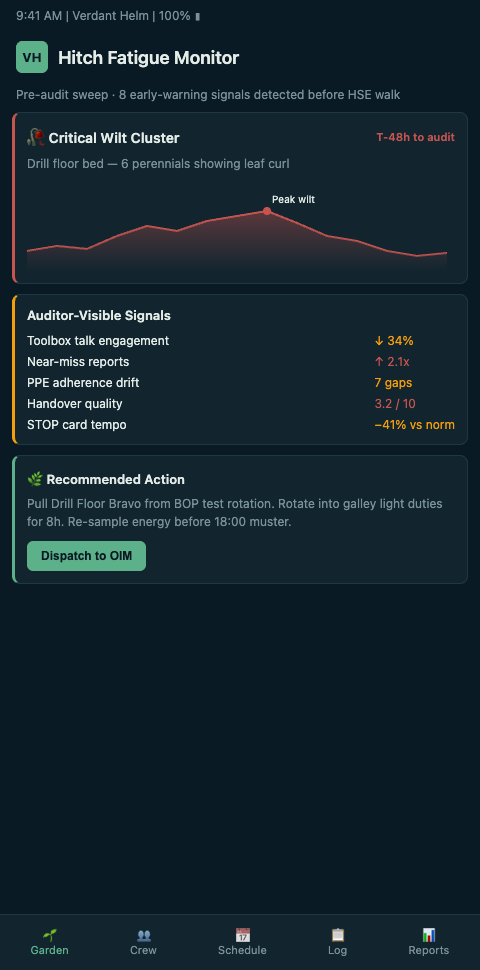
The leading-indicator framework is not speculative. A 2018 IChemE Hazards 26 paper on leading indicators for offshore drillwell blowout argued that near-miss reports, permit-to-work audits, and JSA quality metrics predict catastrophic incidents more accurately than lagging metrics like TRIR. HSE auditors have been using that framework for a decade. An OIM who only reads lagging indicators is always behind the audit team.
The practical shift is to make the same leading indicators visible on the rig, in real time. For hitch fatigue specifically, three leading indicators show up in almost every audit finding: JSA signature quality (who signed, in what order, with what detail), near-miss report latency (how many days between observation and logged entry), and permit-to-work step compliance (isolation, hot work, confined space — in that order of risk). When any of those three drift, the crew is telling the rig something. The OIM-facing energy map view surfaces those drifts before the audit does.
The same pattern holds for emotional-labor roles, and the cross-industry parallel is worth studying. Cruise-ship crew in hospitality roles show fatigue through complaint patterns, not near-misses — the underlying signal family is the same. The cruise-fleet guidance on detecting emotional-labor burnout covers the detection approach that translates across maritime industries.
Advanced Tactics: Reading the Garden on Day 8, Not Day 18
The shift from day-18 reactive to day-8 proactive takes three practical moves. First, move the fatigue check-in from paper to a two-question digital pulse at the end of every shift, driven by the Samn-Perelli 7-point scale that IOGP 626-3 recommends. Second, combine that pulse with the rig medic's walk-in log — not individual patient data, but counts and categories by department. Third, overlay handover-note quality as a lagging confirmation of the first two. When all three rise together, the garden is already wilting.
Second, rebalance the hitch calendar around the known curve. Most 21-day rotations show measurable fatigue inflection between days 12 and 16. BOP tests, critical lifts, and high-risk JSAs should not cluster in the second week unless the garden is showing strength. A mid-hitch schedule that fights physiology is one the auditor reads as a preventable finding.
Third, treat the audit paper trail as a garden-tending record, not a defense. When the ALARP case is written, the most persuasive evidence is a continuous record of fatigue-aware decisions — shifts moved, JSAs expanded, permits re-reviewed when the garden indicator dipped. That record is what separates a rig that earns the benefit of the doubt from one that does not. Verdant Helm compiles it automatically, which is the point.
The common mistake is to install a fatigue system and treat it as a compliance layer. Rigs that do that generate paper nobody reads. The rigs that get value from the garden approach are the ones where the OIM looks at the display every morning before the stand-down and asks the toolpusher a specific question about a specific bed. That is what the auditor would do on day 18. Do it on day 8 and the finding never gets written.
A fourth tactic is to pre-write the audit paper trail rather than reconstruct it after a finding. When the HSE auditor asks "what did you do when you saw the sleep-debt trend rising on the deck team in week two," the OIM who can show a time-stamped record of three interventions — JSA pair added on day 9, break repositioned on day 11, permit re-reviewed on day 12 — is the OIM the auditor stops auditing. The continuous record is the differentiator. Auditors have limited time on a rig, and a rig that presents a defensible record on day one gets fewer findings by day three. Verdant Helm compiles the record as a byproduct of daily operations, which means the paper trail is already there when the auditor steps off the helicopter.
A fifth tactic is to build the audit conversation before the audit. When the scheduled HSE audit window is six weeks out, the OIM should book a half-hour with the senior HSE coordinator and walk through the last two hitches' garden trajectories. What wilted. What recovered. What did the rig do. That rehearsal makes the live audit conversation unremarkable, which is the outcome both sides want. Rigs that skip the rehearsal get surprised. Rigs that do the rehearsal get routine audits.
CTA: For OIMs and Drilling Supervisors Running 21-Day Rotations
If you are an OIM walking into a 21-day hitch with a audit window opening in the third week, the best move this rotation is to start reading the garden every morning — even on paper, even roughly. A one-page fatigue heatmap by department, updated daily from Samn-Perelli pulses and medic-round observations, will catch 80% of what an auditor would flag. Verdant Helm builds the heatmap automatically from the logs your crew already keeps, but the discipline comes first. Book a 30-minute review with a drilling supervisor from a comparable rig that has run the pilot — the conversation is more useful than any demo.
The prep that makes the review call useful is light. Pull the last two hitches of near-miss reports, the current crew manifest with hitch-days-in, the next 21 days of planned operations, and the last HSE audit findings letter. The drilling supervisor on the comparable rig will sketch the garden against those four documents inside 20 minutes. The remaining 10 minutes cover the specific interventions the pilot rig applied in its own third week — which JSAs got a second signature, which permits got deferred, which handovers got extended. Walking away with a named Monday-morning move beats walking away with a slide deck. For drilling supervisors running multi-rig portfolios, the same review compares gardens across three or four rigs in parallel so the OIM can see the rig-to-rig variation before picking the next hitch's focus bed.