The Hidden Price of Stacked Good-Weather Weeks
The July Window That Looked Like a Gift
A German Bight wind farm O&M team running Siemens Gamesa 8MW turbines opens the late-July forecast model to a 14-day Hs-below-1.3m band. The annual campaign has been running behind by 22 planned work packs because of an unusually stormy June. The weather-gated catch-up opportunity is obvious. The crewing manager commits to stacked CTV runs every day of the window. By day 6, the three CTV pairs are averaging 3.8 climbs per shift. By day 9, one blade tech has flagged a near-miss on a tool drop and two others have quietly skipped the 19:30 mess hall in favour of crashing in the cabin.
By day 12, the near-miss log carries three entries the manager files without cross-reading against the rotation roster. On day 14 an unscheduled hand injury during a gearbox inspection takes a senior tech off the rotation for three weeks, consuming most of the campaign gain the benign weather delivered. The campaign manager signs the post-incident report on day 15 and notes, for the third summer in a row, that the July window "ran hot."
The pattern is not exceptional. OSHA guidance on long work hours and worker fatigue documents a 37% higher injury risk across 12-hour days and rising accident rates over consecutive shifts. The offshore wind season amplifies this because workable days are bunched by weather rather than distributed evenly: a ScienceDirect paper on seasonality in offshore wind decommissioning shows North Sea campaigns compress into roughly 120-150 accessible days per year, and the stacked weeks inside that window carry a disproportionate share of the annual human-factors load. German Bight and Irish Sea operators see this most acutely in July and early September, when two or three weather windows regularly concentrate 40-50% of the season's delivered work into roughly 20% of the calendar.
A PMC integrative review of physical and mental fatigue in shift work documents the cumulative fatigue trajectory that a benign-weather streak recreates in wind operations — fatigue is not reset between shifts when sleep is interrupted, meals are skipped, and the shift envelope keeps extending. The window looks free. The ledger does not agree. Blade specialists operating under rope access feel the stacked cost earliest because suspended work compounds shoulder and grip fatigue faster than ladder work; gearbox techs follow next because torque-precision operations demand cognitive steadiness that erodes over consecutive days; HV techs register the cost last but most sharply, because one missed switching step on a loaded array is a reportable incident rather than a near-miss.
What the Garden Sees Beneath the Benign Forecast
A head gardener who gets two unseasonable weeks of sun in July does not plant the entire season's cuttings into the window. She knows that a bed which blooms for 14 days without rest arrives at the next storm already depleted, and that the pruning she defers during the bloom becomes a full re-bed in autumn. Verdant Helm treats stacked good-weather weeks as the same compounded load: the forecast's gift is partial, and the garden-state view shows where the real cost accumulates.
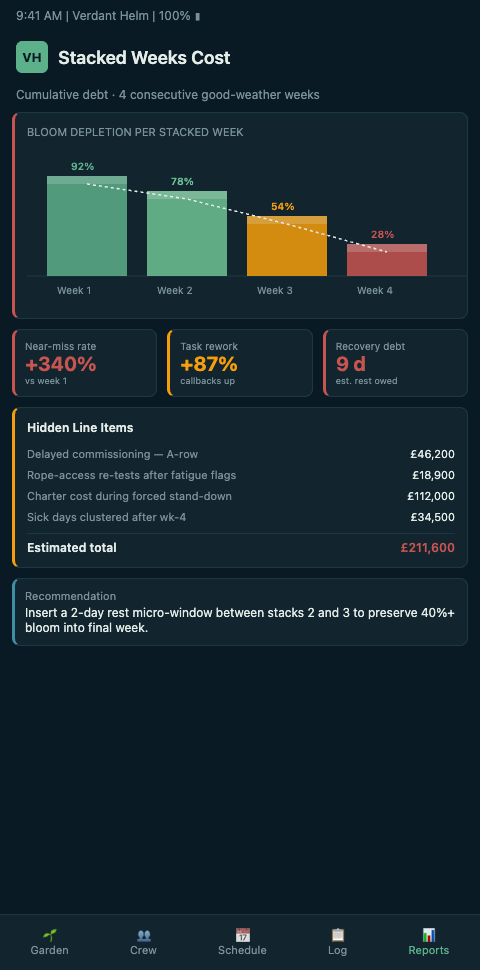
The mechanism is the cumulative bed reading across consecutive days. A tech who carried a 3-climb Monday at a fresh bloom of 88 returns Tuesday at 84 without recovery. Tuesday's 3-climb day lands at 80 by Wednesday morning. By Friday the bed reads 72, and by Sunday — if the campaign manager stacks through the weekend — the reading is 66, drifting into amber. A PMC study on consecutive shifts in nurses found fatigue biomarkers rise significantly over three consecutive 12-hour shifts and plateau into a meaningfully degraded state thereafter; the offshore wind pattern compresses the same trajectory into a stacked weather window. The wilt is invisible to the forecast but visible to the garden because the garden reads the tech, not the sea state.
The degradation is also not symmetric — a tech who carries four heavy gearbox days on Siemens Gamesa 154-DD turbines arrives at day 5 visibly more depleted than a tech who carried four lighter blade ply checks on Vestas V112 platforms, and the garden tracks both the count of climbs and the cumulative profile load across them.
The intensity signal comes from compression. An MDPI JMSE paper on weather window prediction using operation failure probabilities shows that stacked favourable forecasts compress planning into narrow bursts, accelerating workload in a way that deterministic threshold planning hides. Verdant Helm's intensity overlay multiplies planned climbs by the forecast's compression density, giving each scheduled day a visible load weight. A campaign plan that reads four climbs per pair per day through a 14-day window carries a different coloured weight than a plan that reads two climbs per day with built-in rest rotations; the manager sees the difference at the planning stage rather than at the post-mortem.
The perennial-and-prune metaphor resolves the framing honestly. Bloom is not free production. Each bloom draws on root reserves, and a bed that blooms for 14 days without tending returns to winter with less reserve for next year's flowering. Verdant Helm's campaign view shows cumulative draw across a rotation — a measure of how hard each bed has been asked to work relative to its rolling baseline. Techs sitting at low cumulative draw on day 10 can carry the next window's stack. Techs sitting high need to be pruned before the 14th day, not after.
The decision pressure is real and documented. A Frontiers in Marine Science decision-making tool for O&M captures how benign-weather pressure pushes operators to override fatigue signals; an industry guide at Leadvent on weather risk and maintenance planning describes how seasonal workload stacking compounds operational cost. The garden view does not remove the pressure. It makes the cost of each stacking decision visible before it lands.
Advanced Tactics
Three campaign-level habits re-price the stacked window before the decision rather than after.
First, plan the rest day inside the window, not after it. The strong temptation during a 14-day benign stretch is to run hard for 14 days and rest on day 15 when the Hs returns to 2.5m. That schedule reliably produces a tired crew through days 10-14 and a recovery day that only partially closes the draw. Verdant Helm's recommended alternative is to program one half-rest day every four working days inside the window — a deliberate prune of roughly 20% of stacked capacity, returned as genuine recovery margin. The campaign finishes the window at a bloom state that can carry the next window, rather than limping into recovery with an injury already booked.
Second, rotate climb load more aggressively than the sheet suggests. The default dispatch pattern pairs the same two techs across consecutive days for continuity. During a stacked window the continuity cost becomes a fatigue cost: the same pair climbing together for 10 days accumulates correlated wilt. Verdant Helm's rotation layer suggests a partner shuffle every 3-4 days so the bloom pattern breaks up and individual beds get variety in physical load and social dynamic. Teams report the shuffle surfaces near-miss signals that a static pair would normalise away.
Third, treat the near-miss log as the garden's pest-spread indicator. OSHA guidance notes accident rates climb across consecutive shifts, and the early signal is usually a rising near-miss count rather than a reportable incident. Verdant Helm wires the near-miss log into the bloom trace directly: three near-misses across a pair in five days trigger an amber flag on both beds regardless of self-report state.
The pattern is the signal; the numbers just let the manager see it before the tool drop becomes a tool injury. Campaign managers who enforce the trigger report the intervention is almost always a well-timed half-rest day rather than a stand-down, which preserves campaign momentum and the crew's trust in the flag. The intervention also pays forward — a pair that takes a programmed half-rest on day 7 of a stacked window reliably outperforms a pair that pushes through to day 14, measured both in work packs completed across the full window and in near-miss count.
The stacked-window framing links to the deeper rotation and window patterns. The 14/14 hot-weather rotation crack documents the specific rotation failure mode that compounds from stacking, and early warning signs of weather-window burnout catalogue the leading indicators the campaign manager should be watching through days 7-14. The pattern is not unique to wind — back-to-back crew-change costs on rigs describes the same compounding effect on drilling operations, and the shared read helps wind managers calibrate expectations.
Price the Window Before the Ledger Closes
Offshore Wind Ops teams can test the intensity overlay against a single stacked window and compare the predicted draw to the actual incident log at the end of the campaign. Verdant Helm renders the overlay in the standard dispatch tool without separate training, and crewing managers find the colour shift on day 6 is usually the decision point the post-mortem identified in hindsight. The next benign July looks like a gift. Price it honestly before day 1, and the gift stays intact through the autumn storms.
Pick the July window that is already on your modelled forecast rather than the one already in progress. The intensity overlay earns its value at the planning stage — the moment the crewing manager is tempted to commit to 14 consecutive CTV days. Running the overlay against the forecast three days before the window opens gives the senior tech time to propose the half-rest cadence, gives the charterer time to re-balance the CTV booking, and gives the occupational health lead time to flag the two or three beds who entered the previous rotation with an unreturned ledger debt.
Run the post-campaign comparison honestly. At the end of the window, pull three numbers: planned climbs, delivered climbs, and near-miss count across days 7-14. Compare those against the same numbers from the previous two July windows. Teams that ran the overlay and honoured the half-rest cadence typically show delivered climbs within 3-5% of the uncadenced baseline, with near-miss counts down 40-60% and zero reportable incidents. Those three numbers are the argument that converts the charterer and the operator for the next benign window, and they are the numbers the post-mortem asks about when a stacked week goes wrong. The ledger is cleaner when the comparison is already in the file.