Why a 14/14 Rotation Cracks During a Hot Weather Window
The Problem: 14 Days Was Never the Ceiling for a Hot Window
The 14/14 rotation is the industry standard for offshore wind technicians — 14 days on the field, 14 days off. The PMC qualitative analysis of the 14/14 schedule among German offshore wind workers and their families names 14 as the "safety ceiling" in the social literature: the workable limit for sustained offshore cognitive and physical load before family and circadian strain begins to dominate. The ScienceDirect systematic review of North Sea shift schedules and the companion working-time arrangements study both affirm the 14-day envelope for an average workload.
The average workload is where the rotation was modelled. A hot weather window is not the average. When eight or ten workable days stack through the middle of the rotation, the crew does not work 14 average days. They work 14 days where the workable subset is front-loaded into the trough where their circadian and cumulative fatigue is already peaking. OSHA's long-hours guidance — 12-hour shifts carry 37% higher injury risk, nights and evenings worse — is the baseline the rotation was built against; it is not the baseline a hot window runs on.
The German Bight crew on the day-12 crack had logged eight workable days in a row through days 4-11 of the rotation, servicing a Siemens Gamesa SG 8.0-167 fleet on monopiles in 30-40m water depth. Every day compliant with rest-hour rules. Every day inside G+ OW 2105 physical-fitness thresholds. Every climb, transfer, and torque within spec. And by day 12, the small errors started: a wrench left on a gearbox platform, a torque check initialled without a measurement on a generator bearing, a transfer abort on a 1.1m Hs sea state that would have cleared on day 3. The reNews coverage of the G+ 94% incident rise tracks this exact pattern at industry scale — 2023 incidents nearly doubled as campaigns intensified through hot windows.
The rotation cracked because its design assumption — that workable days would distribute roughly evenly across 14 — broke. A hot window concentrates the workload into the part of the rotation where recovery debt has been accumulating. The Fatigue Science analysis of fatigue-linked workplace accidents cites 13%+ injuries as fatigue-related with evening and night shift risk multipliers; when a hot window forces extended-hour shifts into day 8-12 of a 14/14, the multipliers compound.
The Solution: The Garden Reads the Calendar Against the Weather
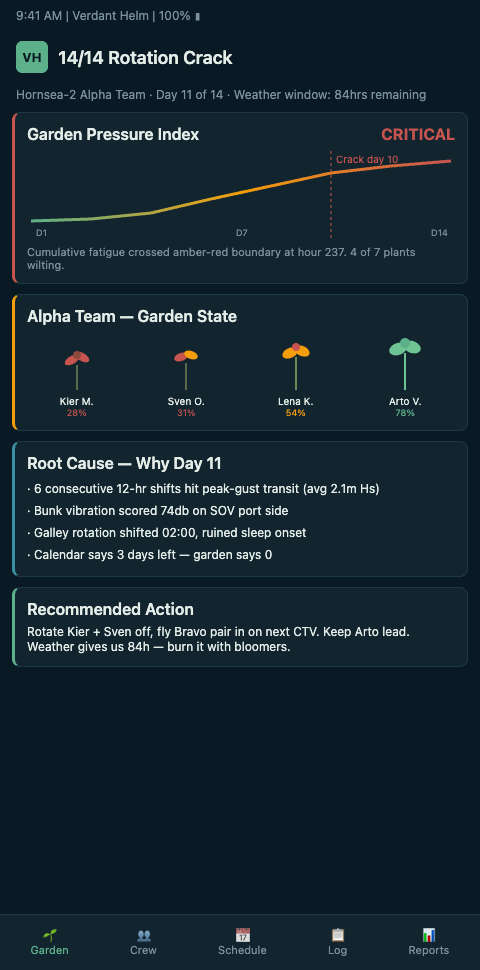
Verdant Helm treats the 14/14 rotation as a garden with a seasonal bloom curve. The perennials in the bed bloom on their own rhythm — most hit peak bloom in days 3-7 of the rotation, hold through day 10 with active tending, and need careful watering into days 11-14. The rotation standard assumes this curve. The dashboard tracks it in real time and flags where the curve is getting compressed by the weather.
When the metocean forecast shows a hot window opening into days 8-12 of the rotation, Verdant Helm runs a compression alert. The alert does not say "reduce hours." It says "the bloom curve you have budgeted across 14 days is about to be compressed into a six-day stretch, and the garden will go into the amber band for the back half of the rotation." The operator sees the compression before it happens, and the decision moves upstream — into crew-change timing, CTV assignment, and cross-site pull of a fresh pair.
The garden framing reveals which perennials crack first. Some techs bloom fast and fade fast; they handle the front of a hot window but should not be on the back. Some techs carry a flat bloom curve through 14 days and can hold the compressed back window if the morning hours of days 10-12 are shaped right. The G+ OW 2105 physical-fitness standard sets the floor; the garden adds the state-of-day and state-of-rotation modulation the fitness test does not measure.
The hot window also rewrites the rest-hour rule. Rest-hour compliance is necessary and not sufficient. A crew that sleeps eight hours but spends day 9 transferring in 1.3-meter sea state on a CTV is not at the same bloom state as the crew that sleeps eight hours after a light day. The PubMed seafarer fatigue review and the ScienceDirect working-time study both point at this gap — the rule-based rotation does not capture work-load nonlinearity, and the hot window is precisely where the nonlinearity bites.
The fix is to run the rotation as a live garden rather than a static plan. Verdant Helm holds the 14/14 calendar as the default shape and overlays the weather window and bloom state continuously, producing a revised rotation map by day 5 of every hot window. The map shows which pairs flex, which crew-change dates shift, which tech gets pulled from the field into a recovery day at the shore base.
Operators running this pattern in neighboring contexts find the same compression dynamic. The hidden price of stacked good-weather weeks covers the industry-scale version, and tech exhaustion curves inside a 10-day weather window traces the inside of a single window. For drilling teams working a compatible 12-hour-handover pattern, 12-hour handover safety signals covers adjacent ground from the oil and gas side.
Advanced Tactics
Four patterns extend the compression model into an operator-grade tool. The first is the pre-rotation pre-seed. Before the rotation starts, the dashboard reads the three-to-seven-day and 10-day extended metocean forecasts and predicts the compression shape. Operators seat the rotation accordingly — front-loading the fast-bloom perennials into the predicted workable days, holding the flat-bloom perennials for the back half. The pre-seed does not eliminate the compression; it assigns the right perennials to the right segments of it. On a Vestas V174 fleet where gearbox change-outs require a specific specialist lineup, the pre-seed also books the bench specialist days before the turbine's condition monitoring fault escalates.
The second is the mid-rotation crew swap. The SPRAT and IRATA certifications and the GWO BST refresher cycle both already assume mid-rotation movements for some teams. Verdant Helm makes the swap a live decision: if the compressed window exceeds the garden's capacity, the tool generates a specific swap — this pair out to shore on day 9, this pair in from the on-call roster — and the operator signs off or tweaks. This is the lever the German Bight crew did not have on day 11. On walk-to-work SOV operations where the crew change happens via daughter craft or helicopter, the tool also surfaces the transit window — so the swap does not land on a day when the helicopter is weathered out.
The third is the compressed-window briefing variant. The standard morning brief (see the energy briefs work) shifts format during a compressed window. The brief adds a rotation-day marker and an explicit compression score, so every tech knows where they are in their personal curve and where the garden overall sits. The transparency is not a morale tool; it is a decision aid that lets the tech flag before they crack.
The fourth is the rotation-ending debrief. At the end of every rotation that included a hot window, Verdant Helm generates a compression retrospective — which perennials took the biggest bloom hit, which recovery window they need on the off-rotation, and which crew-change date got changed and why. The retrospective feeds into the next rotation's pre-seed, so the operator's model of their own garden sharpens through the season. The PMC 14/14 qualitative work explicitly calls for this kind of cross-rotation integration; the data rarely exists to run it.
The fifth pattern, which operators often layer in after two full hot windows, is the task-mix rebalance. A compressed window tempts the planner toward high-value work — gearbox change-outs, blade repairs — because the vessel-hours are scarce. The bloom curves often cannot sustain a full week of high-intensity tasks. The rebalance rule mixes in lower-bloom-cost tasks — torque checks, cable inspections, SCADA alignment — so the garden keeps breathing across the compressed stretch. Operators running Vestas V174 fleets with scheduled 6-month service visits have found the rebalance particularly effective on day 9-11 of a compressed rotation.
Pre-Seed Your Next Rotation Before the Next Hot Window
If your rotation planner is still pinning 14/14 to the calendar and hoping the weather cooperates, the next compressed window is going to land in your LTI column. The Verdant Helm team will run a one-rotation pilot — reconstruct the bloom curves for your next rotation from shift and transfer logs, overlay the ECMWF extended-range forecast, and deliver the pre-seed and mid-rotation swap options three days before dispatch. Offshore Wind O&M managers running North Sea, Baltic, Taiwan Strait, and US East Coast fields have used this pilot format, including floating-wind teams on Hywind Tampen and Kincardine running 21-on rotation variants. Most managers seat two adjustments per rotation within the first hot window and report crew-change conflicts dropping across subsequent rotations.
Citations:
- PMC: Living the 14/14 Schedule — Offshore Wind Workers Qualitative Analysis
- ScienceDirect: Shift Schedules on North Sea Oil/Gas Installations — Systematic Review
- ScienceDirect: Working Time Arrangements and Safety for Offshore Workers in the North Sea
- OSHA: Long Work Hours, Extended or Irregular Shifts, and Worker Fatigue
- reNews: 94% Rise in Offshore Wind Safety Incidents
- G+ OW 2105 — Recommended Physical Fitness Standard for Offshore Wind Farm Technicians
- Fatigue Science: Understanding Workplace Accidents Caused by Fatigue