Crew-Change Flight Planning Using Garden-State Data
The Reshuffled Sikorsky
A crew-change flight from Bergen to a Norwegian Continental Shelf platform got reshuffled at 11:40 on the day of rotation because a weather window threatened to close. The relief crew had mustered at 05:30, been held at the heliport for six hours with limited rest, and was then loaded onto a delayed Sikorsky S-92 at 13:20 for the transit out. The manifest was compliant with IOGP 690 practice.
The crew's cognitive state on arrival — already halfway into a wilt curve before they set foot on the helideck — was not in the scheduling decision. The rig's toolpusher met them on arrival, ran a standard induction, and scheduled the incoming drill floor crew onto a 19:00 tour-start. The first wilt-driven near-miss landed six hours into that first tour. The post-incident review flagged "first-tour integration challenges" without connecting them to the 8-hour heliport transit that preceded the tour, which is how the same pattern continues to repeat across fleets.
IOGP's Report 690 on offshore helicopter recommended practices treats the transit as one of the riskiest phases of an offshore worker's rotation, with risk controls across the aviation-operator interface, the manifesting process, and the passenger preparation (IOGP Report 690 Offshore Helicopter Recommended Practices; IOGP 690 Offshore Helicopter Recommended Practices PDF). Research on tactical helicopter transportation planning across the Norwegian Continental Shelf quantifies the multi-platform sequencing problem that drives reshuffles in real operations (MDPI Tactical Helicopter Transportation Planning NCS).
The Flight Safety Foundation's Basic Aviation Risk Standard for offshore helicopter operations explicitly covers fitness-to-fly and fatigue considerations, but the fatigue it covers is the aircrew's, not the passengers' on arrival (Flight Safety Foundation BARS Offshore Helicopter Operations). That is the gap. The aviation side has decades of fatigue-risk management discipline; the passenger side inherits the operational consequences without the same instrumentation. Closing the gap does not require rewriting the aviation standard — it requires adding a passenger-readiness layer on the operator side that meets the aviation data at the heliport and flows into the rig's first-tour plan.
The Garden-State Manifest
Verdant Helm reframes the manifest as a garden being transplanted. Each crew member is a perennial with a current state — some in full bloom at the start of leave, some returning mid-recovery after two weeks off, some still carrying debt from the last hitch. The crew-change flight is the transplant event. A poorly timed transplant puts wilted plants into the bed alongside a rig that needs peak performance in the first 24 hours; a well-timed one puts rested perennials into the beds that need them most, and schedules the recovering plants onto lighter opening tours. The transplant metaphor is not loose; the physiological parallels to circadian disruption, sleep architecture, and stress response are well-documented and track closely with the scheduling decisions OIMs make every hitch.
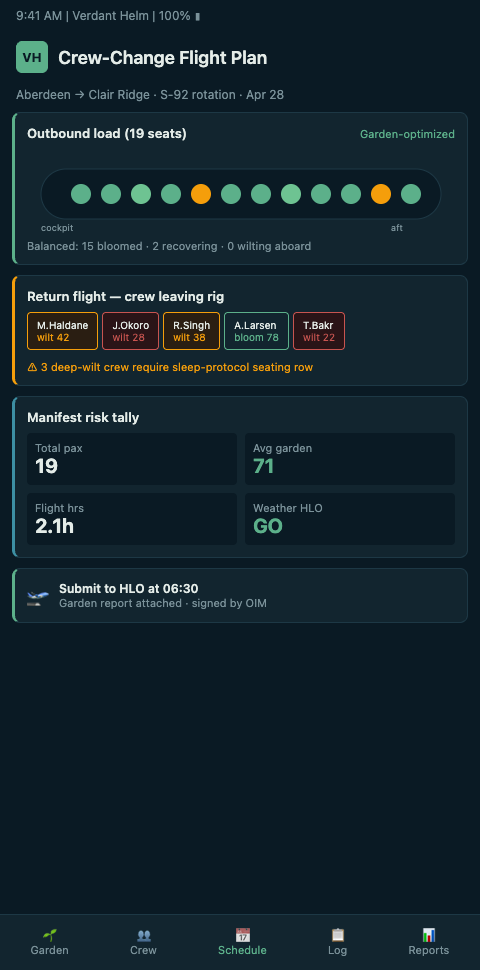
The framework has three layers. First, pre-flight readiness. Each outbound crew member logs a short readiness check 4 hours before muster, capturing sleep quality, known stressors, and time since last full rest. The garden view aggregates this across the flight and flags any manifest where the aggregate readiness score drops below a threshold. This does not ground the flight; it changes the arrival plan. Offshore Norge's guideline 066 covers the manifesting and pax-handling side on the Norwegian Continental Shelf and gives operators a structural place to add the readiness input (Offshore Norge Guideline 066 Offshore Helicopter Operations). The readiness check is not a self-grading exercise that the crew member can game; it combines subjective input with objective proxies (time since last rest window, travel hours to heliport, known disruptions during leave) so the score carries weight beyond self-report alone.
Second, arrival-match. The toolpusher sees the incoming crew's garden state before they land and matches them to tours, tasks, and JSA participation appropriate to that state. A crew arriving at 70%+ readiness can take the standard first-tour assignment. A crew arriving below 50% gets a 12-hour integration window before full production tours. Third, rotation rebalance. Across a season, the crew-change planner sees which rotations consistently land crew in low-readiness states and can rebalance shore leave, transit routes, and stopover timing.
Existing crew-scheduling tools integrate manifests, rotations, and logistics efficiently (Ascertra Crew Scheduling Software for Offshore Projects). The missing layer is arrival-state data that informs what happens in the first tour after landing. The helicopter-logistics market itself treats fatigue management as a growing driver (Dataintelo Offshore Helicopter Logistics Management Market Report), and the garden overlay turns that driver into a scheduling input rather than a compliance note. The same data also supports the operator-contractor interface, because the arriving crew's readiness is typically the contractor's responsibility while the first-tour assignment is the operator's — the garden gives both sides a shared view. Disputes about first-hour incidents often stem from different assumptions about arrival readiness; the shared garden view removes the ambiguity and shortens the post-incident conversation.
Advanced Tactics for Flight Planning
Three tactics shift the planning discipline from "fill the manifest" to "steward the arriving garden." The first is the hold-at-heliport exception. When a flight slips by more than three hours due to weather, the readiness scores of already-mustered crew degrade measurably.
The planner has a choice: push the flight, or rebuild the manifest for the next window. The garden data makes the trade-off quantitative instead of instinctive.
The work on heli-deck arrivals decoding crew energy details what the toolpusher sees in the first 20 minutes after touchdown, and it starts at the heliport.
The heliport itself can be instrumented — quiet rooms, meal timing, nap provision — to slow the rate of readiness decay during unavoidable holds.
The second tactic is back-to-back detection at the logistics layer. Crew changes that compress a worker's shore leave show up in the readiness score on next muster, and the garden tracks this across hitches. The hidden cost of back-to-back crew changes covers the rig-side consequences; the flight-planning side catches it a layer earlier.
The parallel practice on offshore wind — jack-up campaign predictive energy planning — shows how the same logic applies to technician transits across a wind-farm campaign.
The third tactic is manifest role-mix balancing. A flight carrying four derrickhands and zero roustabouts arriving into a rig that needs a tripping crew at 20:00 is not an optimal transplant, regardless of individual readiness scores. The garden view shows the rig's current role needs and the arriving crew's roles, and the planner rebalances across nearby flights when possible. This reduces the "we got the people but not the right people" pattern that creates early-hitch wilt.
A fourth tactic is multi-leg routing visibility. Crews transiting through hub airports, then helibases, then offshore platforms accumulate hidden fatigue in ways that single-leg measurements miss. The garden tracks cumulative transit time and rest windows across the full journey, so a crew arriving from a three-leg transit is treated differently from a crew with a single helicopter hop, even if both arrive at the same clock time. The transit footprint is a rotation variable, not a logistics incidental.
A fifth tactic is regional variance awareness. A crew arriving from a domestic North Sea transit has a different fatigue profile than a crew transiting from a distant home base with overnight flights and time-zone shifts. The garden tracks the baseline variation across home-base regions so the arrival-match logic does not apply a one-size threshold to a diverse fleet. This matters particularly for operators running crews from mixed geographies into the same rig, which is common on international drilling contracts.
Common mistakes include treating the aviation risk and the arrival-state risk as two different conversations, loading compressed-rest crew onto the last flight of the day, and measuring flight success by on-time-landing rather than by first-tour readiness. A subtle trap: the flight that lands a crew 18 hours earlier than planned is also a manifest disruption, because the rig may not be ready to integrate the crew, leaving them in transit-adjacent rest rather than recovery.
Another common mistake is failing to communicate the garden state back to the aviation operator — the pilot and dispatcher making the weather call have context the operator does not, and the exchange runs both ways. A further trap is treating the arrival-state data as purely the operator's property; when the logistics provider also sees the data (in aggregate, with privacy safeguards), they can adjust their own scheduling in ways that reduce hold times at the heliport.
Bring Your Next Manifest
If you run OIM or logistics-coordinator duties for a rig or a fleet, bring us your next planned crew-change manifest and the last three months of flight-slip events. We will overlay the arriving crew's rotation position and model what the first tour looks like with and without readiness input. Verdant Helm gives drilling supervisors the data to convert a compliant manifest into a tour plan the garden can actually support, before the reshuffle and the weather push the decision into the last hour. Book the walkthrough — it takes 25 minutes with your existing data; the output is a first-tour staffing plan matched to arrival readiness, not a theoretical model.
The 25-minute walkthrough produces three artifacts the OIM can act on before the next helicopter lifts off from Aberdeen, Bergen, Stavanger, or Houma. First, a readiness overlay showing each manifested crew member's predicted arrival state based on their current rotation position, transit pattern, and prior-hitch recovery data. Second, a first-tour assignment recommendation that matches tasks to readiness — which derrickhands take the night tour, which roustabouts pair up on heavy-lift, which drilling supervisors run the first permit review.
Third, an escalation matrix for the three most likely flight-slip scenarios given the season and weather window, with specific re-manifesting moves tied to each scenario. OIMs and logistics coordinators who have run the walkthrough keep the three artifacts in a shared folder with the rig's flight-planning team. The next time a weather cell threatens the scheduled window, the conversation is quick because the alternatives are already modeled. Rigs that combine the walkthrough with the heli-deck arrival baseline check see the strongest first-week incident reduction because both the logistics side and the rig side share the same garden view of the incoming crew.