The Roustabout's Field Guide to Logging Fatigue
The Four-Every-Shift Problem
A roustabout on a semi-sub pencils in a four on the fatigue log on day one of the hitch. Also on day five, day ten, day fifteen, and day twenty. Always a four, written at the end of the shift in the same dulled pen. The HSE coordinator stacks the logs at the end of the rotation, notices everyone wrote roughly the same number, and files them. The auditor comes on day 18 and writes a finding about unreliable fatigue data. The roustabout is not lying. The form is asking the wrong question in the wrong way at the wrong time, and the answer is whatever takes the least time to write. The data is useless because the design is useless.
The research confirms the pattern is near-universal. A four-week Gulf of Mexico compliance study published in Taylor & Francis measured how offshore workers actually respond to daily fatigue assessments. Compliance rates varied sharply with the design of the instrument, and the workers who logged most honestly were the ones whose interface matched their workflow. A separate qualitative interview study with offshore drilling workers captured the reality in the crew's own words — workers describe fatigue with terms like "gassed" and "rundown," not on a one-to-ten scale, and they underreport when the form uses language they do not own. An SPE JPT article on offshore worker sleep health documents the same pattern at industry scale. Crews will log honestly. The form has to earn it.
Designing the Log Like a Perennial Bed That Wants Tending
The Verdant Helm approach treats every crew member's fatigue log as a bed in the garden that needs to be tended — and the tending has to be quick, familiar, and honest or the bed gets abandoned. Roustabouts are perennials with high daily output and specific wilt patterns. The log has to match their work rhythm. Three design moves matter.
First, the check-in has to happen at a natural pause in the shift, not on a clipboard at shift end. The clipboard at shift end is exactly when a tired roustabout wants to be in the mess, not writing a number. Verdant Helm puts the two-question pulse at the end of the JSA briefing at shift start and again right before the handover — two moments already in the routine. Each pulse is two taps on a shared tablet or phone, takes 15 seconds, and uses language the crew uses. Not "rate your fatigue one to ten," but "how slept did you feel last night — solid, patchy, or wrecked," and "how is your body feeling right now — fresh, loaded, or shot." The language comes from the crew interviews.
Second, the scale has to be scientifically defensible. The two-question wrapper uses the Karolinska Sleepiness Scale as its backbone — a nine-point subjective sleepiness scale widely used in offshore self-logging because it maps human words to measurable states. The Karolinska wording gets translated into rig vernacular on the tablet, but the underlying numbers feed the same biomathematical model the toolpusher reads on the energy dashboard. The Safer Together Individual Fatigue Risk Assessment Tool provides the structural template — start-of-shift, extended-shift, and symptom check-ins layered into a single flow. Verdant Helm implements that structure as one interface with three conditional paths.
Third, the crew has to see what happens with the data. IOGP Report 626-1 publishes eight worker-facing info sheets that explain fatigue science in terms crews can own — and the rigs that share those sheets get more honest logging. The display in the doghouse shows the roustabout's own bed in the garden alongside their department. Nobody sees anyone else's individual data — the aggregation is by department — but each crew member can see their own trend, and that ownership is what shifts the log from compliance to self-knowledge.
The garden metaphor lets a crew see their week clearly. A roustabout whose bed has been consistent green through week one sees a yellow tint on day nine after a short-sleep night, a red warning on day 13 after three short-sleep nights in a row. That personal trend-line is what makes the log feel like useful information rather than paperwork. The ResearchGate paper on fatigue monitoring in the offshore sector describes the five-question electronic self-assessment protocol that Verdant Helm adapts — the evidence base is there; the interface work is what closes the compliance gap.
The Roustabout-Facing Log
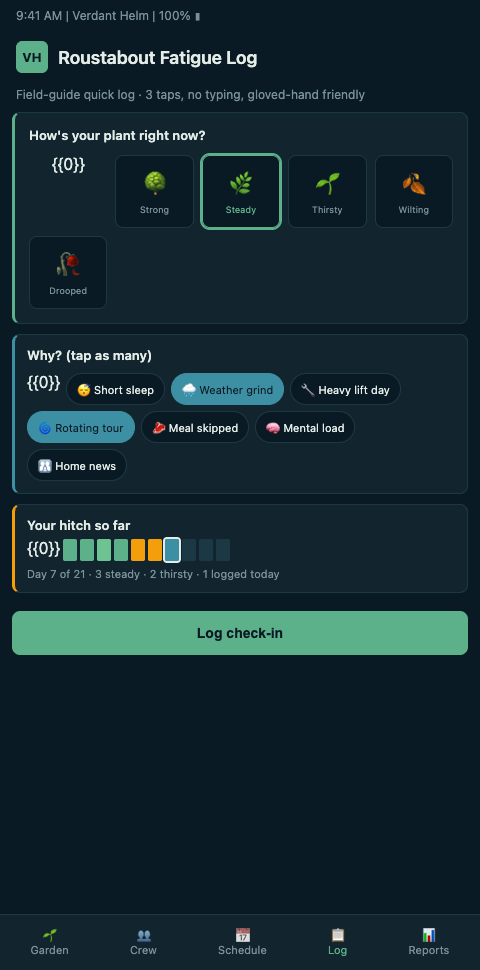
The interface a roustabout sees on the shared doghouse tablet is deliberately spare — two questions, three word-buttons on each, and a personal seven-day strip chart at the bottom showing their own garden bed. No typing. No sliders. No rating-by-dials. The tap takes less time than reading this sentence. The strip chart is visible only to the individual and rolls forward each shift. When a crew member asks the rig medic for something for sleep, the medic can pull the same strip chart with consent — the rig medic garden-based signals post covers how that handshake works without blurring medical confidentiality.
The tablet itself is wrapped in a weatherproof sleeve and bolted to the doghouse wall next to the JSA board. Wet gloves work on the screen. A gloved tap from a cold, rain-soaked roustabout registers the same as a dry-hand tap at the start of shift — which is the point. The three word-buttons for each question are rendered in large text with high-contrast backgrounds so a tired eye at 05:50 on day 17 does not have to work to read them.
The strip chart at the bottom shows seven bars in the crew member's personal color, with no numbers and no clinical language — just a visual rhythm the roustabout can read between the clipboard and the coffee urn. Verdant Helm's design discipline here is deliberate: the log earns its place on the wall only if it costs the roustabout less time than the paper log it replaces, and the interface has to hold up against the rig environment rather than a boardroom demo.
Advanced Tactics: Making the Log Earn Its Place
Three tactics turn a log design from compliance to operations. First, pair the log with the JSA review. When a JSA is being written for a task with elevated risk — trip out of hole, critical lift, hot work — the team's aggregated energy state on the permit should appear on the JSA form as a contextual input. It does not veto the work. It changes the conversation. A JSA written with the garden showing two yellow beds on the deck team gets more review than the same JSA with all green. The JSA fatigue review guidance covers the protocol in depth.
Second, close the loop with actual changes. Crews log honestly when they see their data driving actions — a shift swap, a rescheduled task, an extended handover, an extra break. If the log is collected and the day proceeds exactly as if the log had not existed, crew members revert to the pencil-in-a-four pattern within two hitches. Honest logging is earned. The toolpusher has to be seen responding.
Third, learn from adjacent industries where crews have solved the same problem. A cruise-ship bar team faces the same challenge — fatigue logging built for medical researchers will be ignored by a bar manager who has 140 covers to run. The cruise bar manager cheat sheet describes the same design discipline applied to hospitality crews. The common thread is interface-fit-to-role. Rigs can learn from cruise ops and vice versa.
Medic round data acts as a parallel source — walk-in counts corroborate self-logged trends without requiring additional logging effort from the roustabout. When self-log data matches medic-round data, the signal is real. When they diverge, something in the logging design needs review.
The common mistake is to design the log for the HSE coordinator's report rather than the roustabout's reality. A form that looks great in a compliance deck will fail on a cold, wet deck at 06:00 on day 14. Design for the wet glove, the tired tap, the 15-second window. The science is the same. The interface is where it lives or dies.
A fourth tactic is to collect the log at the same physical point every shift so the ritual becomes automatic. On rigs that have run the Verdant Helm pulse for three or more hitches, the tablet is mounted in a known spot — the doghouse wall, the mud shack entrance, the tool locker end-cap — and the crew log on the way in and on the way out. Predictable physical location beats predictable calendar reminder. The tap becomes muscle memory. When the tablet moves — a cable runs short, a winch interferes with access — compliance drops within two days. Keep the tablet in place.
A fifth tactic is to use the log's aggregate output to settle crew-level arguments. A derrickhand who insists the deck team is under-resourced for the current trip, and a toolpusher who thinks the team is being slow on purpose, can both look at the departmental bed on the garden display and see the same seven-day trend. The data does not decide who is right. The conversation becomes specific rather than adversarial. Rigs that use the log this way report fewer shift-change frictions and cleaner handover notes because the disagreements have been worked through before the shift ends.
CTA: For Toolpushers Rolling Out Fatigue Logs on a Rig Floor
If you are a toolpusher or drilling supervisor who has seen a fatigue log die quietly on your rig — pencil fours every shift, binders nobody reads — the next step is to redesign the instrument before redesigning the program. Verdant Helm provides the two-question pulse template, the Karolinska-backed scale, and the doghouse-tablet rollout kit. Start with one crew over one hitch and compare the honesty of the output against the last six weeks of paper logs. The delta will make the case without a slide deck.
The one-hitch trial has four concrete steps. Mount the tablet in the doghouse before the hitch starts. Walk the chosen crew through the two-question flow in the first JSA briefing. Let the shift pattern play out for 21 days without editorial intervention. Compare the distribution of responses against the last six weeks of paper logs. Toolpushers who run the trial report the same pattern: paper logs showed four-every-shift uniformity, the tablet pulse showed a distribution with visible wilt on days 12 through 16 and recovery by day 20.
The distribution itself is the case for the redesign. Book a 30-minute scoping call with a toolpusher from a comparable rig who has run the trial — the conversation covers the three specific design decisions that matter for your rig's doghouse layout, the tablet mount location, and the language translation from Karolinska to your crew's own vernacular. That tuning is what separates a pilot that sticks from one that gets abandoned at hitch end.