ISM Audit Readiness From Continuous Cognitive-Debt Metrics
The ISM audit is changing shape under the same code
The IMO International Safety Management Code page has been stable for a generation — safety management systems, Document of Compliance, Safety Management Certificate, internal audits, external audits. The IMO Resolution A.1118(30) guidelines set the revised implementation expectations in 2017. The code has not changed dramatically. The audit practice underneath it is changing. On VLCC and ULCC fleets trading against OCIMF-vetted charterers, the audit change runs faster because the charterers are already asking for continuous evidence ahead of class societies.
Safety4Sea's reporting on DNV's audit focus describes the shift directly — safety management audits are moving to seafarer wellbeing signals as a continuous safety indicator. The ClassNK Safety Management System Handbook for ISM Audits details objective-evidence expectations; the evidence that satisfies a modern auditor is no longer a signed paper form. The ICS Guidelines on Application of the IMO ISM Code, sixth edition reinforces the posture — implement SMS with objective evidence that the system is genuinely operating. A DPA preparing for a DOC renewal audit on a mixed fleet of Panamax container vessels and Feeder container vessels sees the posture directly in the pre-audit correspondence from class. A DPA on a tanker fleet running OCIMF TMSA assessments alongside ISM audits sees the same expectation in the charterer's vetting letters before the class society ever writes.
The tension is that most SMS implementations still produce the old evidence type. Binders. Signed forms. Retrospective interviews with Masters and Chief Mates whose recall of an incident twelve weeks ago carries the usual fragility. The WMU Journal of Maritime Affairs study of investigated casualties under the ISM Code concluded that severe accidents recur despite the SMS framework, with human factors as the main cause. The code's intent is not being met because the evidence is not the kind of evidence that reveals human-factor gaps. PSC inspectors have the same problem when they board for a focused inspection; they are looking for signals in a binder that was never designed to carry them. A bosun who remembers the day Traore was rotated off the bilge pump round because his perennial was thin cannot document the memory in a form the auditor will accept twelve weeks later.
Continuous cognitive-debt metrics as the new evidence class
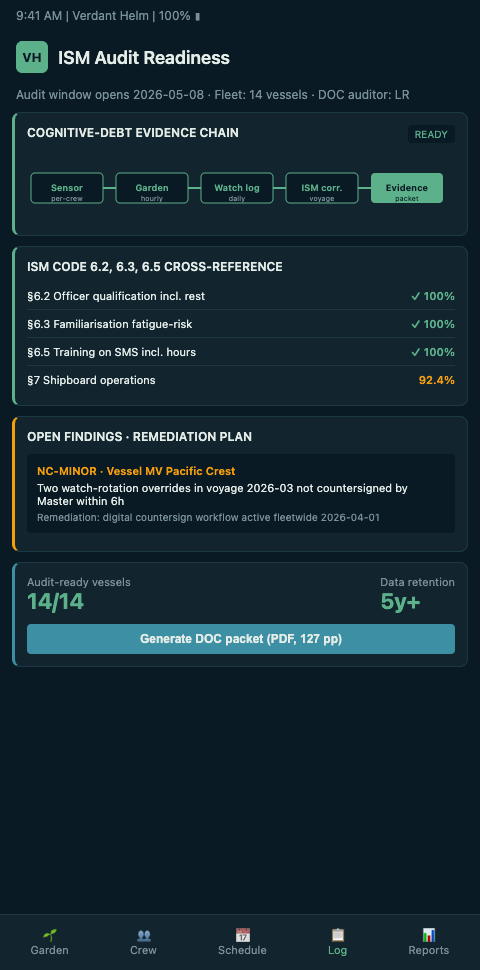
The Verdant Helm approach produces the evidence class the modern audit expects. The ship's botanical garden generates a continuous cognitive-debt trace for every watchkeeper, every voyage. The trace is time-indexed, tamper-evident, cross-referenced against the ECDIS and engine logs, and available to the DPA in real time. The garden's colour grammar — fresh green for strong perennials and blooms, amber through russet for the debt bands — translates directly into audit artefacts a surveyor can read without a training session.
The evidence is structural. The garden's perennials across the fleet show the baseline capacity the SMS is meant to protect. The bloom-and-wilt cycle within each voyage shows how the SMS responds to operational pressure. The recovery pattern between voyages shows whether the leave system and crewing pattern are rebuilding perennials or drawing them down. The eCFR 33 CFR Part 96 implementation of the ISM Code for US-flag ships expects audit evidence that the SMS is effective; a continuous garden trace across twelve months is precisely that evidence. US-flag Masters preparing for Coast Guard audits see the same expectation reflected in the inspection regime. An AMSA surveyor boarding an Australian-flag Panamax or a Transport Canada inspector boarding a St. Lawrence bulker reads the same class of evidence and the trace answers both regimes without modification.
Auditor questions change shape against this data. Instead of "show me your fatigue log," the auditor asks "show me how the SMS responded when this perennial crossed this threshold on 12 March." The DPA pulls up the garden view, overlays the watchkeeping records, shows the Master's intervention, shows the recovery over the following 72 hours. The evidence is concrete, specific, and repeatable across other events. A Chief Mate's perennial trace over a TransPacific rotation, shown alongside the Master's standing orders that protected his day-9 rest cycle, reads as a small and traceable SMS decision rather than a paragraph in an audit narrative. The bosun's deck-garden record from the same voyage, with specific rotation calls during the Chief Mate's protected window, reads as SMS operating across the whole crew rather than concentrated in one officer.
The IMO ISM Code itself asks for objective evidence of SMS effectiveness. The garden supplies it by the hour. A single audit day can be backed by thousands of data points; a full DOC renewal audit can be backed by years of continuous trace. That inverts the preparation burden — instead of assembling a binder in the week before the audit, the DPA runs queries against a standing dataset. Masters stop spending the week before an audit hunting for missing signatures on rest-hour forms and start spending that week on actual operational decisions. Chief Mates stop chasing bosuns for deck-round signatures, and bosuns stop chasing ABs for toolbox-talk initials; the documentation chain that has always produced the least reliable evidence is the chain the continuous trace retires first.
Advanced: reshaping the DPA's relationship with the auditor
The deeper capability is the shift in how the DPA works with the auditor. When the evidence is continuous, the audit becomes an interrogation of the data rather than an interrogation of the paperwork. The DPA is not defending the paper. The DPA is exposing the data surface and explaining what the SMS did in response to it. That conversation takes an experienced auditor into specific events rather than generic findings, and it reduces the ritual component of the audit to a small fraction of the total time.
This matches the intent of the ICS Guidelines on the Application of the ISM Code — demonstrate that SMS works in operation, not in documentation. The DPA's preparation cost drops because the data is already there. The auditor's confidence rises because the data is tamper-evident and operationally linked. A DPA attending an OCIMF TMSA assessment on top of the ISM audit finds the same dataset serves both; the cognitive-debt trace answers TMSA Element 6 questions on operational risk with the same evidence it uses for ISM Code clause 10 questions on ship maintenance. A chemical tanker operator under CDI inspection sees the same reuse; the dataset answers the CDI questionnaire on crewing and fatigue without separate paperwork assembly.
For flag-state administrations, the posture provides a new compliance surface for PSC inspections. An inspector boarding a vessel with a live garden can query the previous 30 days of cognitive-debt trace against the ECDIS event log. Discrepancies — a quiet watch with a Master intervention that has no corresponding garden record — become investigable in minutes rather than days. A Paris MoU inspector working a concentrated campaign on fatigue under MLC and STCW uses the garden in the same way. A US Coast Guard boarding officer looking at a VLCC at anchor off Valdez reads the anchor-watch perennials directly and can confirm response-time readiness without a paper interview. Tokyo MoU inspectors working the Far East Pacific routes see the same compliance surface on any vessel in the network and the cross-regional consistency simplifies the inspection.
Fleet superintendents gain a management artefact their boards can use. The continuous trace across 14 vessels over two years is the kind of evidence class insurers and charterers are starting to ask for. A reinsurance renewal meeting where the broker is asking about fatigue-driven loss potential becomes a conversation backed by perennial distributions rather than an anecdote about the Master's standing orders. The board's risk committee, which usually hears about fatigue through incident narratives, reads a perennial-based trend across the fleet and can direct capital investment with a grounded view of where the largest returns will come from.
Post 24 on STCW telemetry reform covers the adjacent regulatory conversation on training and certification telemetry, and post 15 on retiring MLC rest-hour paperwork explains how the MLC side of the same evidence base comes together. The upstream industry has been building the same kind of continuous-evidence posture under a different name; post 20 on ALARP documentation from continuous fatigue trace shows how offshore oil and gas operators converted their fatigue trace into ALARP evidence at board level.
For deep-sea cargo fleet leaders preparing next year's ISM audit cycle
If your next DOC or SMC audit is due within 12 months and your DPA is still assembling evidence from paper, Verdant Helm will run a full cognitive-debt trace across one vessel for a voyage cycle and convert the output into an ISM audit evidence pack. Schedule the ISM evidence trial with your DPA and the class society lead for your next scheduled audit, and invite the flag-state representative to sit in on the trial walk-through so the evidence class is calibrated against all three audiences at once.
Before the trial, pull the previous two internal audit reports and the last twelve months of non-conformity records. The trial almost always locates two or three non-conformities that the continuous trace would have closed at the point of occurrence rather than at the audit interview three months later. On a Greek-flag Panamax bulker running the Black Sea-Far East trade with a DNV DOC audit cycle, the pack typically assembles the Chief Mate's day-nine rest-window intervention, the bosun's deck-rotation calls during the Cape passage, and the Master's standing-order history on TSS transit staffing into one continuous record.
The DPA gets an audit-evidence console that answers both ISM and OCIMF TMSA questions from the same dataset, so the three-week audit preparation period shrinks to a standing query window. Flag-state surveyors from the UK MCA, Marshall Islands, or HRS read the same pack and the audit closes on the walk-through rather than a correspondence loop that drags into the next renewal cycle.