Integrating Permit-to-Work Flows With Crew Energy Data
The Permit Signed at 02:40
A confined-space entry permit on a North Sea semi-sub was issued at 02:40 on day 16 of a 21-day rotation. The hot-work portion of the task involved torch-cutting a corroded bracket inside a ballast compartment. The permit carried four signatures inside 90 seconds, and the crew went in. An hour later, the standby man called a near-miss when the entrant failed to respond to a radio check for 40 seconds. The investigation found the entrant had micro-slept on his feet. The permit was complete. The permit-to-work system had no view of the fact that the two-man entry team had each lost three hours of night-tour sleep on the previous shift.
That gap is not unusual. HSE UK's guidance on permit-to-work systems catalogues recurring failure modes across petroleum and chemical sites including communication breakdowns, insufficient monitoring, and terms of the permit not being adhered to by the holder (HSE UK HSG250 Guidance on Permit-to-Work Systems). What the paperwork cannot capture is the cognitive state of the humans signing it. A ScienceDirect interview study on offshore fatigue culture found that most crews still manage fatigue through supervisor observation and self-reported log entries, both of which degrade exactly when they are needed most (Safety culture and worker fatigue management offshore). Toolpushers and OIMs know the pattern: the permit closes on time, the task completes, and the next audit cycle shows a steady trickle of precursor events tied to the same tired signatures.
Wiring Energy Signals Into the PTW Gate
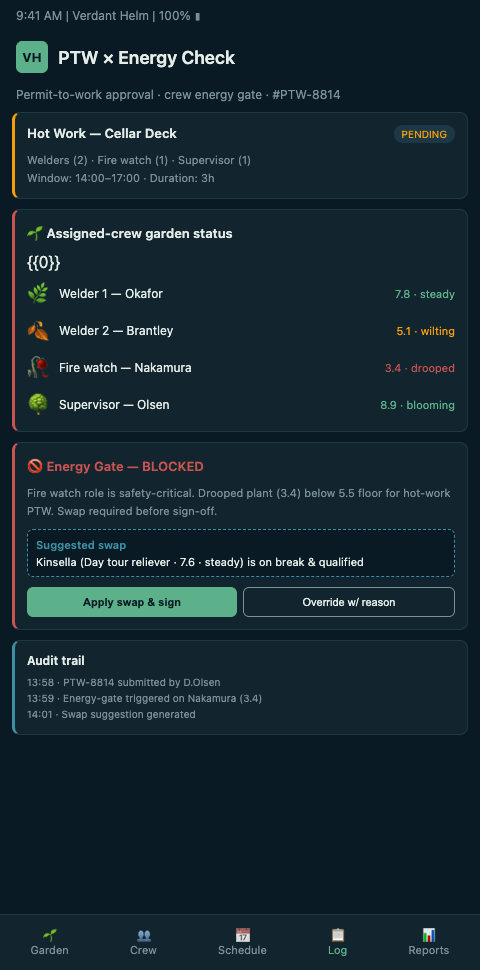
Think of the permit-to-work flow as a gate into the garden. Right now, most gates check for hazard isolation, gas readings, PPE, and training currency. Verdant Helm adds one more check: the living state of the plants about to do the work. In the botanical metaphor, every crew member is a perennial with a growth curve across the hitch. Some bloom in the first week, wilt around day 12, partially recover after a sleep cycle, then wilt again. A torch-cutting JSA issued to a crew sitting in a pronounced wilt deserves a different level of supervision than the same permit issued to a rested team at day 2. The gate does not block the permit; it reshapes what the permit looks like when the crew behind it is not at full bloom.
The integration works at four points in the PTW workflow. First, permit preparation: when the applicant selects the intended crew for a hot-work or confined-space task, the PTW form pulls each named crew member's current energy bed score and displays it alongside training records. A score below a pre-set threshold on any named entrant prompts a structured conversation, not an automatic refusal. The conversation is brief — the driller or supervisor acknowledges the state and either confirms the task with a named mitigation or defers.
Second, issuing: the issuing authority sees the aggregate crew state plus individual outliers and decides whether to issue, defer, or add mitigations (extra standby, shorter work window, peer-check every 15 minutes). The issuer's signature carries a record of what they saw, which matters for the audit trail later. Third, active permit window: the system monitors the crew state during the permit life, because fatigue does not freeze at signing. A sharp dip in a named worker's score triggers a notification to the permit issuer, who can call a check-in, extend the standby, or close the permit early. Fourth, close-out: the permit record captures the energy state at issue, mid-task, and close, so the audit trail tells a story about decisions made.
HSE's technical measures page on PTW describes the same failure modes the garden approach addresses: communication failure at handover, tasks running longer than the permit envisaged, monitoring that tails off after the first hour (HSE UK Permit to Work Systems COMAH). IOGP Report 577 reinforces the linkage between job safety analysis and permit gates as a single operational-readiness decision, and energy data fits the same decision without creating a new form (IOGP Job Safety Analysis / Permit to Work Report 577). On the fatigue-specific side, API RP 755 gives refining and petrochemical sites a standard for fatigue-risk management that process-safety-sensitive PTW tasks can reference directly, and offshore drilling supervisors can mirror the practice without rewriting their procedures (API Recommended Practice 755).
Advanced Tactics for Integrating at Scale
Running the integration across a fleet of jackups and drillships adds edge cases. The first is threshold calibration. If the energy gate is set too permissive, nothing changes; the system becomes a logging exercise. If set too strict, the drilling supervisor stops trusting it after the third false refusal and overrides become routine. Start with a gate that flags for conversation, not blocks. After three hitches of data, the toolpusher can see the correlation between flagged permits and actual precursors, and the threshold tunes itself through an HSE review cycle. The calibration should sit with the OIM and HSE lead, not with the vendor, because the thresholds have to defend themselves in an audit conversation.
The second is cross-contractor permits. A third-party wireline crew or a well-services specialist may not have energy data on the garden. Rather than waive the check, run a 5-minute pre-task self-assessment that feeds the same record. This turns the visitor into a named plant in the garden for the duration of the task, and the audit trail is consistent. The visiting crew's home base may have its own fatigue program, in which case the two systems exchange summary state rather than raw data, which keeps the data-privacy footprint narrow.
The third is shift-change overlap. Permits often issue at the tail of a night tour and execute into the day tour, with the issuer and the supervisor being different people. The garden view shows both outgoing and incoming crew state, and the issuing authority can see which tour will actually carry the work. Chevron's work-authorization standard treats readiness as a first-class input to PTW, and fatigue state fits the same input slot (Chevron Work Authorization OE Standard). A common mistake is to let the system auto-populate the crew from the previous permit of the same type; the roster can change overnight, and the check must rebind to who is actually holding the torch. The same logic ties this work back to ALARP evidence built from continuous fatigue metrics — the permit record becomes part of the safety-case narrative, not a separate paper trail.
A fourth edge case is permits that share a crew with upcoming high-consequence tasks. If the same derrickman signed a hot-work permit at 06:00 and is scheduled on the BOP test timing window at 18:00, the garden surfaces that stacking before either permit issues. The permit desk can re-sequence or add a standby layer for the second task.
Existing digital PTW platforms handle workflow and compliance well but do not yet consume human-energy signals as a first-class input (EHS Insight Oil and Gas Safety Management Software); the garden layer fills that gap without requiring a rip-and-replace of the existing PTW stack.
Finally, the same energy signals feed the bridge team on cargo vessels through ECDIS events correlated with crew energy timelines, so the cross-industry pattern reinforces the offshore practice.
A fifth edge case is permit reissue during a task. Permits often get extended or modified mid-task when scope creeps. The garden view shows how the crew state has changed across the original permit window, and the reissue decision inherits that context. A permit that was issued to a rested crew and reissues three hours later to the same (now depleted) crew is a different permit in garden terms, even if the paperwork is a continuation. Toolpushers who treat the reissue as a fresh gate catch more precursors than those who treat it as a rubber-stamp extension.
A sixth pattern is seasonal calibration. A North Sea rig in November generates different garden curves than a Gulf rig in July, because daylight, weather, and crew-change logistics shape the baseline. The permit gate thresholds should reflect the seasonal baseline, not an annual average; otherwise a winter crew gets permitted against a summer standard and the gate loses meaning. The HSE review cycle is the right place to re-tune, with the OIM contributing the qualitative context the data alone cannot capture.
Common mistakes beyond the ones above include stacking multiple high-cognitive-load permits into the same tour without aggregating their garden impact, relying on the issuer to mentally combine energy data with gas readings (which defeats the integration's purpose), and failing to feed permit-closure data back into the garden (which breaks the learning loop). A subtle trap is the "clean permit" effect, where supervisors unconsciously route the best permits to the best-state crews, which inflates the apparent safety margin while leaving the marginal crew exposed on marginal tasks. The garden data surfaces this skew when it is run as a reporting overlay at the end of each hitch.
Next Step for Your Permit Desk
If you run the permit desk on a jackup, semi-sub, or drillship, pull the last 30 days of permits and mark the ones that closed with a precursor event or near-miss. Look at the crew named on those permits against their hitch day. The pattern usually shows itself in one afternoon of review. Verdant Helm gives OIMs and toolpushers a way to wire that same signal into the front of the permit flow so the decision happens before the torch strikes, not after. Book a 20-minute walkthrough and we will model one hitch of your permit data against the garden framework.
The walkthrough runs on your rig's actual permit data rather than a generic demo. Send over the last 30 days of permit records — entrants, issuing authority, permit type, active window, and close-out notes — and Verdant Helm's analyst team maps the garden state that would have been visible alongside each permit if the integration had been live. The walkthrough then focuses on three specific permits: one that closed cleanly on a rested crew, one that closed cleanly despite elevated wilt, and one that closed with a precursor event. The contrast between the three is where the permit desk learns to read the garden as a decision input rather than a compliance overlay.
Toolpushers who run the 20-minute walkthrough with their HSE lead in the room leave with three concrete changes for the next hitch's permit flow: one threshold to tune, one conversation script for the pre-issue check, and one escalation trigger for active permits where the garden shifts mid-task. Bring the permit desk's senior issuing authority to the walkthrough — the threshold calibration decisions surface faster when the person who signs the permits is in the conversation. The 20 minutes pay back within the first hitch that runs the integration because the first deferred permit avoids the cost of the near-miss it would have generated, which is the argument the permit desk already makes internally about every other gate.