Correlating ECDIS Events With Crew Energy Timelines
The alarm log and the person muting it were never in the same file
At 03:42 on 23 March 2020, the chief officer of the Kaami reached across the bridge console and acknowledged an ECDIS anti-grounding alarm. He silenced it and did not act on it. The MAIB report records the next eleven minutes: no course change, no speed reduction, no revised passage plan. The general cargo ship grounded on the Stac Mhic Aonghais pinnacle in the Little Minch at a speed of 12.6 knots. The chief officer had been the sole watchkeeper on the 00:00 to 06:00 bridge watch.
The alarm log was reconstructable after the casualty. The fatigue state of the chief officer on that watch was not. The OOW's rest hour form and the ECDIS event log were held in separate systems that nobody on board or ashore had ever correlated. The MAIB investigators had to do that correlation manually after the fact, from medical records, cabin badge access, and crew statements, to name fatigue as a factor. The bulk carrier was not exceptional. It ran a short-sea cargo route that any Feeder container ship or coastal bulker in the North Atlantic could have drawn.
Across the fleet, that correlation is still absent in real time. An ECDIS alarm either fires or does not fire. The watchkeeper either acknowledges it or does not. What nobody sees is what the muting hand had been doing for the preceding six hours of watch, or for the four voyages before that one. Riviera reporting describes OOWs in the Dover Strait TSS receiving ECDIS alarms every few minutes, developing the reflex to clear them without engaging. That reflex is a cognitive symptom, not a navigation signal.
The reflex is especially acute on VLCC and ULCC bridges crossing the Singapore Strait, where the combination of heavy traffic density and look-ahead parameters set conservatively by the Master produces an alarm every ninety seconds during peak transit. A Second Mate three days into a Europe-Asia rotation, running the 00:00 to 04:00 watch as ship-time clock drifts past Colombo, will clear sixty look-ahead warnings on a single watch and remember almost none of them. The cognitive record was kept by his tiredness rather than by his logbook.
Plant the ECDIS log next to the garden and read them together
The Verdant Helm approach puts the two streams side by side and treats them as one record of the watch. The ECDIS events — cross-track deviations, look-ahead anti-grounding alerts, safety-contour breaches, as specified in IMO Resolution MSC.232(82) — stream into a time-indexed overlay. The crew's cognitive state streams in as the botanical garden of perennials, blooms, and wilts that the platform renders for every watchkeeper on the bridge.
The garden metaphor holds because the signals behave like a tended plot. Each watchkeeper has a bed. Their baseline alertness is a perennial that returns across voyages if rested well. Inside a watch, attention blooms in the first hour and wilts as the fourth drags. Sinks are the places where a specific watchkeeper always loses energy — the 04:00 to 05:00 slot for a chief officer on a 4-on-8-off, the post-lunch drag for a Master who joins the bridge at 14:00 for a pilot boarding, the 22:00 to 23:00 slump for a Second Mate whose ancillary duties ran from 16:00 onwards. When you prune a watch short because the forecast is busy, the garden shows which bed recovers and which does not.
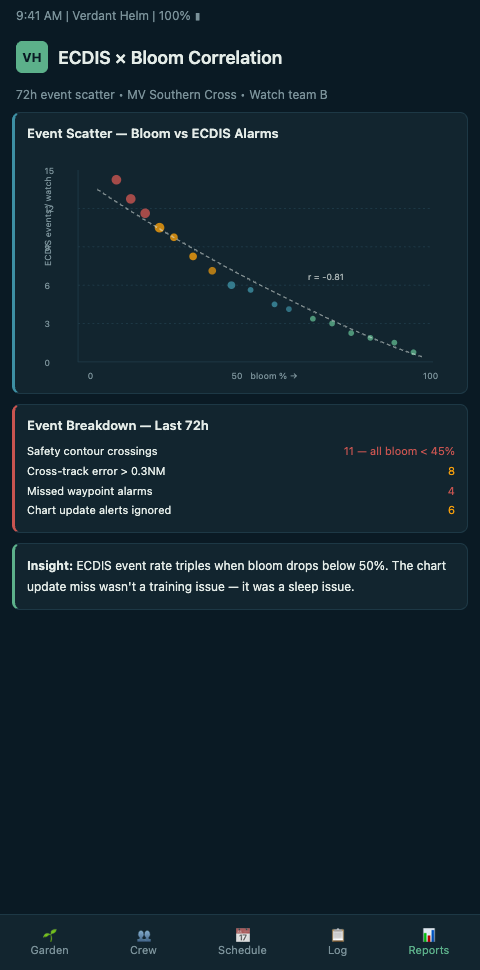
The overlay then makes the correlation visible. When an ECDIS safety-contour alarm fires at 03:42, the bridge display does not only show the alarm. It shows the OOW's cognitive bed alongside it — wilted perennial, two consecutive short rest cycles, eight hours into a six-hour attentional window, a wilt pattern that matches the MAIB bridge watchkeeping safety study description of fatigue-driven groundings between midnight and 06:00. The colour coding is deliberate; watch-cycle wilts render in deepening amber through to russet for the worst bands, so a glance at the bridge tells the Master which bed is the one to watch and which is carrying the shift.
The Master sees the composite. So does the DPA ashore. The alarm is no longer a decontextualised ping. It is a ping in a context where the OOW's capacity to respond to it is visibly depleted. That changes what the Master does next. A call to the bridge. A supplementary lookout posted, usually the off-going OOW held back for 20 minutes. A course adjustment that does not wait for the OOW to decide.
On a Panamax container ship running the Europe-Asia trade, the same overlay has cued Masters to shift the passage plan around the Hormuz approach when the Chief Mate's perennial was showing cumulative debt from a dense port-call week in Jebel Ali. The bosun, who usually has no view into bridge alarms, can be asked to carry up a coffee and a paper chart check at 03:50 without anyone having to explain why; the garden state on the bridge tablet already explains it.
Over a voyage, the correlation becomes a policy surface. If 70% of silenced ECDIS alarms on the ship's last three voyages fired during cognitive wilts, that is not an alarm management problem. It is a watch design problem. The Nautical Institute's ECDIS-assisted grounding case file documents a bulk carrier where the audible alarm was disconnected entirely; the cognitive signal had been absent for months before the casualty. Masters reading their own fleet's correlation data tend to reach the same conclusion earlier — the alarm design and the watch design have to be calibrated together, not tuned in separate offices.
Advanced: turning the correlation into a debriefable trace
Once the overlay is live, the next capability is the retrospective trace. Every safety-contour breach, every XTD exceedance, every look-ahead warning is tagged with the cognitive state that was present at the moment of the event. Over 90 voyages on a container vessel, you accumulate a dataset where alarm silencing without corrective action clusters in specific garden states — usually wilted perennials that have not bloomed at the expected watch-change time. A Second Mate's trace across a TransPacific rotation shows a different cluster pattern from his trace on a Europe-Asia rotation; the voyage type is part of the signal.
That dataset feeds the kind of audible alert and situation awareness research published in the Journal of International Maritime Safety, which has shown watchkeepers become insensible to repetitive ECDIS alarms. The Verdant Helm trace shows which alarms a given watchkeeper has become insensible to, and in which cognitive band that insensibility lives. An OOW may respond alertly to look-ahead warnings in the morning bloom window but mute safety-contour alarms consistently after 02:30; that is a targeted retraining opportunity that the paper record cannot surface. The trace also separates habitual muting from habitual engagement — two Second Mates with identical alarm counts can have opposite cognitive profiles behind those counts, and the appraisal conversation needs to recognise the difference.
Masters can use the trace to calibrate individual watchkeepers. A Second Mate whose XTD alarms cluster in the last 45 minutes of the 20:00 to 00:00 watch is not a weak officer. He is an officer whose perennial is showing a predictable late-watch wilt that the rota can be redrawn around. Pairing this with OCIMF recommendations on ECDIS usage turns a generic warning into a targeted intervention. A Master holding this trace in an appraisal review with a cadet promoting to OOW has evidence that supports coaching rather than marking. If this approach resonates, post 3 on OOW alertness and ECDIS drift alarms walks through the per-officer calibration loop.
Post 14 on fatigue troughs as collision and grounding precursors extends this trace into incident causation models that DPAs can present to class societies.
The wider MAIB critique, articulated in Seatrade Maritime's report on watchkeeping reform, is that the industry has not radically rethought the watchkeeper role since ECDIS became mandatory. A correlated ECDIS-plus-energy record is a practical first step.
It gives the Master, the DPA, and the fleet superintendent a shared artefact that weather-informed planners can also cross-reference through live forecast-to-energy fusion, making the watchkeeper's state legible in the same display where their navigation decisions already live. PSC officers boarding the vessel for a STCW and ISM spot-check can query the same trace, turning what used to be a paper hunt into a directed conversation with evidence already on the screen.
For deep-sea cargo fleet leaders running ECDIS-heavy trades
If your OOWs silence more than three ECDIS alarms per watch and you cannot pull up the cognitive state behind each silencing, Verdant Helm will wire the ECDIS event stream to the bridge garden on a three-vessel pilot within one voyage cycle. Request the ECDIS-energy overlay demo scheduled against a TransPacific transit of your own choosing, and bring your last internal voyage-data reconstruction as the comparison baseline.
Before the demo, pull the ECDIS event log and the Chief Mate's rest-hour form for the 72 hours preceding the most recent silenced-alarm cluster. The overlay almost always exposes a sustained-debt reading on the OOW who muted the alarms, held against a 00:00-04:00 watch window that followed a port-call day with a pilot disembarkation late in the preceding evening. On a Singapore Strait eastbound transit aboard a ULCC with the bunkering stop at Fujairah two days astern, the overlay maps the look-ahead warning count against the Chief Mate's bloom curve and reveals the window where a supplementary lookout or a pre-briefed conn handoff would have caught the silencing pattern.
The DPA gets a three-vessel report that ranks silenced-alarm density by OOW bloom state, with the Master's standing-order history attached to each flagged watch. P&I clubs and OCIMF vetting committees reviewing the overlay read a bridge posture that reads ECDIS configuration and officer state as one record, which changes how the next SIRE inspection opens and how the next reinsurance renewal conversation frames fatigue-driven loss.