Tying Fatigue Troughs to Collision and Grounding Precursors
Two casualties, two cognitive signatures that nobody had in hand
In the NTSB Marine Accident Report on the Exxon Valdez, the third mate's sleep in the 24 hours before the grounding is documented at five to six hours. The NTSB lists fatigue among the probable causes. A generation later, the NTSB report on the Cosco Busan allision with the San Francisco Bay Bridge cites degraded pilot cognitive performance — medication effects combined with bridge communication failures — as a cause of the 53,500-gallon spill. A VLCC and a Panamax container vessel, two decades apart, same cognitive signature in the casualty file.
Both casualties have the same shape. The cognitive trough was already present in the record. In one case it was a sleep log that the master could have read before clearing the officer for the transit. In the other it was a medical prescription that the bridge team had no view into. In both cases, the precursor was knowable. The correlation between the precursor and the casualty was made retrospectively, by government investigators, with authority to subpoena records that the operating company did not have in continuous form. A DPA facing an internal review a week after each event had nothing like the evidence a year-long NTSB investigation eventually assembled. The same pattern appears in TSB Canada reports on grounding events in the St. Lawrence Seaway and in MAIB reports on Feeder container vessels grounding in the Irish Sea; the cognitive trace was reconstructible but it had not been continuous.
The Cambridge Journal of Navigation study on circadian rhythms and shipping accidents shows the pattern across datasets — shipping accident probability peaks at night, tracking the circadian trough. The MAIB Annual Report 2024 flags fatigue, the doubling of groundings from 2022 to 2023, and poor crewing as causal patterns. The pattern is not a mystery. The operational layer that sees the precursor before the casualty is the missing capability. Flag-state administrations and P&I clubs are asking for that layer more aggressively every quarter, and an OCIMF vetting committee reviewing a VLCC fleet's safety record expects to see how the fleet's operations answer those questions in data rather than in policy statements.
The garden as a continuous precursor trace
The Verdant Helm approach treats fatigue troughs as a continuous signal, not as an after-the-fact reconstruction. The ship's botanical garden carries every watchkeeper's perennial across voyages, and every watch's bloom-and-wilt cycle in real time. When a perennial has been in decline for four consecutive voyages, that is a cognitive debt accumulating. When a wilt deepens beyond the voyage baseline, that is a trough forming. When the trough aligns with a high-complexity navigation event — pilot-on-board, TSS entry, port approach — the garden shows the overlap before the event begins. The wilt colour darkens from amber through russet as the perennial drops, so a Master glancing at the bridge view during watch handover reads the risk state in under three seconds. The same three-second read works for a bosun on morning deck round or a Chief Engineer on a pre-bunker walk-through; the signal does not require a training session to interpret.
The method scales from individual watchkeeper to bridge team. A third mate with a wilted perennial conning a loaded tanker through a restricted channel is visible in the garden as a specific risk state. A master and pilot both in wilted states, with a poorly blooming Second Mate as backup, is visible as a compounded risk state. The Shipowners' Club fatigue guidance describes these compounded states as ever-present risks; the garden makes their presence continuously visible.
A ULCC entering the Hormuz Strait with two officers and a bosun on the bridge has a garden state that the Master can read as a composite before the approach even begins. That composite is the exact artefact a DPA wants to hold before approving a pilot boarding in a restricted waterway, and it is the exact artefact an ISM auditor wants to see produced continuously rather than assembled from interview testimony after the fact.
Within a voyage, the trace shows the classic night-watch peak. The Project MARTHA final report documents sleep and fatigue deteriorating over long voyages, with a predictive fatigue model for voyage planners. Verdant Helm renders that model continuously against real rest patterns, so the Master can see when an individual officer's perennial has crossed into a band that historically precedes a lookout failure. Prune the watch. Pair the officer. Reroute around the challenging piece of coast. The intervention options exist because the trace is continuous, not because a forensic team assembled it after the fact.
The Project HORIZON simulator findings — 45% of six-on-six-off watchkeepers falling asleep on the midnight-to-06:00 watch — map directly onto the garden's trough bands, giving the Master a calibrated scale rather than a qualitative judgement. A Master on a Panamax container vessel approaching the Singapore Strait TSS at 05:30 can read the OOW's trough band alongside the traffic density and make the call to take the con himself for the transit, with a garden screenshot that supports the decision on a casualty review later.
Across a fleet, the trace becomes a precursor distribution. A fleet superintendent can see which vessels spend the most watch-hours in deep wilt, which routes force the most troughs, which pairings recover best. That is a management artefact the MAIB Kaami grounding report implies exists — or should exist — in any well-run company. Containership operators running the Europe-Asia trade and tanker operators running Middle-East-to-Asia rotations have different trough distributions, and the management response needs to differ accordingly. A bulk carrier on a Capesize rotation between Brazil and China carries a different trough pattern again, shaped by the longer ballast leg and the different port-call rhythm, and the fleet's management policies need to recognise the route-specific shape.
Advanced: from precursor trace to causal model
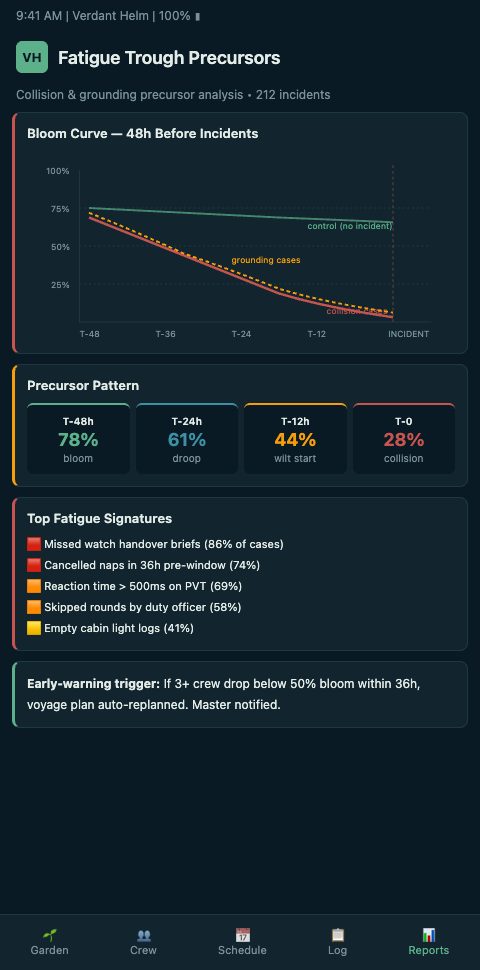
The deeper capability is the causal model the trace enables. Every near-miss, every XTD alarm, every close-quarters situation is tagged with the cognitive state of the watchkeeper at the moment of the event. Over 240 voyages across a mid-sized cargo fleet, the dataset supports a causal chain — this perennial depth precedes this trough frequency precedes this near-miss rate precedes this casualty probability. The chain runs from the voyage-level signal down to the individual OOW's watch log, so the same dataset answers both strategic and operational questions without a schema change.
That chain is defensible to class societies, P&I clubs, and flag-state administrations. It moves fatigue out of the anecdotal category and into the measurable category. The causal model links to the MARTHA fatigue prediction framework and can be validated against published voyage casualty distributions. A fleet whose trace shows declining trough depth across voyages is a fleet whose casualty probability curve is being actively pulled down. A TSB Canada or MAIB investigator reviewing a grounding that did not escalate can read the trace and see the interventions that prevented the escalation — rota changes, watch pairings, the Master's standing order that brought an OOW off the bridge at 03:15. The same chain supports reinsurance renewal discussions; a broker asking about fatigue-driven loss potential across a 14-vessel fleet can read the perennial distribution directly rather than accept a narrative assurance from the safety manager.
DPAs can use the trace to defend operational decisions. When a Master declines a berth slot because the cognitive garden forecasts a wilt cluster at the pilot boarding time, the DPA has a quantified reason to back the Master against charterer pressure. The Seatrade Maritime reporting on rest-hour falsification captures the cultural tension the trace targets; a Master with the trace in hand is not negotiating from an anecdote.
For a VLCC Master working under the STCW and MLC regime, the trace is the evidence the PSC officer asks for when the detention threshold is close. Cadets and Chief Mates working the same watch get a shared view — the trace is not a management surveillance tool, it is a ship-wide artefact everyone on the bridge reads the same way.
For adjacent context, post 7 on voyage week-three near-miss clusters covers the specific temporal pattern the trace should resolve. Post 22 on two collision-free years on a VLCC fleet presents the case study of a fleet whose trough trace has been pulled down over 24 months. Fleet superintendents will also recognise the logic from post 14 on near-miss reports as fatigue-trough signals in the wind-technician programme, where the same correlation is run against different casualty types.
For deep-sea cargo fleet leaders building a casualty defence
If your internal casualty reviews name fatigue as a factor more than twice a year and your board wants a quantified answer, Verdant Helm will produce a trough-to-precursor trace across the last 12 months of one vessel's voyage data. Request the precursor audit and bring the three most recent internal casualty reviews so the trace can be calibrated against the exact event pattern the board is already worried about.
Before the audit meeting, assemble the XTD alarm logs, ECDIS event logs, near-miss reports, and the Chief Mate and Master rest-hour records for the twelve months covered. The trace almost always locates the casualty's cognitive signature hours or days before the event, in a perennial's wilted trunk and a predictable circadian trough the paper record could not surface. On a Panamax container vessel working the Europe-Asia trade with Suez and Hormuz approaches in the same round voyage, the trace typically shows the precursor clustering against the Chief Mate's debt-crossover point between days seven and nine, with the Second Mate's carry-over from the preceding rotation as a compounding factor.
The DPA receives a board-ready brief pairing each flagged perennial with the tending decisions that moved its trough line, and the brief reads as a causal chain the class society and P&I club can audit directly. Flag-state surveyors reviewing the same trace during a DOC renewal see SMS evidence continuous across the twelve months, and the renewal conversation shifts from paperwork defence to operational interrogation of the data the Master has already been reading.