Two Collision-Free Years on a VLCC: What the Garden Saw
The Master had been at sea thirty-one years when the bosun brought him the question. The crew bar had a running joke that the ship's two-year wall calendar had more crossed-out days than the Chief Mate's night-order book had amendments. Two years since the last close-quarters situation. Two years since the last ECDIS drift alarm acknowledged in the anchor. Two years since the last near-miss filed with the DPA ashore. The question from the bosun was simple. Was it luck, was it crew, or was it the garden?
The Master's answer was the one he gave the class surveyor six months later, and it is the answer we are going to unpack across this post. The garden did not sail the ship. The bridge team sailed the ship. But the garden saw things the logbook could not, and it saw them in time for the OOW on watch to act on them. The case is specific to one vessel on one trade, but the reproducibility signals from the operator's follow-on instrumentation of nine sister ships mean the VLCC safety community is reading this as evidence of what is possible at scale rather than as an anomaly.
The problem: how a VLCC gets into trouble
VLCCs do not drift into collisions. They build into them. The VLCC bridge is a different beast from the container bridge or the bulker bridge because the vessel's stopping distance, turning radius, and draft profile create a decision horizon of sea miles rather than ship lengths. An OOW who sees a developing close-quarters situation on a VLCC has ten to fifteen minutes to act before the geometry forecloses on him; the same officer on a 6,000 TEU container vessel has four. Fatigue erodes that decision horizon in exactly the opposite direction from where it is most dangerous.
The 318,000 dwt class carries around two million barrels of crude and stops over a distance measured in sea miles rather than ship lengths. TSS transits in the Malacca and Singapore Straits, COLREGS interactions with fishing fleets off the Chinese coast, and bunkering rendezvous in the Fujairah anchorage all demand extended-attention OOW windows that a 4-on-8-off schedule is not optimized for. The EMSA 2024 Annual Overview of Marine Casualties documents that the human element accounts for 80.1% of investigated casualties; the VLCC contact-with-bulker case is a canonical illustration of how poor judgment and lack of situational awareness layer into a tanker collision event.
The garden problem, stated plainly, is this: the Chief Mate's paper rest-hour records can show 10 hours off-watch between the 0400 handover and the next 1200 watch, while the officer's actual sleep was broken into two 2-hour blocks plus cargo-operation oversight in port. MLC- and STCW-compliant on paper. Cognitively already in debt. On this VLCC, the owner had decided two years earlier that they wanted to see the physiology, not just the attestation.
Adjacent incident reports sharpen what is at stake. The MAIB report catalog covering tanker groundings and contacts in UK waters has recurring fatigue findings; the NTSB Marine Accident Briefs on Gulf of Mexico tanker incidents name broken sleep and inadequate handover as contributing factors on ten separate occasions in the 2018-2023 reporting window. The Japan Transport Safety Board's tanker-incident publications catalog similar patterns on the Tokyo-Chiba refinery approaches. Frontline and Euronav, two of the largest VLCC operators with combined fleets north of 120 crude carriers, treat this incident corpus as live vetting input rather than historical reading. Britannia P&I Club's loss-prevention bulletin series repeatedly flags the midnight-to-four watch as the highest-severity window for VLCC claims.
What the garden saw, season by season
Verdant Helm rendered the bridge team as four perennial plants and three annuals. The Master was a deep-rooted tree that showed bloom on the 1200 watch and wilt after 1800. The Chief Officer was a hardy perennial whose 0400-0800 perennial held up beautifully on sea-passage days and then wilted sharply on the first two days after a port call. The two Second Officers had opposite rhythms; one was an early-morning bloomer, the other a night-watch perennial. The cadet and the two ABs on lookout were annuals being trained into a rotation.
The garden tend action was the handover. A thorough tend on a VLCC bridge means the outgoing OOW is not just handing over traffic and nav warnings but is also handing over the actual state of their attention reserve. Verdant Helm displayed the handover as watered soil. A thin tend left the next perennial wilted by the mid-point of its watch. A deep tend meant the next watch started in bloom.
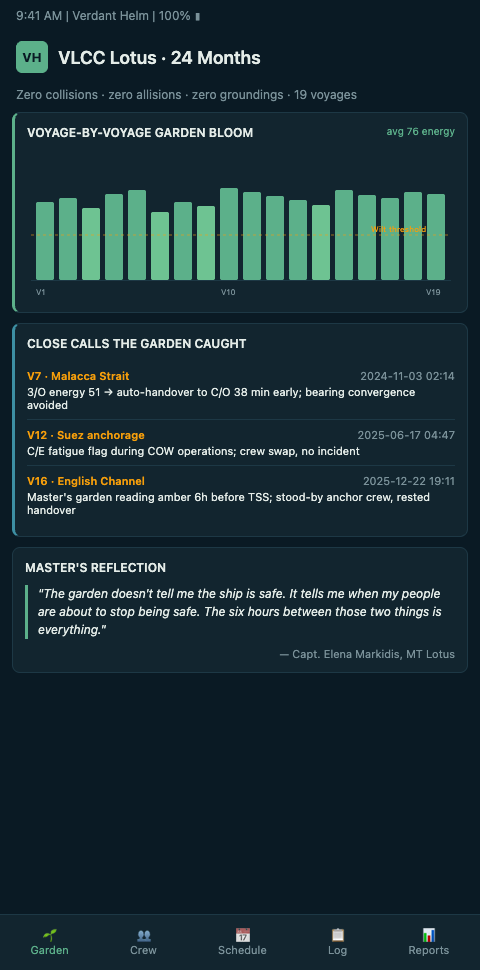
What the garden saw across the first Arabian Gulf to China voyage of year one was a consistent wilt in the 0400-0800 perennial on voyage day six. The Chief Officer was legally rested. The garden said the physiology was not. The Master used the view to schedule himself onto the 0600-0700 hour of that watch for the rest of voyage one, nominally to review passage planning for the Malacca entry, functionally to keep a second set of eyes on the traffic dense part of the watch. The pattern held. By voyage three the Master had adjusted the Chief Officer's in-port sleep window and the day-six wilt had softened into day-eight wilt, which the voyage plan absorbed before the Singapore Strait TSS entry.
Across year two, the garden surfaced a second structural signal the Master had not anticipated. The Second Officer on the 1200-1600 watch showed a narrow bloom window on voyages that included a Fujairah bunkering rendezvous. Bunker-call anticipation on a VLCC is a cognitively loaded window; the officer was compensating with caffeine on the watch before the bunkering and paying for it on the watch after. The garden tend at the 1600 handover was thin on six consecutive voyages. The Master restructured the pre-bunkering brief to land on the 0800-1200 watch instead, and the thin-tend pattern resolved inside two voyages.
A third pattern emerged around the cadet and the two ABs on lookout. Annuals take longer to establish than perennials, and the garden showed that the cadet's annual wilt-and-bloom pattern was not stabilizing through the normal voyage one establishment window. The Master initially read this as a training issue and asked the Chief Mate for an extra bridge-familiarization round. The garden data over voyage two showed that the pattern was actually a caffeine-timing issue; the cadet was eating on the 1200 watch rather than the 0800 watch, with downstream effects on the 2000-2400 watch performance. A two-sentence correction on meal timing reshaped the pattern inside four watches. The Chief Mate noted that no standard bridge-team training module would have surfaced the issue because the rest-hour log and the training checklist both registered as compliant.
A fourth pattern showed up in anchor watches. This VLCC waited on the Fujairah anchorage twice per voyage and on the Chinese coastal anchorage once per voyage. The garden showed that anchor watch on the 0000-0400 window produced a deeper wilt than a corresponding 0000-0400 sea watch, even though the officer on anchor watch was nominally less occupied. The Master attributed the difference to the cognitive load of maintaining anchor watch discipline with traffic and bunker-barge activity in the anchorage, which the rest-hour log simply did not capture. Over eight anchorage cycles, the Master began pruning post-anchor-watch voluntary overtime on the officer coming off anchor watch, and the following-sea-watch bloom recovered on schedule. Small interventions, visible only because the garden made them visible.
Advanced: the oil-major view and what it took to reproduce
Two years is not a fluke and it is not yet a trend. It is a case. But the case had enough structure in it that the operator submitted it as part of their OCIMF SIRE 2.0 packet at renewal and the inspector used the garden telemetry as supporting evidence for the operator's bridge-team-management program. The INTERTANKO BRM/BTM guidance is explicit that BTM is not just a training module; it is bridge procedures, passage planning, and team behavior lived out on the bridge. ISGOTT 6 is the operating baseline that oil-major vetting inspectors read against. INTERTANKO's guidance library supports the same case. Garden telemetry sits on top of all of those as instrumentation, not as a replacement. It also gives a VDR-adjacent evidence trail that P&I guidance on collision preparedness and VDR evidence would recognize.
The reproducibility question matters. This was one VLCC. The owner is now instrumenting nine more. The pattern they are watching for is the voyage-day-six wilt on the 0400-0800 perennial across different Masters, trades, and cargo mixes. If it holds, it becomes a fleet signal rather than a ship story. One of the early signs pointing to reproducibility is that the same wilt signature appeared on the sister ship's first instrumented voyage with a different Master and a different Chief Officer, on the same AG-China rotation. Skuld P&I's published claims data shows the midnight-to-eight watch band producing a disproportionate share of VLCC collision and contact claims; West of England's annual loss-prevention report draws the same line on bunker-call windows. If the garden can anticipate a wilt that the P&I claims data confirms is a real loss driver, the reproducibility argument becomes a commercial one as well as a safety one.
The container fleet rollout across 120 vessels shows what happens when this kind of case is reproduced at liner scale. The ULCC and VLCC watch-cycle fatigue profiles expose the aggregated curves that each VLCC story is a sample of. Offshore teams have seen similar outcomes; the zero-LTI-year semi-sub case is the rig-side analogue of this tanker case.
Verdant Helm did not sail this VLCC. The Master and the Chief Officer did. But the garden let them see cognitive debt building where their rest-hour log could not, and it let the Master intervene without singling out his Chief Officer or making it a disciplinary conversation. That is what a garden is for. If you are a VLCC or ULCC Master, fleet DPA, or vetting superintendent with a two-year safety case you would like to instrument rather than hope into existence, we will sit with you and walk through how a single-ship case becomes a fleet signal. Bring the voyage pattern and the bridge-team composition; we will show you what the garden would see on voyage one.