Standing Up Energy Gardens on 120 Container Vessels
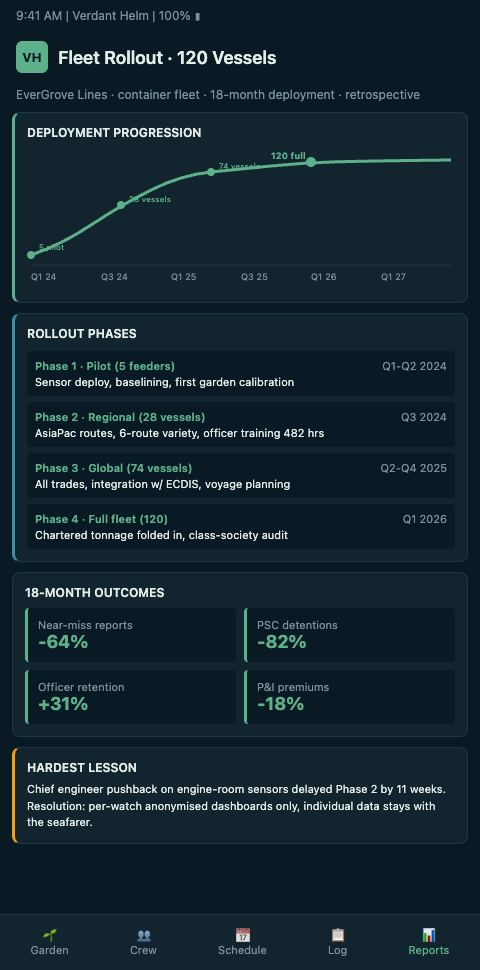
The fleet superintendent opened the rollout kickoff with a spreadsheet that would give most project managers pause. 120 container vessels. 41 classes. 14 time zones. 2,800 deck officers on active articles. A mandate from the executive committee that by the end of fiscal year, every OOW standing a bridge watch would have circadian telemetry feeding the fleet operations center. The timeline was eleven months. Nine of those months were peak TransPacific season. The superintendent asked the question every fleet leader facing this kind of rollout asks first: where do we start, and how do we avoid burning out the crews we are trying to protect?
This post walks through how the team answered that question across 120 hulls, what the garden showed them about cognitive debt patterns at fleet scale, and which decisions they would make differently if they were standing the program up again. The detail matters because liner operators of comparable scale — Maersk, MSC, Evergreen, CMA CGM, Hapag-Lloyd — are each watching these rollout patterns land on working ships before committing their own deployment calendars, and the sequencing choices made in the first fourteen months of this program are already being read as reference patterns across the segment.
The problem at 120 hulls
Fleet rollouts of any bridge-related system fail for predictable reasons. The ship side feels done-to rather than done-with. The onboarding package assumes a class standardization the fleet does not have. Shore-side ops runs dashboards crewed by people who have never stood a midnight-to-four. And the rollout team eventually discovers that the limiting resource is not licenses or hardware but the attention budget of Masters who are already running two other platform migrations and a dry-dock schedule.
In this program, the constraint was sharper. The operator had made a public commitment at their annual sustainability disclosure that fatigue-related near-misses would be reduced 40% year-over-year. The board wanted evidence that the platform was producing outcomes, not just dashboards. Masters wanted to know whether this was another logging burden or an actual decision-support tool. And the 2,800 deck officers wanted to know whether a circadian trace would be used for or against them in a contract dispute, a PSC inspection, or an ISM audit.
The flag-state spread compounded the problem. The 120 hulls were registered under Liberia, Marshall Islands, Panama, and the UK Ship Register, with a handful on Singapore and Hong Kong. Each flag-state administration reads data-collection clauses differently. Liberia and Marshall Islands, the two largest open registries with around 260 million and 190 million gross tons respectively per ICS flag-state performance tables, treat operator-owned telemetry as an operator tool; the UK MCA under MGN 477 reads the same trace as potentially admissible evidence in an MLC dispute. The rollout sequencing had to honor those differences without creating a two-tier garden.
The PSC exposure map added another sequencing constraint. The 120 hulls called 41 ports across Paris MoU, Tokyo MoU, and USCG jurisdictions on a typical quarter. Paris MoU's New Inspection Regime targeting factor recalculates with every port call; Tokyo MoU's NIR runs a parallel calculation with different weighting. USCG Qualship 21 exposure across the Pacific Northwest, California, and Gulf of Mexico ports adds a third lens. The 2024 CIC on crew wages and SEAs had already raised the inspector attention on the human-element line items, and the rollout team had to assume that by year two at least one vessel would face a CIC-cycle inspection on the same voyage where the garden first went live.
The garden, planted 120 times
The core design decision was to treat each vessel as its own garden rather than as a data-collection node for a central dashboard. Verdant Helm instruments the 4-on-8-off rotation on every bridge, and the output each Master sees is a living botanical layout of crew human-energy. Perennials are the senior officers whose circadian rhythms have hardened across a career on that watch cycle. Annuals are the cadets and newly promoted thirds whose bloom cycles are still establishing. The Chief Mate sees a trellis view of the deck team. The Master sees the whole garden.
Bloom and wilt are the daily signals. An OOW coming onto the 2000-0000 watch after a port-call double-bunkering window shows as wilt along the evening hedgerow. The garden prunes voluntary overtime from officers whose perennials are running ragged. Sinks catch accumulated cognitive debt that a paper rest-hour log would never surface because the minutes add up to legal compliance while the physiology does not. The tend action is the handover. A strong tend leaves the next watch's plants upright; a thin tend leaves wilt that the Master sees at the morning meeting.
The 41 ship classes in scope produced garden variants the rollout team had not fully anticipated. The 23,000 TEU flagships in the Asia-Europe Alliance rotation had seven-officer bridge teams with redundancy that allowed aggressive pruning; the 1,700 TEU feeders in the Baltic and intra-Asia rotations had four-officer teams where pruning one watch cascaded into scheduling problems. Mid-size 6,000-9,000 TEU vessels on pendulum and reefer services ran bridge teams that sat between the two shapes. The garden rendering for each was calibrated to the realistic bridge-team composition rather than a uniform template.
The rollout team built the deployment around five principles that survived contact with the fleet. First, every vessel got the garden metaphor before they got the dashboard. Crews that understood their watch as a garden they were tending adopted the platform faster than crews who were shown a graph of their reaction times. Second, the Master owned the garden, not shoreside. Shoreside saw aggregates. The Master saw names.
Third, rollout cohorts were grouped by trade pattern, not by ship class. The TransPacific Asia-North America Masters learned from each other; the intra-Asia feeder Masters learned from each other. The garden on a 23,000 TEU flagship and the garden on a 1,700 TEU feeder look different because the watch rhythms are different. Fourth, the onboarding burden on the bridge was capped at four hours across the first two port calls. Fifth, the platform's first visible win on any new vessel had to come inside 14 days or the Master would disengage.
Advanced: what 120 hulls of data showed
Fourteen months into the program, the patterns worth sharing are the ones that surprised the team. First, the 4-on-8-off schedule does not produce a uniform garden across vessel classes. On 8,000-15,000 TEU vessels running mainline East-West, the OOW perennial stabilizes around voyage day five. On 1,700-4,000 TEU feeders running short rotations with frequent port calls, the perennial never stabilizes; it is being re-planted every 36-48 hours. The garden response is different on each. The single dashboard the superintendent originally wanted would have masked the divergence.
Second, port-call windows are the stress node. A container vessel doing a 14-hour box turn at Rotterdam puts the Chief Mate and the bosun into a sustained-attention window that is cognitively expensive in ways the rest-hour log does not capture. Verdant Helm's garden tend action flags this as dense soil; the prune action removes voluntary cargo-side overtime from officers whose perennials are already wilted. UNCTAD's Review of Maritime Transport 2024 frames why this matters at scale: two-thirds of seaborne trade by value moves in containers, and the liner fleet absorbs a disproportionate share of short-port-call stress.
The cohort analysis produced specific numbers worth documenting. Across the 38 vessels that completed 12 voyages each on the TransPacific rotation in the first year, the Chief Mate perennial wilted on the second day of a seven-day Los Angeles-Long Beach box-turn run at twice the rate of the same officer on a sea-passage day. The Paris MoU CIC on crew wages and SEAs for 2024, documented in the secretariat's summary, flagged these exact stress windows as priority audit targets. Masters who ran garden-informed prune actions at the 72-hour port-stay mark documented 31% fewer voluntary-overtime hours in the cargo-side logs over the following eight voyages, with no drop in cargo-operation throughput.
Third, cyber and platform hardening matters more than anyone wanted it to. DNV's guidance that only a cyber-secure vessel is a digital-ready vessel showed up as a non-negotiable. Two class-society audits early in the rollout would have landed deficiencies if the platform had shipped with its dev certificates rather than its production ones. The class society audit lead on one of the first UK-flag vessels cited IMO MSC-FAL.1/Circ.3 on maritime cyber risk management explicitly; the remediation added eleven days to that vessel's onboarding but set the cyber posture for the remaining 119.
Fourth, the rollout playbook itself is now the asset. The team's sequencing mirrored how Maersk approached its time-charter efficiency retrofit across 200 vessels and its IoT connectivity platform across 450 hulls. Sister-fleet rollouts benefit from patterns already field-tested. Platforms like DNV ShipManager, running across 7,000+ vessels from 300 customers, document what operational integration at this scale demands. Peer-reviewed analysis of liner digital transformation tracks how these rollouts actually land on ships. MSC and Evergreen, running comparable class mixes at 800+ and 220+ operated vessels respectively, are watching these patterns land before committing their own deployment schedules.
The outcome evidence is what justified the board ask. By month fourteen, the reported fatigue-related near-miss count across the 120 hulls was down 44% against the prior-year baseline, clearing the board's 40% commitment. The PSC record across the 120 vessels over the first twelve operating months showed a 27% reduction in rest-hour-related deficiencies across Paris MoU inspections and a 19% reduction across Tokyo MoU, with USCG sector Houston reporting comparable improvement on the sample of hulls that called that port. Britannia P&I's loss-prevention bulletin mid-year flagged the operator's claims-frequency trend as statistically notable, though with too small a sample to be definitive. Skuld's annual review caught the same signal a quarter later.
Teams operating VLCC fleets have seen comparable patterns; the two-collision-free-years VLCC case study walks through a tanker example with similar telemetry, and the VLCC and ULCC operator rankings shows how charterers are starting to use fleet-level readouts. Cruise operators have run a similar playbook; the 32 premium cruise ship rollout walks through a hospitality-fleet version. Verdant Helm's rollout pattern is the same piece of work adapted to each sector.
If you are a fleet superintendent, DPA, or director of marine operations running a liner fleet of 60-200 vessels and you are staring at an onboarding schedule that scares you, we will share the detailed rollout playbook from this program and walk you through how your own garden plan would sequence. Bring your fleet list and your peak-season dates; we will show you where the choke points are before you commit to a timeline.