Rolling Out Energy Gardens Across 32 Premium Cruise Ships
The Premium Fleet Rollout Problem
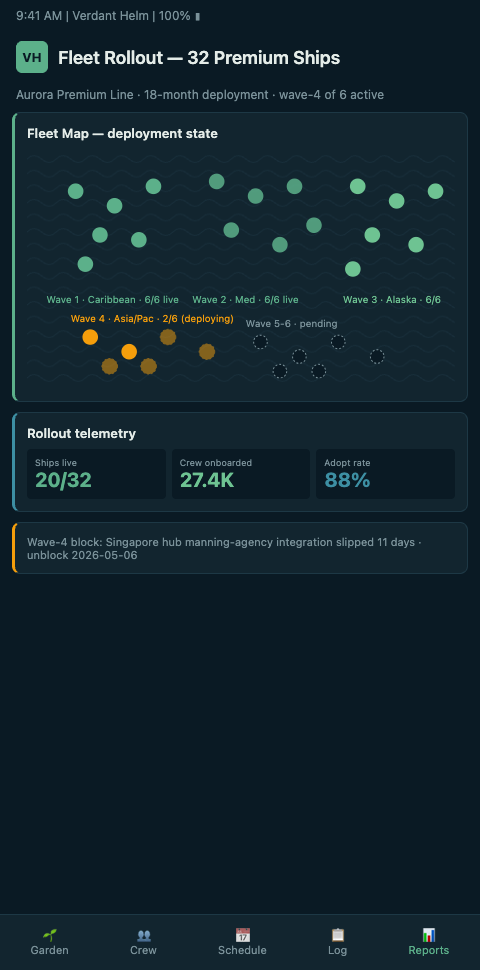
A premium cruise group signed a 32-ship deployment contract in early 2024. The kickoff slide deck promised an 18-month sequence: four Mediterranean ships in the first cohort, then Caribbean, then Alaska, then Asia-Pacific. The Hotel Directors on the first four ships had been lobbying for fleetwide emotional-labor telemetry for two years. Their CVP of Hotel Operations had finally agreed. The shoreside welfare office in Miami had been redesigned to receive garden telemetry and route recovery interventions back to each ship.
Six months later, two Caribbean megaships had quietly unwound. The dashboards still showed their stateroom attendant rosters, but nobody opened them. The Lido and dining venues were back on the spreadsheet rotation the Assistant Hotel Directors had maintained since 2018. NPS on those two ships had not moved. The Hotel Directors said the system "did not fit the shipboard rhythm" in their weekly regional calls. One ship's welfare officer stopped logging entries after week nine. The other never moved past the initial training cohort.
The problem was not the tool. CLIA data shows the luxury cruise segment tripled to 97 ships between 2010 and 2024, and Royal Caribbean's Icon-class program alone locked in five megaship builds plus a seventh option, per Seatrade Cruise coverage. Premium brands are adding tonnage faster than their rollout playbooks can adapt. When emotional-labor software lands on a fleet that has been scaling through acquisition and new builds, the first four ships are almost always easier than ships five through thirty-two. The first-cohort Hotel Directors have volunteered. The later-cohort Hotel Directors have inherited.
The failure mode on those two megaships was instructive. Neither Hotel Director had been part of the kickoff cohort. Both had inherited the system from a predecessor who moved to a shoreside role between ship cycles. The handover had been forty minutes on a turnaround day. The cabin steward leads had never been trained at all. One of the two ships had also absorbed a merged cast-member team from a retired sister ship, which doubled the training debt without doubling the training budget. The second-order consequences showed up in the quarterly review: two ships missing their retention targets by 8-11 points, travel-agency NPS commentary flagging "inconsistent stateroom service" on both hulls, and the brand's premium-tier positioning getting quietly questioned by the CVP's board.
The Botanical Garden Fleetwide Blueprint
Think of the 32-ship deployment as 32 separate gardens sharing the same seed stock and greenhouse methods but growing in radically different climates. A Mediterranean ship doing seven-day itineraries with heavy European repeat guests is a temperate perennial bed. A Caribbean megaship doing four-day Nassau loops with first-time cruisers and a packed Lido is a tropical glasshouse running at full humidity year-round. An Alaska ship running fourteen-day expedition itineraries is an alpine garden that only blooms for four months. An Asia-Pacific ship positioning for a Yokohama-Shanghai repositioning in shoulder season is a transplant bed that needs different tending again.
Verdant Helm's fleetwide rollout model stops pretending the same configuration works across all 32 ships. Each garden keeps the same underlying plant taxonomy — the same wilt signals for stateroom attendants, the same bloom markers for maître d' teams, the same perennial metrics for cast members holding guest-facing roles night after night. But the tending calendar is local. The Caribbean glasshouse prunes harder on embarkation day because the turnaround cycle is brutal, with 2,100 crew processing a full guest rotation and a reprovisioning window compressed into nine hours. The Mediterranean bed tolerates longer bloom phases because the itinerary lets crew breathe between Civitavecchia and Barcelona. The Alaska alpine garden runs its four-month season at controlled bloom intensity because the crew know recovery is seasonal, not in-contract.
The first four Mediterranean ships looked like they validated a single playbook. The fleet rollout lead duplicated that playbook to the Caribbean cohort and watched two ships quietly stop using the garden. The postmortem, borrowed from Management of Change protocols standard in marine operations, surfaced the real issue: a fleetwide MoC policy was never issued. The system had been introduced as a tool upgrade rather than a procedural change, so when the first Hotel Director rotated off, there was no document binding the incoming Hotel Director to keep tending the garden. The Filipino cabin steward leads — many of whom had spent six or seven contracts on the same hull — knew the garden worked, but they had no authority to force the new Hotel Director to adopt it.
The playbook rewrite enforced three changes. First, every Verdant Helm rollout is now tied to a formal MoC document signed by the CVP of Hotel Operations, the ship's Captain, and both the outgoing and incoming Hotel Director on any handover. Second, the cabin steward leads and dining-venue managers get two hours of hands-on training during every turnaround day, not just at initial install, and the training log travels with the ship rather than the person. Third, the fleetwide rollout timeline added a four-week "settling" phase per cohort before moving to the next regional group, drawn from MIGSO-PCUBED's change management research on team-wide deployment showing that team rollouts beat individual ones only when lessons feed forward. During settling, the shoreside welfare office runs daily check-ins with each ship's welfare officer, catches procedural drift early, and ships the fix before the next cohort kicks off.
The Royal Caribbean digital transformation described in this NashTech case study is a useful counterpoint. That 60-ship mobile backend rollout succeeded because the shore-to-ship sync layer was designed before the ship-side apps. Verdant Helm's fleetwide rollout now follows the same sequence: the shoreside welfare team configures the garden first, then the ships plug in rather than the other way around. The sync layer carries the brand's emotional-labor standards — which guest-facing thresholds matter for a six-star butler versus a contemporary-brand cabin steward — so when a ship comes online, the garden already knows what bloom and wilt look like for that specific hull.
Advanced Tactics For Multi-Ship Rollouts
The 32-ship rollout produced four tactical lessons worth stealing for any premium fleet deployment.
Cohort sequencing by itinerary type beats sequencing by geography. The original plan grouped Mediterranean ships together because they were geographically proximate and shared a shoreside welfare office. The revised plan groups by itinerary pattern: seven-day repeat markets first, four-day turnaround markets second, expedition itineraries third. Crew rotate between ships of similar itinerary profiles more often than they rotate across geographies, and the garden travels with them when the itinerary pattern matches. A Filipino cabin steward moving from a Mediterranean seven-day ship to a Caribbean seven-day ship carries the same bloom rhythm; moving her to a four-day turnaround megaship inside her next contract breaks the rhythm and produces the exact mid-contract wilt that unwound the two Caribbean megaships.
Train-the-trainer needs a specific target: the cabin steward lead, not the Hotel Director. SpecTec's 2026 maritime fleet management guide calls adoption the biggest failure point in fleetwide software rollouts, and cruise is no exception. Hotel Directors rotate every 18-24 months, but cabin steward leads stay on a given ship for multiple contracts — often 6-10 contracts across five or six years. Training them makes the garden durable across Hotel Director handovers. The counterfactual is visible on those two Caribbean ships: when you skip the cabin steward lead training, you get a garden that unwinds the moment the Hotel Director changes.
Regional welfare offices need a shared review cadence. After cohort one, the rollout added a biweekly cross-cohort review where Mediterranean, Caribbean, and Alaska welfare leads compared garden health signals. The conversation surfaced patterns no single ship could see — like the way CLIA's luxury growth to 97 ships creates brand-level staffing pressure visible only in fleetwide aggregate. Mediterranean ships were absorbing crew who had been rotated off struggling Caribbean ships, which meant the Mediterranean bloom numbers were flattering because the most resilient crew were concentrated there. The cross-cohort review caught the distortion before it produced misleading fleetwide conclusions.
Finally, the unwind playbook matters. When a ship's garden starts drifting, the regional welfare lead now has 14 days to either re-engage or formally pause the deployment on that ship. Two months of quiet non-use had destroyed the trust on those original Caribbean megaships. A formal pause preserves it.
The pause triggers a structured re-engagement sequence — a shoreside visit from the welfare team, a refreshed training cohort, and an MoC reissue — rather than a quiet decay that no one is accountable for. The same pattern shows up in Niche 1's North Sea drilling rigs, where the 14-rig North Sea rollout post documents how drill crews needed even tighter MoC binding across rig handovers.
What Premium Cruise Operators Should Do Next
If you are a Hotel Director or Cruise HR leader evaluating a fleetwide rollout, start by writing the MoC policy before writing the purchase order. The megaship NPS postmortem shows what disciplined deployment looks like when the policy is in place from day one.
The cruise brand emotional-labor scorecards piece explains why the scorecard regime will make unwound deployments increasingly visible to travel agencies and recruiters. Schedule a Verdant Helm rollout review with your CVP of Hotel Operations and your flag-state MoC lead before the next newbuild enters your fleet. The premium segment is adding hulls faster than playbooks can scale, and every ship that launches without an emotional-labor garden is a future postmortem waiting to happen.
Before the review, pull the last four Hotel Director handovers across your fleet and ask three questions. How many hours did the outgoing director spend walking the incoming director through the garden state. How many of the cabin steward leads and F&B venue managers were trained as part of that handover. What was the elapsed time between the old director's last dashboard login and the new director's first. If any of those numbers look thin, the handover is the weak point the rollout will eventually fail through, and it is cheaper to fix before the next cohort begins than after.
Cruise HR Leaders who institute a formal 12-hour garden-state handover between Hotel Directors — including a joint review of the preceding four voyages' bed trajectories and rotation decisions — report that the continuity effect outlasts any other rollout investment. The garden does not travel with the director; it travels with the ship. Making that explicit in writing, and in the Management of Change policy, is the work that the first-cohort Mediterranean Hotel Directors had not done and that the Caribbean megaship unwind ultimately paid for.