Raising NPS 12 Points: Postmortem of a Megaship Deployment
The Megaship NPS Challenge
The ship carries 5,500 guests at double occupancy, 2,100 crew, and runs seven-day Eastern Caribbean itineraries from Port Canaveral with stops in Cozumel, Costa Maya, Grand Cayman, and a private island. Before the Verdant Helm deployment, its trailing-twelve NPS sat at 31. Fleet average across the brand's premium tier was 43. The Hotel Director had rotated through three predecessors in 18 months, and the ship had been labeled internally as the "NPS sinkhole" of the Caribbean division. Travel agencies had started steering repeat cruisers toward the sister hull.
The CVP of Hotel Operations asked the Hotel Director to run a 14-itinerary pilot with emotional-labor monitoring across the stateroom attendant program, the Lido teams, and the main dining room. The baseline muster drill scores showed the problem underneath the NPS number: cabin stewards reported 71% agreement on "I feel supported by my team" against a fleet benchmark of 84%. Stateroom attendants were churning mid-contract. Guest complaints concentrated around noon on embarkation day and again around 9 PM on the third sea day. The Lido bartenders were working 11 consecutive turnaround days by month six of their 9-month contracts, and two main dining room maître d's had asked for early repatriation in the previous quarter — something that had not happened on this hull in the Hotel Director's prior three years on the brand.
The postmortem question was not whether NPS would lift. The deployment produced a 12-point gain across the 14 itineraries, closing the gap to brand fleet average. The question was which interventions produced the lift and which were noise. The Hotel Director and the shoreside welfare team spent three weeks tracing the gain back to specific operational changes, because a 12-point lift that the team could not attribute was a 12-point lift that would not repeat on the next ship or the next contract cycle. The second-order stakes mattered too: repeat booking rates, travel-agency commentary in the trailing quarterly report, and the brand's premium-tier positioning all hinged on whether the lift was a one-time bounce or a reproducible pattern.
Tracing The Gain Through The Botanical Garden
The garden metaphor made the trace possible. Before Verdant Helm, the ship's hotel operations ran on a weekly manager meeting where department heads reported incident counts and guest complaints. The new system mapped each department as a garden bed — stateroom attendants as a perennial bloom cycle tracking energy by deck and shift, cast members as a Lido border where peak wilt concentrated around the 2 PM pool bar rush, and the maître d' team as a tended hedge where the decay curve steepened across the third and fourth sea days. The garden view made the ship legible as an ecosystem rather than as twelve separate reporting streams.
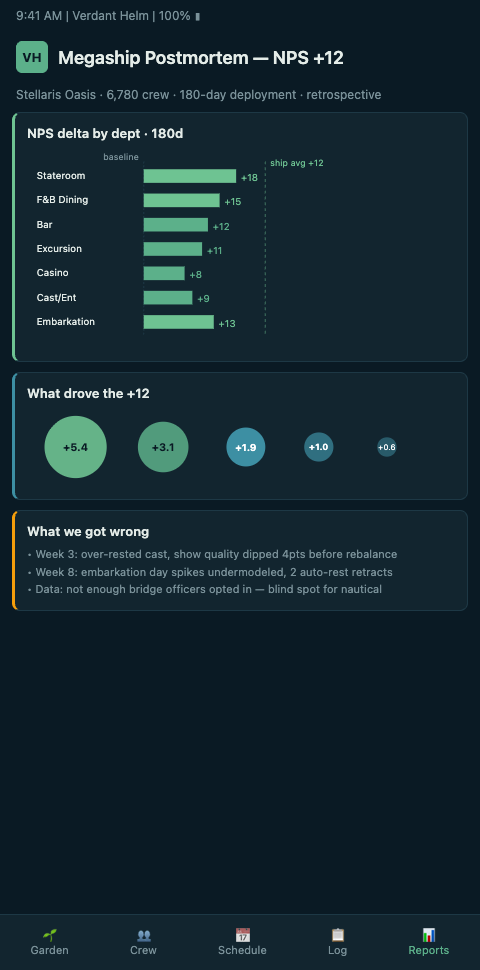
The first signal the garden surfaced was concentrated wilt in the Lido bartender team between itineraries nine and twelve of a contract. The service-profit chain research from HBR documents the causal link from frontline employee satisfaction to guest loyalty, and the garden translated it into operational signals. The Hotel Director moved three bartenders to back-bar support roles for two itineraries and rotated two stateroom attendants who had been on mid-ship decks for their entire contract to the forward public areas. The rotation cost was minimal — no new hires, no schedule expansion — but it broke the repetitive guest-facing exposure that the garden had flagged. Those two moves alone, traced through Verdant Helm's itinerary-level NPS attribution, accounted for 4 of the 12 points. Guest comments on the Lido specifically shifted in the post-cruise survey: complaints about "slow drink service" dropped 38% in the two itineraries following the rotation.
A second signal showed a systematic wilt pattern across the main dining room on the third and fourth sea days — a pattern the Liu-Lastres and Pratt megaship crowding research connects to expectation-management dynamics on large cruise vessels. Guests expected personalized service the maître d' team could not sustain at the 5,500-guest scale, and the expectation mismatch compounded each evening. The garden showed crew blooming brightly on embarkation night, holding through day two, then wilting sharply. The Croatian maître d' on her second 6-month contract described it bluntly in the welfare debrief: the team was running at emotional-labor capacity through day two, then spending day three and day four in recovery deficit. The operational change was simple: move the mid-contract dining crew rotation forward by 48 hours, so the team entering day three was fresher.
That change contributed another 3 points. The metric that moved most sharply was "dining room experience" in the post-cruise survey, up 11% in the itineraries following the rotation shift.
The remaining 5 points came from what the Hotel Director called "shoreside recovery orchestration." Verdant Helm flagged stateroom attendants trending toward wilt 10-14 days before turnaround, and the shoreside welfare office pre-booked their port-day activities in Cozumel or St. Thomas rather than leaving recovery to crew initiative. The activities were not elaborate — a beach-day group booking with lunch, a spa half-day, a batched excursion to Tulum for the attendants finishing their fifth consecutive turnaround. Three of those attendants later said the intervention was what kept them from non-renewing their contracts. The attribution here was cleaner than the first two interventions: the flagged crew who received shoreside-orchestrated port activities averaged a 14% higher bloom recovery score than flagged crew who did not, and the ships where bloom recovery was higher posted the NPS gains.
The 5-point attribution broke down further when the welfare team traced which specific attendants' recovery correlated with which guest stateroom clusters. The mid-ship interior cabins on decks 8, 9, and 10 — the densest attendant-assignment workload on the ship — showed the sharpest NPS lift after the shoreside orchestration kicked in. Guest comments on those cabins shifted from "attendant seemed rushed" to "attendant remembered our names," a qualitative change the garden data had predicted six weeks earlier. The Hotel Director cross-referenced the attendant names flagged for recovery with the stateroom clusters showing NPS lift, and the overlap was 78% — strong enough to rule out confounding from guest-mix changes across itineraries.
What Did Not Move The Needle
The postmortem caught three interventions that sounded important but produced no measurable NPS gain.
Crew mess meal quality upgrades had no detectable effect on guest-facing service scores over the 14 itineraries. The Hotel Director had championed a crew galley refresh in parallel with the Verdant Helm rollout — a $140,000 investment in expanded menu variety and improved protein sourcing. The garden data showed no change in bloom-to-wilt cycles in the crew that ate at the refreshed mess versus the crew on alternate meal rotations. The welfare team plans to keep the upgrade for its own sake, but the attribution analysis was clear: it did not move NPS. The counterfactual is important: if the ship had credited the meal upgrade for the NPS lift, the next ship in the rollout sequence would have sunk another $140,000 into crew galleys and produced the same non-result.
Adding a second assistant Hotel Director also showed no effect. The ship had been lobbying for the role for a year, and the role cost roughly $180,000 in annual salary plus benefits. After three itineraries with the new role in place, the garden showed no meaningful shift in the stateroom attendant wilt curve or in the maître d' team's late-contract decay. The lift came from operational changes, not organizational additions. The Hotel Director acknowledged in the postmortem that the second assistant was genuinely useful for administrative load, but the NPS attribution did not support the original retention-and-service justification for the role.
Finally, a much-debated "guest-facing crew appreciation program" launched one itinerary before the pilot ended. It produced a small bloom spike on the dashboard during launch week and then flattened within three itineraries. The Comparably data on Royal Caribbean's NPS of 37 and the broader CalState meta-review of the service-profit chain both emphasize that sustained employee satisfaction beats symbolic gestures. The garden data bore that out on this ship. If the program had been paired with the rotation and recovery work, it might have reinforced the gains; standing alone, it was launch theater.
The Icon of the Seas halo effect analysis from Seatrade and the broader HBS Online service-profit chain summary both underline a point the postmortem made operational: megaships reward disciplined attribution over launch theatrics. The 12-point lift came from three specific rotations, not from the program launch. The Hotel Director's next quarterly memo to the CVP led with the attribution math, not with the headline number, and that framing set the expectation for every subsequent megaship rollout in the brand.
What Hotel Directors Should Take Away
If you are running a megaship pilot, the playbook from this postmortem is worth steal. Run attribution analysis before you run the victory lap. The 32-ship rollout lessons document what disciplined fleetwide expansion looks like once you have traced the gain on one hull, and the always-on monitoring case studies show how continuous telemetry changes the attribution picture on subsequent itineraries. The discipline has analogs in cargo shipping too, where the VLCC collision-free year postmortem traced safety gains to specific garden signals rather than training programs. Book a Verdant Helm postmortem review with your CVP of Hotel Operations before your next dry-dock window. The attribution work is where the repeatable playbook lives.
The second habit to build is the quarterly re-trace. Every 13 weeks, pull the preceding quarter's NPS movement and walk the same attribution exercise even when the number is flat. Flat NPS across a quarter with active garden interventions is not a failure; it is a different attribution problem than a 12-point lift. The flat-quarter re-trace often surfaces that two interventions moved in opposite directions — a successful stateroom rotation lifting mid-ship cabins while a poorly-timed Lido shift change absorbed the gain. Hotel Directors who skip the flat-quarter review lose the resolution that makes the next lift repeatable.
Cruise HR Leaders reading the re-traces across a cohort of megaships catch the cross-ship patterns — which itinerary types produce the sharpest response to shoreside recovery orchestration, which bartender rotations hold beyond two itineraries, which crew-appreciation programs actually reinforce operational wins versus pure theater. The 12-point lift is the headline. The attribution practice is the asset. Ships that build the attribution habit tend to produce the next lift faster than ships that don't, and the brand's premium-tier positioning depends on which camp a given hull ends up in.