Deploying Gardens on 14 North Sea Drilling Rigs
A Rollout That Started With One Defensive Toolpusher
The UKCS operator approved the 14-rig rollout in February 2025 after OEUK's annual dataset showed injuries had returned as the leading cause of North Sea medevacs, according to the OEUK Health & Safety Insight 2025. The fleet ran three jackups in shallow water, eight semi-subs in moderate depth, and three newer semi-subs drilling in up to 140 metres. The vice-president of drilling wanted a single welfare dashboard across all 14 assets by year-end.
Rig one was a 20-year-old jackup with a toolpusher who had rolled his eyes at every wellness initiative in living memory. The first installation meeting ran 75 minutes. He argued that his crew had managed fatigue through four decades of hitches without software and that dropped-object incidents were a supervisor problem, not a data problem. The project lead asked him to run it for 21 days and flag anything that felt like overhead.
On day 17, the same toolpusher called the project lead unprompted. The garden had shown a derrickhand's energy collapsing across three consecutive night tours — a pattern the toolpusher had genuinely missed because the man kept showing up on time and passing his JSA reviews cleanly. The derrickhand had been covering for a flu-hit colleague across four nights in a row. The toolpusher reassigned him for 48 hours and the garden recovered. That call changed the rollout's trajectory.
How a 14-Rig Garden Grows Across Nine Months
The botanical-garden metaphor is how Verdant Helm renders crew energy. Each crew member is a perennial in a bed, their energy visible as bloom or wilt. Shared tasks create sinks where energy pools low. When an OIM opens the rig dashboard, they see 100-plus perennials grouped by crew, watch bloom patterns across the hitch, and identify beds that need tending before they collapse into safety cases.
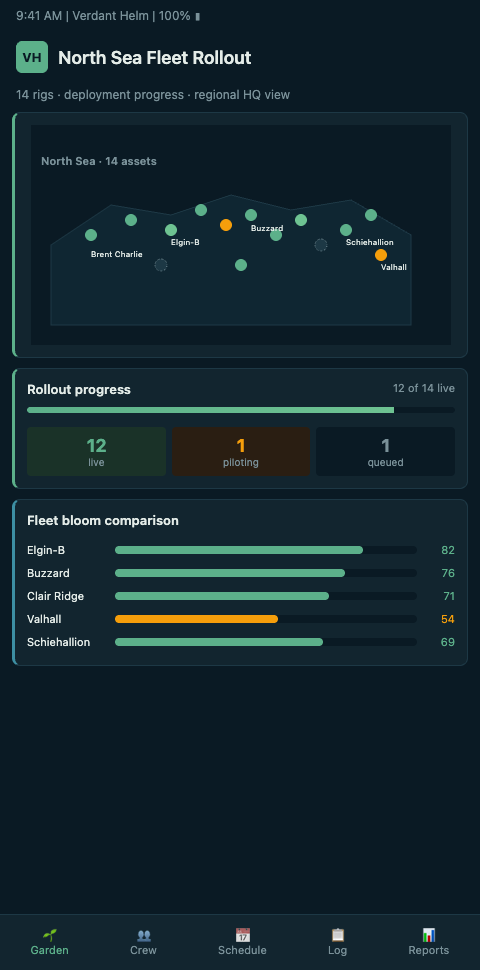
Rolling 14 gardens in sequence meant accepting that each rig starts as raw soil. The operator's rollout team took the following staged approach.
Weeks 1-6: Three jackups. The rigs closest to shore and simplest operationally were first. One garden per rig, 60-80 perennials each, OIM training on bloom-vs-wilt interpretation inside two days. Shift captains learned to check the bed view before starting their own watch. By the end of week six, the three jackups were generating daily handover notes that referenced garden trends alongside production data.
Weeks 7-18: Six older semi-subs. The biggest rigs, the most politically sensitive, and the ones where the drilling supervisors pushed back hardest on the overhead claim. The rollout team addressed pushback by embedding one wellness analyst per rig for the first 14 days, letting the analyst absorb the interpretation work while the OIM learned the dashboard. Two drilling supervisors asked the analyst to leave on day three; one requested the analyst stay for a second hitch.
Weeks 19-30: Three newer semi-subs. Deepwater rigs with more permit-to-work complexity and more bridging document friction across the operator-contractor boundary. The gardens surfaced a pattern visible nowhere else: BOP test days pulled energy from crews that were already low heading into those tests. The head of drilling used that pattern to renegotiate BOP test scheduling with two contractors.
Weeks 31-40: Two jackups returning from warm stack. The hardest rollouts of the lot, because returning crews carry unfamiliar fatigue patterns that the first hitch cannot reveal. The rollout team ran a two-hitch baseline on each rig before enabling HSE-facing features.
The Fleet-Wide Signals That Only Appeared at Rig 14
Nine dropped-object incidents were reported across the operator's fleet in the 12 months before rollout. The Energy Voice North Sea HSE report documented 175 dangerous occurrences across UKCS installations in a 12-month period, giving the project lead a baseline against which to judge post-rollout results. But the single-rig garden view was not what changed the numbers. The fleet view was.
With 14 gardens running, the operator's wellness analyst spotted two patterns invisible at the rig level. First, crew-change days clustered on specific weekdays pulled energy across the entire fleet when helicopter weather forced delays, because delayed crew arrived at rigs where the outgoing hitch was already running past demob. Second, a specific contractor's roustabouts consistently showed lower bloom in the middle third of their hitches across four different rigs, suggesting the contractor's own onboard support was weaker than their safety statistics implied.
Neither signal was visible inside any single rig's garden. Both drove policy changes at the operator level. The North Sea Transition Authority licensing reviews now accept welfare telemetry summaries alongside production reports — something the operator pushed for partly on the strength of these fleet-wide findings. The Westwood UK Norway E&P Outlook 2025 suggests 10 UK exploration wells are expected in 2025, meaning fleet-level coordination matters more as drilling activity returns.
The Rig-Level Variation That Surprised the Rollout Team
Halfway through the rollout, the project lead built a rig-to-rig variance report. The finding that surprised the team most: rig-class did not predict garden-health as strongly as OIM tenure. Semi-subs with new OIMs (less than 18 months in the seat) showed consistent mid-hitch wilt across four consecutive hitches regardless of operational complexity. Jackups with long-tenured OIMs showed steadier bloom patterns even when drilling programmes hit unplanned complexity. The rollout team began pairing new OIMs with senior OIMs for the first three hitches after garden deployment, which closed the tenure gap by roughly half within one rotation cycle.
A second surprise: the two rigs with the most elaborate internal safety programmes before rollout showed the slowest garden adoption. The incumbent programmes created organisational resistance — OIMs and HSE leads framed garden data as overlapping with existing tooling rather than as complementary. The two rigs without elaborate programmes absorbed the garden faster because it did not compete with entrenched systems. The lesson: sequence rollouts from less-formalised rigs to more-formalised ones, not the opposite.
The third surprise was purely operational. Weather disruption affected the garden in ways the team had not modelled. When North Sea winter weather delayed crew-change flights by 72 hours across a four-rig cluster, the incoming crews arrived into gardens where the outgoing crews were already running three days past demob. The compressed handover period produced measurable wilt in the incoming crews during their first week, even before they had completed their own absorption. After the third such event, the rollout team built a weather-adjusted handover protocol into the standard rig playbook.
Advanced Tactics: What the Second Decile of Rollouts Gets Wrong
Most 10-plus rig rollouts stall in the third quarter, not the first. The team that gets three rigs running tends to underestimate how quickly the political friction compounds when 10 rigs are live simultaneously. Three tactics consistently separated the operator's successful rollout from stalled peer rollouts we compared against.
First, they staffed a permanent wellness analyst role from day one, not the last quarter. Rig-level OIMs do not have bandwidth to interpret garden trends for their own rig and participate in fleet calibration calls at the same time. The analyst role absorbs that second duty. The HSE UK offshore statistics show audit focus has shifted to installations that generate continuous signals, which means someone needs to own the signal.
Second, they allowed three rigs to delay by two hitches without penalty. A forced concurrent rollout makes laggard rigs feel scapegoated. The two-hitch grace let the slower OIMs ask questions the faster ones had already burned past, and it prevented one of the toolpushers — the same one who had called unprompted on day 17 — from becoming the rollout's unofficial mentor to five other rigs.
Third, they committed to a quarterly fleet review with the head of drilling present. Without executive attendance the rollout decayed into an HSE-department project. With the vice-president of drilling visibly using the dashboard on his own rig visits, the fleet adopted it as operational tooling, not overhead. Contractor OIMs adopted faster once they saw the same patterns the operator was looking at. The Step Change in Safety Human Factors workgroup offers rollout sponsors a UKCS-wide peer group that helped the project lead calibrate early decisions. For comparison with larger-scale fleet telemetry, see the rollout write-up for 450 offshore wind turbines.
Bringing Fleet Patterns Back to the OIM
North Sea OIMs and drilling supervisors running more than three rigs across a single operator should plan the rollout around the nine-month arc, not the first pilot. The fleet-wide signals — the crew-change weekday clustering, the contractor-level bloom patterns, the BOP-test energy pull — do not appear on rig one. They appear at rig 10.
For a deeper drilling contractor comparison lens, see how a garden-health ranking shapes drilling contractor benchmarking.
For a single-installation postmortem using the same methodology, the zero-LTI year on a semi-sub postmortem shows how one rig's trajectory compounds over 365 days.
Verdant Helm supports staged 3-6-5 rollouts with per-rig baselining. Book a fleet rollout scoping call with a drilling operations sponsor present — the nine-month arc works best when the head of drilling is in the room at quarter one.