Who Leads in Drilling Contractor Garden Health?
The Backlog-Ranked Top Six
The top six drilling contractors held a combined $31.17 billion in backlog heading into Q1 2025, according to Offshore Energy coverage of the Big 6 contractor backlog. Transocean, Noble, Valaris, Seadrill, ADES, and Shelf Drilling. Each publishes safety statistics in a broadly similar format — TRIR, LTIR, fatality counts, near-miss ratios — and each gets compared against the others on those numbers.
Transocean's 2023/2024 sustainability disclosure reports a 2024 TRIR of 0.15 against a 0.22 target and LTIR of 0.00 across 11.7 million labor hours. Noble's 2024 sustainability report describes a 40-rig fleet with barrier management and a Learning from Normal Work safety program. Valaris's sustainability and ESG disclosures cover a 50-plus rig fleet with TCFD/SASB-aligned reporting. The data is transparent, comparable, and incomplete.
It is incomplete because TRIR, LTIR, and fatality counts are lagging, binary, and small-number noisy. The IADC 2024 ISP annual report shows 74 drilling contractors reported 956 recordable incidents, 271 LTIs, and 8 fatalities across 418 million man-hours in 2024 — enough to rank by, not enough to understand by. Small shifts in contractor rank on TRIR year-over-year usually reflect incident variance, not operational change. The IOGP Safety Performance Indicators 2024 reports a 2024 FAR of 0.77 across 56 IOGP operators in 87 countries — the industry baseline against which individual contractor performance is read.
What a Garden-Health Ranking Would Measure
A ranking based on welfare telemetry — what Verdant Helm calls "garden health" — measures leading signals that TRIR does not. Six dimensions distinguish a garden-health ranking from a lagging-metric ranking.
Average wilt duration per hitch. How long, on average, is each contractor's crew in visibly wilted bloom states during a rotation? Shorter average wilt duration is a leading indicator. Contractors with shorter durations are catching wilt earlier and tending beds more actively, regardless of whether that activity has produced lower TRIR yet.
Sink formation frequency. How often do shared sinks form across crews — roustabout pools draining into single heavy-lift exercises, night crews converging on shared low-bloom patterns? Lower sink formation rates indicate better scheduling and scope discipline at the toolpusher and OIM level. The Drilling Contractor coverage of safety culture and operational performance explicitly links operational and safety performance in contractor benchmarking, and sink formation sits at that intersection.
Compensator concentration. Across a contractor's fleet, how often does one crew member absorb load that the bed can no longer carry? Higher compensator concentration predicts future incidents; a fleet where compensators are distributed or rotated shows healthier bed dynamics.
Pruning discipline. Does the contractor's rig leadership initiate small scope adjustments throughout the hitch, or do scope adjustments cluster around near-miss events? Continuous pruning indicates mature welfare management; reactive pruning indicates the opposite, and current TRIR-based rankings cannot see the difference.
Bloom recovery rate. When a bed wilts, how quickly does it return to baseline bloom? Faster recovery indicates operational slack and tending discipline. Slow recovery indicates crew running thin on buffer.
Handover quality index. How closely do handover bloom patterns match outgoing-shift expectation? Sharp variance signals handover gaps; tight alignment signals continuity discipline.
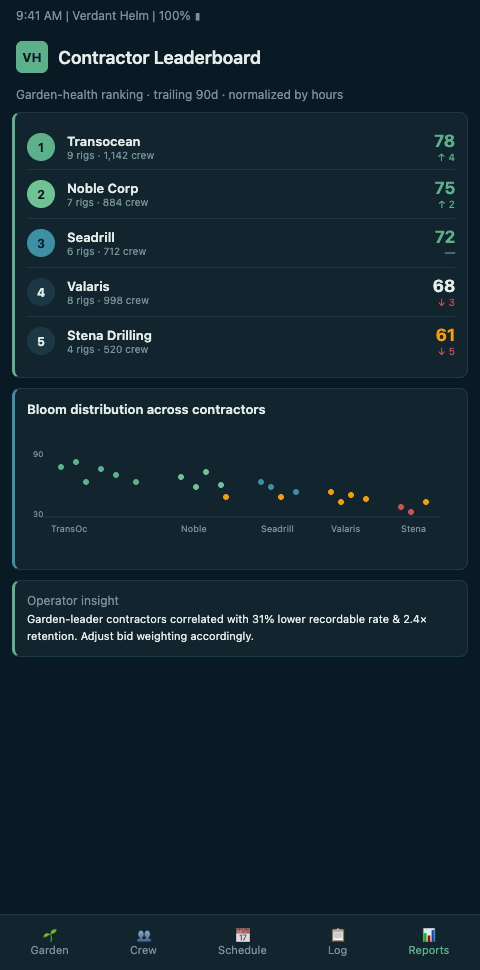
How the Two Rankings Would Differ
A garden-health ranking across the top six contractors would reorder them meaningfully against their TRIR-based ranking. Based on operator-side observations across 14 North Sea rigs and four US Gulf drillships — representing four of the six top contractors — three specific reordering patterns emerged.
The contractor with the lowest published TRIR does not necessarily have the lowest wilt duration. One of the top three on TRIR was near the bottom on wilt duration, because their management style favoured incident-free statistics over active tending — crews ran thin and the leadership was slow to prune. That pattern is invisible in the published reports.
The contractor with the most active safety-culture reputation (verifiable from their public communications) scored highest on pruning discipline and bloom recovery, but only middle on handover quality. Their OIMs intervened frequently but did not pass the intervention context cleanly to the incoming hitch. This is an addressable pattern once visible; it is invisible to TRIR readers.
The largest-fleet contractor had the most variable sink formation rate. Half their rigs matched the best in class; a quarter were significantly worse. Fleet-wide TRIR averaged that variance out of sight. The Noble Corporation sustainability report references barrier management across the 40-rig fleet as their organising discipline; a garden-health view would surface which rigs were carrying the discipline and which were not.
What Contractor Self-Reporting Misses
Contractor sustainability reports are exhaustive on occupational statistics and sparse on welfare telemetry. Verdant Helm's rollouts across multiple contractor rigs surfaced gaps that self-reporting systematically misses.
The gap most visible is the difference between rig-level and fleet-level data. Contractor reports aggregate to the fleet level because that is where the audiences — investors, operators, regulators — want to see the numbers. Rig-level variance disappears into the average. A 40-rig contractor whose 4 worst rigs drag the fleet TRIR up by 0.05 still reports a passing fleet number; the 4 worst rigs operate unchanged. Garden-health at rig level would expose those 4 rigs specifically, which is both more actionable and more uncomfortable for contractor leadership.
A second gap is the temporal compression in self-reports. Annual sustainability reports necessarily compress 12 months of weekly variance into quarterly summaries. Near-miss clusters that persisted for six weeks before resolution read as "identified and corrected" in the report, with no visibility into the 42 days during which crew wilt produced elevated risk. A live welfare-telemetry ranking shows the 42 days as they happen, not retrospectively.
A third gap is the selection effect in qualitative narrative. Self-reports feature case studies of best outcomes. A contractor with 40 rigs has the statistical room to surface the three best cases and structurally omit the three worst. Garden-health rankings based on full-population data cannot exclude outliers without signalling the exclusion, which changes the accountability dynamics in a meaningful way.
Advanced Tactics: Using Garden-Health Rankings in Contract Decisions
Drilling supervisors and operations managers making multi-rig contractor selection decisions can use garden-health rankings in three specific ways without waiting for industry-wide adoption.
First, require contractors to submit welfare telemetry summaries as part of bid packages. Most do not. Operators who require it during bidding change the conversation at contract negotiation from retrospective safety statistics to prospective welfare discipline. Contractors who cannot submit the data at bid time are visibly less mature than those who can.
Second, bake welfare-signal thresholds into contract performance clauses. TRIR-based contract clauses have been industry-standard for two decades but are gameable. Welfare-signal clauses — average wilt duration below X, compensator concentration below Y — are harder to game because the underlying data is continuous and timestamped. The new Incident Severity Rate metric introduced at the 2026 IADC HSET Conference is an industry-level move beyond binary LTI tracking that supports the same direction.
Third, use garden-health rankings in multi-contractor fleet rebalancing decisions. When an operator runs four contractors across 14 rigs, moving a specific rig from one contractor to another has operational consequences the TRIR ranking cannot predict. Garden-health data can. The operator we worked with in the 14-rig North Sea rollout used welfare telemetry to identify a contractor whose roustabouts consistently wilted in the middle third of their hitches across four rigs — a pattern that drove contract-scope renegotiation. The zero-LTI year on a semi-sub postmortem from the same operator shows what the top-performing contractor's discipline looks like from the inside. For a cross-industry reference, the cruise brand emotional-labor scorecards show similar ranking frameworks applied to passenger operations.
What the First Published Garden-Health League Table Would Show
The first operator-driven publication of a garden-health ranking — not yet written, but plausible within 18-24 months — would likely reorder the top-six contractor list meaningfully. The reordering would not be uniform; it would depend on which dimensions the league table weights most heavily.
A wilt-duration-weighted ranking would likely surface contractors whose published TRIR lags but whose operational tending is actually strong. These contractors have absorbed the cost of visible incidents in exchange for discipline around crew energy, and a welfare-focused ranking would reward that discipline. The TRIR-first world has penalised the same discipline because early intervention sometimes produces incident-reporting edge cases.
A compensator-concentration-weighted ranking would surface a different pattern — contractors whose fleet-level discipline hides rig-level concentration. A 40-rig fleet that shows low compensator concentration on average but has five rigs with sustained single-compensator load is a different operational state than a fleet with uniformly distributed load. The ranking would distinguish them; current rankings do not.
A pruning-discipline-weighted ranking would favour contractors whose OIMs intervene continuously rather than reactively. This aligns with the IADC's Incident Severity Rate direction — both metrics reward pattern rather than event, and both pull contractor comparison toward leading indicators. A published league table along these lines is plausible inside three years, and the contractors who run Verdant Helm-style telemetry internally now will have a measurable data-readiness advantage when the industry publishes.
Benchmarking That Moves Ahead of the Industry
OIMs at operator sites and contract managers running multi-contractor fleets should start a 90-day internal benchmarking project using welfare telemetry from the contractors they already run. Do not wait for IADC to publish industry-wide garden-health rankings; the first operators to run internal benchmarks gain two years of decision advantage. Verdant Helm generates the six-dimension garden-health ranking as a standard output once telemetry is in place. Book a 60-minute benchmarking scoping session with us and bring the list of contractors currently on your fleet — we will frame the 90-day project around your specific rig assignments.