Cruise Brand Emotional-Labor Scorecards Explained
From Environmental Scorecards To Labor Scorecards
The Friends of the Earth Cruise Ship Report Card has ranked 21 cruise lines and 243 ships on four environmental criteria since 2009. Travel agencies reference it when advising environmentally conscious cruisers. Industry analysts cite it when building ESG exposure models. Cruise operators complain about the methodology and simultaneously hire communications teams to move up the rankings. The scorecard has quietly reshaped how brands invest in emissions technology, because brand teams cannot afford to sit at the bottom of a rating travel agencies read.
The emotional-labor equivalent is coming. Sustainalytics' ESG risk rating on Royal Caribbean Group already includes social factors in its methodology. The Milken Institute Review's analytical overview of the cruise ship workforce frames the labor conditions comparison across brands. Travel agencies specializing in premium and luxury cruising are asking brands for their crew welfare data — and they are increasingly willing to steer clients away from brands that cannot answer. Recruiters placing hotel crew into brands are already informally ranking operators by what their repeat crew say about work conditions; the Filipino cabin steward network and the Croatian maître d' network both maintain shared reputation data that pre-dates any public scorecard.
The first drafts of formal emotional-labor scorecards are circulating now. They are not yet as polished as the environmental report card, but they follow the same pattern: operator-level methodology, ship-level data, published rankings, annual updates. Hotel Directors who have seen the drafts are asking their CVPs what the operator's garden data would produce if published in the new regime. The answer matters for recruiting, for travel-agency positioning, for ESG investor relations, and — on a longer horizon — for flag-state audit posture when port state control inspectors start referencing published scorecards in their inspection priorities.
What The Scorecards Measure
The emerging scorecards pull from four underlying dimensions the garden framework renders operationally. Each dimension has a measurable signal set that Verdant Helm captures continuously and that operators will eventually need to disclose at some aggregation level.
The first dimension is bloom sustainability — how well an operator's brand sustains crew emotional energy across a full contract. The ScienceDirect cross-level analysis of hotel emotional labor shows measurable differences across brand standards, and luxury brands that demand deep-acting emotional labor face tougher scorecard metrics than contemporary brands running surface-acting service. Verdant Helm's decay inflection data translates directly into the scorecard's bloom sustainability axis. A luxury brand whose butlers reach inflection at day 147 scores differently from a contemporary brand whose cabin stewards reach inflection at day 198, and the scorecard weights the comparison by role intensity rather than by raw day count.
The second dimension is wilt response — what an operator actually does when crew show signs of emotional fatigue. This is where the garden metaphor makes the scorecard legible. An operator that flags wilting crew and does nothing scores poorly. An operator that pre-books shoreside recovery, rotates shifts proactively, and visibly tends the bed scores well. The HBS Online service-profit chain summary provides the theoretical link from wilt response to guest-facing outcomes that scorecards convert into rankings. The scorecard methodology penalizes operators whose flagged crew receive no intervention within a defined window — typically 14 days — because the absence of tending is what produces the retention and NPS deterioration the scorecard is trying to surface.
The third dimension is sink exposure — where crew energy pools below recovery thresholds repeatedly across the contract. Sinks show up in specific departments on specific ships: the Lido bartender rotation on a Caribbean turnaround ship, the main dining room on a megaship doing seven-day itineraries with heavy repeat-guest expectation, the stateroom attendant mid-ship decks on ships where the interior cabin assignments carry the heaviest turnaround load. On a 5,500-guest megaship running four-day Nassau loops, the Lido bar sink forms almost every itinerary between 1 PM and 3 PM; that structural pattern gets flagged in the scorecard even if the individual bartenders rotate. The ScienceDirect research on hospitality aesthetic labor management frames how brand-level expectations create structural sinks the scorecard will penalize.
The fourth dimension is perennial retention — how well an operator retains crew across contract cycles. Contract renewal rates by role, by brand tier, and by itinerary type roll into this axis. The Milken Institute Review on cruise workforce conditions already documents the broad patterns that scorecards will make brand-specific. The scorecard does not just measure absolute renewal rates; it measures renewal rates against role intensity, because a luxury butler who renews is a stronger signal than a Lido cast member who renews, and the methodology accounts for that difference rather than treating all renewals as equivalent.
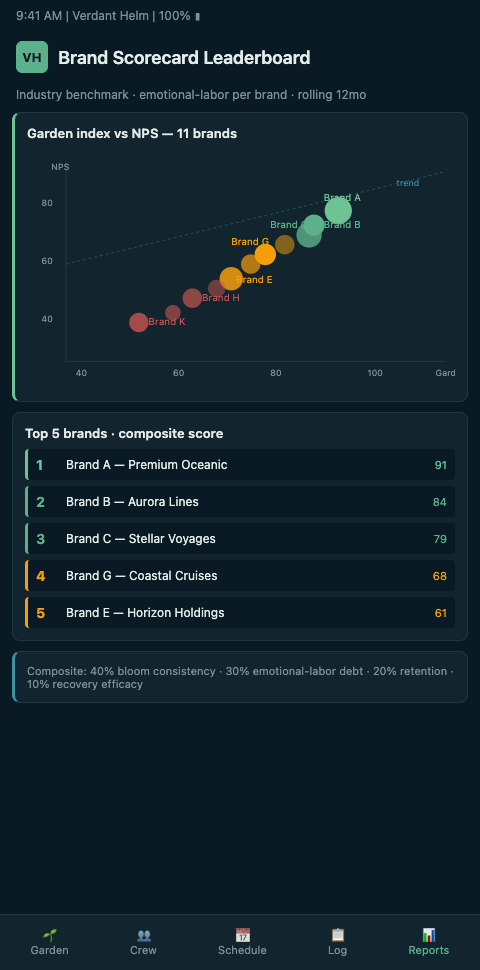
Together, these four dimensions produce a numeric rating that recruiters and travel agencies can reference, similar to how the Friends of the Earth report card produces environmental ratings. The underlying methodology will evolve, but the direction is clear: cruise brands are about to be ranked on emotional-labor performance the way they are already ranked on environmental performance. The brands that understand this early will position for it; the ones that wait will find themselves in the bottom quartile of the first published rankings, explaining to their CVPs why the methodology is unfair.
Advanced Tactics For Scorecard Preparation
The operators who will rank well on the first published scorecards are already running three specific plays.
Benchmark internally before anyone publishes externally. The Sustainalytics ESG methodology is public enough that operators can approximate their own scorecard positioning using internal data. Verdant Helm's cross-fleet dashboards produce a mock scorecard that lets Hotel Directors see where their ship would rank before any external rating body publishes. The operators running this mock scorecard monthly are the ones who will not be surprised when the first external rankings come out. The counterfactual is expensive: the brand that learns its scorecard position from a published ranking has no runway to correct before the travel-agency conversation starts, and by then the recruiting-network chatter is already locked in.
Run the wilt-response playbook as a first-order priority. The managing emotional labor research on service quality is clear that response matters more than measurement. Scorecards will punish operators who measure but do not respond, because the scorecard methodology rewards operational tending over dashboard theater. Ships that have stood up daily welfare standups and shoreside recovery orchestration are positioned to score well. Ships running garden telemetry without tending loops will score poorly. One premium operator running both patterns across different hulls has already seen the retention gap emerge internally — their standup-enabled ships outperform their dashboard-only ships by 8-14 points on quarterly retention, which is a direct preview of the scorecard signal.
Stratify by brand tier for the publication window. Luxury brands face different scorecard weightings than contemporary brands, because their crew carry heavier emotional-labor loads. Operators running both tiers need separate scorecard strategies per brand rather than a single fleetwide approach. A cruise group with a luxury sub-brand and a contemporary mainline brand is going to be ranked on both, and the luxury sub-brand's score cannot be inflated by the contemporary brand's higher bloom sustainability because the scorecard compares like-for-like. The 32-ship rollout post documents how premium fleet deployments need cohort-specific playbooks, and scorecard preparation follows the same logic.
The megaship NPS postmortem shows how attribution analysis feeds the wilt-response axis specifically.
Prepare the communications posture now. Operators who get ranked in the bottom quartile on the first published scorecard will be answering travel-agency questions, recruiter questions, and possibly CVP board questions within weeks. Building the communications posture before the scorecard lands — where the Hotel Director can point to specific tending programs, published welfare data, and operational metrics that contextualize the ranking — turns a bad-news cycle into a credible improvement story. The brands that have this posture ready land softer; the ones that do not read defensive, and defensive reads worse than the ranking itself.
The drilling contractor industry is running a parallel experiment — the contractor garden health leaders post describes how offshore operators are already being ranked on similar axes, and cruise is about 18 months behind them on public disclosure.
What Cruise Leaders Should Do Before The First Scorecard Drops
If you are a Hotel Director or a Cruise HR leader, the scorecard window is where you want to lead rather than follow. Pull together a cross-functional review with your CVP of Hotel Operations, your communications lead, and your senior welfare officer, and walk through where your fleet would rank on the four scorecard dimensions today. Find the gaps, prioritize the wilt-response ones, and schedule a Verdant Helm scorecard readiness review with your fleet welfare team. The brands that show up in the first published rankings with visible garden tending programs will lock in recruiting advantages that take competitors years to close.
The sequencing to run now is straightforward. Run the internal mock scorecard in the next quarter, identify the one or two dimensions where the fleet is weakest, and stand up specific operational programs against those dimensions before the next publication window. If wilt response is the weak axis, launch the daily welfare standup and shoreside recovery orchestration on the bottom-quartile ships first. If sink exposure is the weak axis, redesign the Lido bartender rotation or the mid-ship stateroom attendant assignment on the ships with the deepest structural sinks.
Cruise HR Leaders should also brief the communications lead early — before a published scorecard lands is when the communications posture is cheap to build, and a ranked brand answering travel-agency questions in real time is operating on a much tighter calendar. The recruiting-network chatter from Filipino cabin stewards and Croatian maître d' teams will preview the scorecard signal by two or three quarters, so monitoring that chatter is itself a leading indicator. Brands that watch the informal network catch the scorecard direction early enough to act; brands that wait for the formal ranking usually find themselves explaining rather than leading.