Watch-Cycle Fatigue Profiles for ULCC and VLCC Crews
A Chief Officer on a 441,000 dwt ULCC in AG-Rotterdam service told the vetting inspector the story that makes this post necessary. His previous three commands had been on 318,000 dwt VLCCs on the AG-China trade. The watch system on both classes was 4-on-8-off. The bridge team size on both was similar. The STCW rest-hour requirements were identical. But his fatigue experience on the ULCC, by voyage day sixteen at the Cape of Good Hope, was nothing like the curve his body had internalized across VLCC years. The voyage was longer, the ballast leg was a different shape, and the circadian perennial his body had adapted to on VLCC rotations did not fit the ULCC tour. The vetting inspector asked the question that should be obvious but is not: does anyone have actual telemetry on this?
This post walks through what aggregated garden data exposes across VLCC and ULCC fleets, why the two classes produce distinctly shaped fatigue curves, and what tanker bridge-team design owes to that distinction.
The problem: the supertanker bridge is not one bridge
The supertanker industry tends to talk about the VLCC-and-ULCC bridge as if it were a single design problem. It is not. Clarksons' 2023 shipping market review documents that the tanker fleet grew 1.9% that year and that 50% of Aframaxes exceed 15 years; the VLCC and ULCC segments have their own dynamics that the fleet-scale benchmarking has to honor. What the two classes share is a 4-on-8-off bridge watch system, a Master-Chief Officer-Second Officer structure, and regulatory obligations under STCW and MLC. What they do not share is voyage length, port-call frequency, ballast-leg shape, and the cargo-operation pressure on the Chief Mate in port.
Underlying research pins the fatigue risk to specific watch-system choices. The Nautical Institute's advisory 6 On/6 Off Watchkeeping = Fatigue documents why 6/6 is cognitively expensive on tanker officers. The empirical Project HORIZON report hosted by Nautilus International compared 6/6 and 4/8 on a 40,000 dwt tanker simulator. The Nautical Institute's fatigue and performance study on 6-on/6-off bridge and engine control room watchkeeping and the SAGE sleep-and-circadian-phase study by Arendt et al. provided foundational profile data. The USCG Crew Endurance Management Guide operationalizes the mitigations on US commercial vessels. But none of those datasets separate VLCC and ULCC profiles at class scale, and none of them capture what the voyage-length and trade-geography difference actually does to the perennial.
Operator scale frames how badly this matters. Frontline, Euronav, and DHT between them operate around 175 VLCCs; National Iranian Tanker Company, Bahri, and a handful of Chinese state operators add roughly another 100. Only a small subset run as ULCCs. The flag-state distribution leans heavily on Liberia, Marshall Islands, and Panama, with a meaningful minority of UK and Greek tonnage. The Britannia and Skuld P&I clubs' claims data on VLCC collisions and contacts disaggregates by cargo and trade pattern; the trade-pattern variance maps onto what the garden shows as class-profile variance. A single-class mental model hides the class-specific variance that the vetting inspector was asking about.
The garden as a class-by-class profile
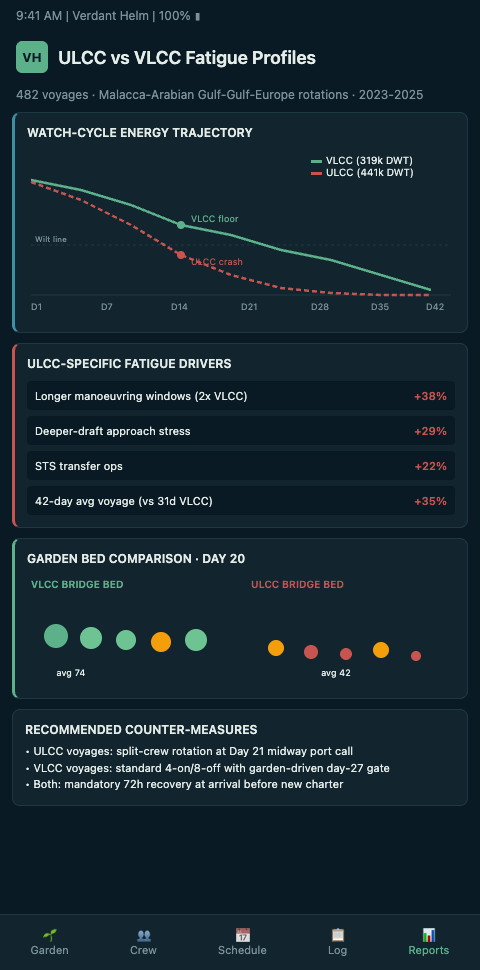
Verdant Helm aggregates bridge-team garden data across voyages, and when the aggregation is cut by vessel class, two distinctly shaped fatigue profiles emerge.
The VLCC profile on the AG-China 21-day voyage shows the Chief Officer perennial establishing across voyage days one through five, holding shape through day seven, drifting on day eight, and then consolidating into a new steady-state bloom-and-wilt pattern that the bridge team can maintain through the Malacca and Singapore transits and the Chinese-coast entry. The garden tend action at handover is dense in the first week, thins in week two, and dense again in the third week as the port-call approach brings cargo-operation anticipation back into the Chief Mate's watch.
The ULCC profile on the AG-Rotterdam 42-day voyage shows a different shape. The first week looks similar. Weeks two and three show the perennial consolidated but sitting in a narrower bloom window; the officer is stable but carrying less reserve. Week four is where ULCC voyages diverge. The Cape of Good Hope passage and the South Atlantic transit combine weather load, swell, and accumulated cognitive debt in a way that the garden shows as multiple sinks filling at once. Week five is the recovery window; week six is port-call ramp-up. The ULCC perennial has to hold shape across more voyage days than the VLCC perennial, and the garden shows that it does, but at a lower bloom ceiling.
The Suez-routed ULCC tells a third variant story. When a ULCC is routed via Suez rather than the Cape, the voyage is shorter by roughly a week, but the Red Sea and Bab el-Mandeb segments add a sustained-vigilance window that the Cape route does not have. The garden shows this as narrower bloom in weeks two and three without the week-four trough the Cape route produces. The total cognitive load across the shorter voyage is comparable; the distribution across the perennial is different. This is why trade-pattern and routing are inseparable variables in any serious profile analysis.
This matters for bridge-team design. A Master staffing a VLCC tour can plan around the day-eight inflection and the day-fourteen consolidation. A Master staffing a ULCC tour has to plan around a four-week accumulation curve that is structurally different. The watch cycle is 4-on-8-off on both. The physiology is not.
Advanced: what tanker operators are doing with the profiles
Operators who have access to garden-data class profiles use them in three ways. First, bridge-team composition. A ULCC on its first AG-Rotterdam tour with a recently promoted Second Officer is a higher-risk composition than the same class with a seasoned Second and a first-voyage cadet; the profile lets the fleet HR ops design around that. Second, voyage-specific rest pattern guidance. The garden profile is class-specific, but within a class it can be tuned to the trade. ULCC Cape routing and ULCC Suez routing produce different week-four shapes. Third, vetting evidence. Oil majors increasingly want to see that the operator has characterized their own fleet's fatigue profile, not just that they have a rest-hour log.
Peer-reviewed evidence supports this kind of profiling. The ScienceDirect analysis of physiological, psychological, and environmental factors on seafarer fatigue documents why real-navigation-environment measurement matters more than simulator-only work. The SIRC Cardiff seafarers' health and access to healthcare study frames the long-horizon context that class-specific profiles sit inside. Cardiff's Fatigue@Sea research stream has extended the methodology into operational deployments on cargo vessels, and INTERTANKO's human-element working group has incorporated class-profile thinking into its BTM and passage-planning guidance updates.
Charterer adoption is already reshaping operator behavior. A major oil-major vetting team in 2025 started asking operators for class-profile data at the pre-fixture stage on AG-to-China and AG-to-Rotterdam lifts; operators who could produce the profile within a week of the request were preferenced in tie-breaking on comparable freight. Britannia P&I's 2024 loss-prevention review cross-referenced perennial-stability signatures against claims-severity data; the correlation is sufficient that the club's underwriting team has begun to ask operators to share class-profile summaries during renewal discussions. Skuld and West of England are watching the same space. A VLCC operator who can present an in-band class-profile read alongside the SIRE 2.0 inspection output gets a meaningfully faster vetting cycle.
PSC regime context lines up with the profile story. Paris MoU inspectors calling Rotterdam and Antwerp have begun requesting class-profile context alongside rest-hour logs during targeted CIC windows; Tokyo MoU inspectors in Singapore and Busan follow a comparable practice on the Asia-Pacific side. USCG sector commanders for Houston and Los Angeles have indicated in their industry briefings that class-profile context will be requested when the targeting factor flags a human-element concern. The MAIB's tanker incident narratives from the last five years include several examples where a class-profile read would have contextualized the voyage pattern; the Japan Transport Safety Board's Tokyo-Chiba tanker incident reports produce similar reference cases. Having the class-profile evidence ready is now a PSC-readiness baseline, not a charterer-only artifact.
The profile story tells three intersecting cases. The two collision-free years on a VLCC is one instance of the VLCC profile's bridge team running clean. The nine-million watch-hour rest-hour dataset is what happens when class profiles are aggregated into a research-grade corpus. Offshore drillship teams have seen related patterns; the deepwater drillship hitch-end decay curves is the rig-side version of the same class-specific exhaustion shape.
Verdant Helm's class-specific profiles are produced because the garden data gives them to us; they are not the output of a survey. If you are a VLCC or ULCC Master, operator DPA, or charterer's vetting team and you want to see what your own fleet's profile looks like compared to the class aggregate, we will run a redacted benchmark against your ship types and trades. Bring your fleet list and a recent voyage pattern; we will show you whether your bridge teams are running inside or outside the class curve.