The Voyage Week-Three Cluster That Fuels Near-Misses
Four near-misses in seven days
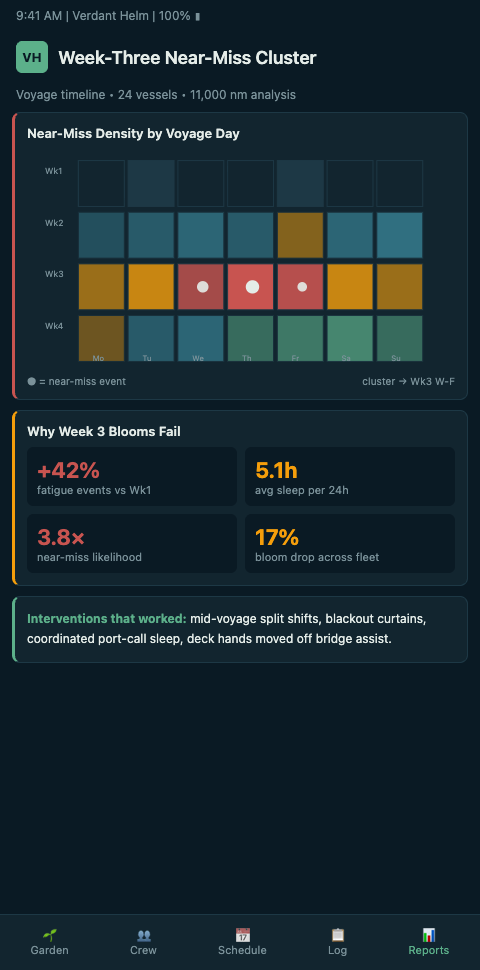
On a 32-day Dalian-to-Rotterdam voyage via the Cape of Good Hope aboard a 5,500 TEU container vessel, a Filipino Second Officer on the 00:00-04:00 watch logged four near-misses across voyage days 17 through 23. Two close-quarters situations with fishing fleet traffic off the Comoros during the Mozambique Channel segment. One ECDIS anti-grounding alarm dismissed and then re-triggered after a heading change. One contact with a towed fishing gear line that snagged the bulbous bow off the Madagascar shelf. Days one through sixteen, one entry in the near-miss log. Days twenty-four through thirty-two, two entries. Days seventeen through twenty-three, four entries. The cluster was not random. It was structural.
The MAIB Annual Report for 2023 documented 1,592 reportable incidents, with fatigue and crewing explicitly cited in the Scot Carrier collision and the BBC Marmara grounding. Nautilus International's breakdown of the MAIB report showed widespread crewing-level pressure driving excessive hours and mid-voyage fatigue. The MAIB's Solong/Stena Immaculate interim report on the North Sea collision surfaced the same pattern in interim findings — fatigue and watchkeeping factors concentrated during mid-passage. Week three is not a coincidence. It is a phase of the voyage curve where accumulated sleep debt, motivation drop, and environmental sinks converge. The Dover Strait near-miss case files from 2021-2023 that involved long-haul vessels (Asia-Europe round voyages, South America-Europe runs) clustered disproportionately at the week-three mark of the inbound leg.
The curve and the garden signal
Verdant Helm reads the voyage as a 30-day growing season on a bridge garden bed. The perennials bloom strong through week one — officers are rested from port, newly calibrated to the rotation, energised by the departure. Week two shows early wilt signs at the leaf tips — sleep debt has started to accumulate, motivation has begun its natural slide. Week three is where the garden crosses its drought threshold.
By voyage day seventeen on a 30-day leg, trailing seven-day sleep is below 5.8 hours/24 for at least one officer on most bridges. The compensating redundancy the fresh bed provided in week one is gone. A single wilting perennial in week three carries the cognitive load that three healthy perennials shared in week one. On a 9,200 TEU Panamax container running Dalian-Rotterdam with a British Chief Officer, a Filipino Second Mate, a Filipino Third Mate, and a Greek Master, the week-three collective reading drops about twelve percent below the week-one baseline across the combined bed, which is the threshold where compensating redundancy is measurably gone.
MDPI's peer-reviewed work on near-miss management in shipping documented that near-miss frequency clusters during mid-voyage when crew alertness sags. The ScienceDirect systematic review of fatigue as a latent risk factor in maritime safety systems reached the same conclusion — fatigue is underreported yet central to near-miss clusters on long passages. The pattern is not hidden in the literature. What has been hidden is the real-time signal that would let a Master tend the bed before the cluster forms. On a Dalian-Rotterdam voyage the week-three segment falls precisely across the Indian Ocean crossing, where traffic is light but environmental fatigue (heat, humidity, monotony) accelerates the decay. The same Indian Ocean segment on a reverse Rotterdam-Dalian leg produces a subtly different cluster shape because the westbound phase shift compresses the Master's evening hours and compounds the Chief Mate's 16:00-20:00 watch with cargo-planning demand for the Suez approach.
The garden signal for the week-three cluster is the collective wilt reading across the bridge team, not any single officer's bloom state. An individual officer who wilts in week three might be handled with a prune — a rota swap, a reduced-duties day. A bridge team whose collective bloom has dropped below a threshold is a system-state signal that no individual prune can fix. The tending action becomes structural: scheduling an easy-water passage (lower-traffic leg, daylight TSS transits, deferred cargo paperwork) across days 17-23, requesting a short crew rest port if the voyage plan allows, or explicitly derating the bridge's capacity for high-demand navigation during the trough.
On a Shanghai-Long Beach TransPacific with the Great Circle track crossing the international date line at roughly voyage day nine, the week-three trough falls in the final approach phase where bridge demand is peaking rather than troughing, which is the most dangerous configuration the cluster curve can produce. On a Rotterdam-Jebel Ali leg via Suez with a Bab el-Mandeb transit at day nine and a Hormuz transit at day fifteen, the week-three trough falls between two chokepoints, so the tending action becomes a posture change rather than a re-schedule — the transits stay, the staffing shifts.
Project MARTHA's fatigue and motivation curves across voyage weeks documented this empirically. Motivation drops faster than alertness, and the two together form the trough that the near-miss cluster rides. The Maritime Safety Innovation Lab's near-miss reporting guide recommended surfacing mid-voyage spikes as a separate metric from overall incident counts, because the spikes respond to different interventions than the baseline rate. Verdant Helm renders the spike as a bed-wide wilt that is readable before it becomes an incident count. The MARTHA bridge-team data aggregated across 1,000+ seafarers showed the motivation curve bottoming out between voyage day 16 and day 22 regardless of total voyage length, which is why the cluster window is consistent across 30-day and 40-day passages.
Advanced tactics for the week-three trough
Three tactics let a Master tend the week-three trough before the cluster forms. First, map the voyage plan against the predicted bed wilt curve at voyage start. A 32-day Dalian-to-Rotterdam run has a known trough shape. The TSS transits, dense-traffic zones, and cargo-operation days on the voyage plan can be compared against the predicted trough. Where a high-demand event falls in days 17-23 with a fresh alternative in days 10-16 or 24-30, the schedule can be biased before departure. On a ULCC routing the same Cape of Good Hope passage, the bunkering stop at Durban or Port Louis can be timed to fall either before or after the week-three trough depending on the bridge's predicted bloom curve.
Second, build a "week-three runbook" for the bridge team. The runbook is not a fatigue management document. It is a navigation-posture change. The Chief Mate takes the conn on high-demand segments. The 00:00-04:00 watch is staffed with a lookout unconditionally. The cargo paperwork batch that would normally fall on the Second Mate's off-watch is deferred to week four. The near-miss reporting threshold is tightened — anything that would be a "noted" entry in week one becomes a full report in week three, because the pattern recognition value is higher.
The runbook is a collective response to a collective signal. British Chief Officers and Greek Masters on European-owned tonnage report the runbook as the simplest pattern to transplant from voyage to voyage, because the posture changes are small and auditable. The runbook also reshapes the bosun's deck-walk schedule, pulling the bosun's rounds one hour earlier on the Chief Mate's conn days so the deck observation layer stays independent of the conn-holder's bloom state.
Third, treat week-three tending outcomes as a voyage-level KPI. A voyage where the bed visibly wilted but no near-miss cluster formed is a successful tending outcome. A voyage where the bed wilted and the cluster formed anyway is a tending failure that feeds back into the next voyage's runbook. Over a year of TransPacific and transatlantic voyages, the DPA gets a pattern library: which runbook actions reduced which clusters, on which routes, with which crew compositions. The tending becomes a learnable craft rather than a per-voyage improvisation.
A fleet running ten VLCCs and eight Panamax container vessels across the same Asia-Europe trade gets a statistically meaningful runbook-effectiveness dataset within four quarterly rotations. The KPI also feeds the ISM audit trail — a Master who can show a closed-loop record of week-three wilt readings, tending actions, and cluster-free voyage outcomes gives the auditor evidence the SMS is live rather than shelf-documented, which changes the audit tone from discovery to verification.
The pattern extends into tying fatigue troughs to collision and grounding precursors for the casualty-investigation angle. The day-eleven Chief Mate crash shows the same trough shape on longer Pacific legs where week three falls at around day twenty. Cruise operators see the analogous timing in the month-four cliff for guest-facing contracts, where different contract lengths produce the same accumulated-debt inflection but at a different calendar point.
What deep-sea cargo fleet leaders should do next
Masters and DPAs running long-haul cargo voyages on container, bulk, and tanker fleets can read the voyage week-three cluster in advance using Verdant Helm. The garden surfaces the bed-wide wilt trajectory at voyage start, so the tending decisions — posture changes, runbook adjustments, voyage-plan reorderings — happen before the cluster forms. Fleet superintendents get a portfolio view of week-three trough severity across every voyage in progress. Send us a 30-day voyage plan from your fleet and our deep-sea team will overlay the predicted trough and the recommended runbook against it.
Before the overlay, pull the near-miss reports from the last four completed round voyages on the same trade. The cluster shape almost always lands in the same seven-day window across voyages, because the same bed produces the same debt kinetics against the same voyage length. On a Dalian-Rotterdam Cape routing via the Mozambique Channel, the cluster typically lands on voyage days 18 through 22 of the inbound leg; on a Shanghai-Long Beach Great Circle routing, it lands on days 16 through 21 of the westbound leg.
The DPA receives a portfolio map that ranks every in-progress voyage by predicted trough severity, with the recommended runbook attached to each flagged vessel — conn reassignments to the Chief Mate, tightened near-miss reporting thresholds, bosun deck rounds pulled one hour earlier. P&I clubs reviewing the cluster record against claim frequency see a bridge posture that tends the week-three trough in advance rather than reconstructing it from logs after a close-quarters situation has already resolved itself in the bridge's favour or otherwise.