Reactive Spraying vs Predictive Brine Mitigation in Coastal Groves
The 9-Hour Reactive Wash Miss
Citrus leaves can tolerate roughly 2,200 to 2,300 ppm TDS at the roots but only about 1,500 ppm foliar before damage turns irreversible, per Salt Tolerance of Citrus Trees (Gardening Know How). That 700 ppm gap between root tolerance and foliar tolerance is the reason coastal grove operators lose Valencia canopy even when the storm surge leaves the irrigation water clean. A St. Lucie County operator running a reactive fresh-water rinse after Hurricane Ian finished the wash nine hours late on his two windward Valencia blocks — by that point, the salt had already moved from foliar deposition into leaf-tissue ion accumulation. The wash removed surface salt but could not reverse the ion load.
The $14,000 reactive rinse invoice was the obvious cost. The less-obvious cost showed up three weeks later as 22 percent of the leaves in those two blocks passed the 1,500 ppm foliar-lethal threshold on lab analysis and began dropping. Canopy loss in late-fall Valencia converts directly to premium-tier pack-out loss in the following spring's harvest — the operator estimated $38,000 to $52,000 in additional downstream revenue impact that the nine-hour timing miss caused, even though the rinse was performed.
Post-Hurricane Landscaping Tips: Wind Burn, Sea Spray, and Storm Surge (UF/IFAS Sarasota) is explicit: fresh-water rinse timing matters more than volume. The window is roughly 6 to 18 hours post-deposition, depending on humidity, leaf-surface hydration, and rootstock tolerance. Salt Stress and How to Manage It in Citrus Grove (UF/IFAS St. Lucie) adds the deposition-side guidance: salt problems trigger at TDS over 2,000 ppm, and night irrigation reduces foliar deposition — a predictive control that cannot be applied reactively.
Reactive spraying is expensive and often too late. Predictive brine mitigation — pre-storm kaolin coatings, scheduled night-irrigation cycles, and leaching irrigation primed 12 to 24 hours ahead — turns the same dollars into wider safety margins.
Helm-Charted Predictive Mitigation Before the Salt Front
HarvestHelm treats brine mitigation the way a yacht captain treats pre-voyage rigging: everything you want done at sea needs to be set before you leave the dock. The helm-charted yield forecast pushes salt-aerosol forecasts onto the block map 48 hours ahead of the salt front, and the predictive mitigation playbook activates automatically when the 48-hour salt-aerosol forecast crosses threshold values for each block's rootstock and canopy profile.
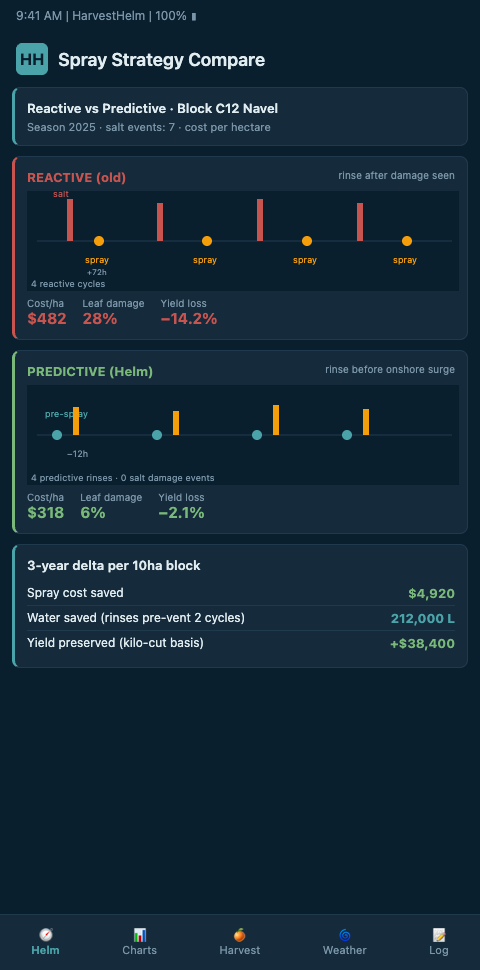
Three predictive levers stack. First, pre-storm kaolin clay coating. Kaolin Clay May Be Viable Option to Protect Citrus Trees (Citrus Industry Magazine) originally framed kaolin as an ACP (Asian citrus psyllid) control tool, but the same particle-film barrier reduces transpiration and offers partial foliar shielding against salt aerosol deposition. HarvestHelm triggers kaolin spray recommendations when the 72-hour salt-aerosol forecast shows windward blocks exposed to over 120 ppm-hour aerosol integrals. Material cost of kaolin is roughly 30 to 40 percent lower per acre than a post-storm fresh-water rinse on the same block, and the protection lands before the salt front rather than after.
Second, predictive night-irrigation cycling. Micro-sprinkler cycling during overnight hours before the salt front reduces deposition by keeping leaf surfaces wet and keeping the boundary-layer salt concentration diluted. Salt Leaching in Orchards and Vineyards (SJV Trees and Vines) documents how drip and micro-leaching 12 to 24 hours post-deposition creates a gradient that pushes salts below the root zone. How Orchard Irrigation Systems Excel at Salt Leaching (Nelson Irrigation) adds the scheduling layer: predictive irrigation cycling counters sodium deposition before ion accumulation crosses the 1,500 ppm foliar threshold.
Third, prophylactic copper and fungicide scheduling. Post-hurricane Expectations for Foliar Diseases and Phytophthora (Citrus Industry Magazine) documents the secondary infection window that opens 48 to 96 hours after storm wounding, when chlorine damage and physical abrasion create entry points for fungal pathogens. Predictive copper application 18 to 30 hours before storm arrival narrows the infection window materially.
HarvestHelm's helm-charted yield forecast stitches these three levers into block-specific recommendations. A Valencia block on Swingle rootstock facing a 48-hour onshore flow at 25 knots gets kaolin plus night-irrigation plus copper; the same block on Cleopatra rootstock with the same exposure gets night-irrigation only, because Cleopatra's higher chloride exclusion gives the block margin that Swingle does not have. See our salt ingress signals workflow for how the early warning thresholds tune per rootstock.
Advanced Tactics: Post-Storm Reactive Layer on Top of Predictive Base
Predictive mitigation does not eliminate the need for reactive response. It reduces the volume and tightens the timing window so reactive spraying becomes precise rather than panicked. HarvestHelm tracks actual salt deposition via grove conductivity sensors during the storm, then pushes post-storm fresh-water rinse recommendations only for blocks where measured deposition crossed the foliar-damage threshold despite the predictive cover.
The timing logic matters. Post-storm rinse scheduled at 0 to 6 hours after the wind subsides is ideal; 6 to 18 hours is workable; past 18 hours is largely cosmetic. HarvestHelm's sensor-driven rinse queue orders blocks by measured deposition severity and projected rinse-window closure, so crews work the worst blocks first inside the effective window. The fruit split post-storm workflow handles the related challenge of freshwater flush management when fruit has absorbed storm rain and is at risk of splitting.
Cross-crop pattern: mango plantation operators running copper vs bio-control programs face the same predictive-versus-reactive trade-off for fungal pressure during monsoon windows. Sensor-guided timing beats calendar-based spraying by roughly 25 to 40 percent on material cost and equivalent-to-better disease suppression. The underlying principle — trigger inputs on sensor-forecasted hazard, not on calendar — generalizes across crops and hazards.
Calibration matters. Every rootstock has a different threshold for when kaolin, night-irrigation, or copper turns from net-positive to net-negative. Log every application against the subsequent salt-deposition measurement and fruit-quality outcome. Over three seasons, your HarvestHelm thresholds will tighten to the specific microclimate gradients of your grove.
Equipment Staging for the 48-Hour Predictive Window
Predictive mitigation fails if the equipment is not pre-staged. Spray rigs, kaolin tanks, copper solution, micro-irrigation pressure boosters, and the crews to operate them need to be positioned and ready when the 48-hour salt-aerosol forecast crosses the mitigation threshold. Grove operators who discover the spray rig has a failed pump 18 hours before the salt front miss the window entirely — and the reactive wash that follows costs double.
HarvestHelm maintains an equipment-readiness checklist per block, with pre-season service records, post-use maintenance logs, and parts-inventory status. When the helm-charted salt-aerosol forecast crosses threshold, the equipment-readiness status elevates to top-of-dashboard and any amber flags route to the maintenance queue immediately. The goal is zero equipment-readiness surprises in the 48-hour window.
Fuel and chemical inventory follow the same discipline. Kaolin clay is generally well-stocked among local agricultural suppliers, but a regional hurricane approach concentrates demand across many coastal operations simultaneously. Growers who carry 2 to 3 day inventory of the predictive-mitigation chemical set avoid supplier-lockout situations. HarvestHelm tracks chemical burn rate against typical event volumes and recommends reorder points that maintain the safety buffer through a full active-track season.
Grove Geography and Mitigation Priority Sequencing
Not every block needs every mitigation lever. Interior blocks with 4+ windbreak rows between them and the coast often do not need kaolin coverage during a 48-hour onshore flow event — the windbreaks reduce deposition enough that the night-irrigation layer alone maintains leaf chloride below threshold. Windward perimeter blocks, by contrast, often need all three levers stacked.
HarvestHelm sequences mitigation recommendations by grove geography. The block map visualizes exposure gradient, windbreak effectiveness (updated annually based on canopy-health assessment), and rootstock tolerance. Mitigation recommendations show the per-block dollar cost against the expected damage-avoidance value. Grove managers see the ROI calculation before committing the spray rig, not after.
This geography-aware sequencing matters for labor utilization. A crew that sprays every block gets tired before the highest-priority blocks are covered. HarvestHelm's recommended sequence targets high-value windward blocks first and leaves interior blocks for the second shift or the next day. The helm dashboard tracks crew-hour consumption against the remaining queue so the sequencing adapts to actual pace.
Water Quality Testing for the Rinse Source
Reactive fresh-water rinse quality is only as good as the water source. A well-water source with elevated chloride (common in coastal wells after storm-surge intrusion) can compound rather than mitigate the foliar salt load. HarvestHelm tracks water-source TDS for each rinse asset and flags any source exceeding 800 ppm TDS as unsuitable for fresh-water rinse use during recovery. Growers relying on whatever water is available post-storm sometimes compound the damage.
Municipal water sources are generally cleaner but supply-constrained during hurricane recovery. Post-storm water-use restrictions often take effect in impacted counties, and agricultural users may find permitted allocation reduced. Pre-negotiated water-supply contracts with clear emergency-use clauses preserve the rinse option when restrictions apply.
Move Spending 36 Hours Earlier. Stop Paying for Panic.
Reactive fresh-water rinse crews cost coastal citrus growers more per acre than predictive mitigation and still miss the 18-hour salt-damage window routinely. HarvestHelm sequences kaolin, night-irrigation, and copper by rootstock and block exposure against the live helm-charted salt-aerosol forecast, keeping Valencia, Hamlin, and Murcott leaves inside the 1,500 ppm foliar safe zone through active tracks. Nothing upfront. The kilo-cut on successful harvest aligns the tool with the canopy you keep alive, not the rinse trucks you dispatch post-storm.
Operations joining the March cohort get kaolin, copper, and micro-sprinkler cycling thresholds tuned per rootstock — Swingle gets all three stacked, Cleopatra gets night-irrigation only — before the first onshore flow event of the depression season. Day one of the dashboard shows equipment-readiness status per block with chemical inventory burn rate tracked against typical event volumes, so spray-rig pump failures and kaolin stock gaps surface 48 hours ahead of the salt front rather than at the 18-hour scramble.