Copper Spray vs Bio-Control: Sensor-Guided Fungal Mitigation
The Copper Residue Squeeze on Indian Mango Exports
Copper fungicides have been the default anthracnose tool on Indian mango plantations for decades. They are cheap, broadly effective, and simple to apply. But the MDPI review of copper use across 12 EU countries documents progressively tightening regulations on copper residue — the EU has cut allowable copper use from 6 kg/ha/year toward 4 kg/ha/year across a decade, and buyers have tightened MRLs on imported fruit in parallel. That regulatory drift matters to Indian exporters because Rotterdam, Hamburg, and increasingly Dubai inspectors now test incoming mango containers for copper deposition on the fruit surface, and a container flagged for residue either gets reshipped or discounted to a lower-value market.
The pure-copper approach also underperforms under high disease pressure. An IntechOpen review of mango disease management reports that copper alone is less effective than dithiocarbamate-based fungicides during severe anthracnose pressure windows, which creates a paradox for growers: raising copper dose to match disease pressure accelerates residue buildup, while holding copper dose flat under heavy pressure lets anthracnose through to the packhouse. Neither path preserves export margins across a full season.
Bio-control has emerged as the structural answer to both problems. Research on Bacillus licheniformis against mango postharvest diseases demonstrates that combining B. licheniformis with low-dose fungicide provides the most effective integrated control. Field trials with Trichoderma harzianum strain DGA01 on Carabao mango reduced anthracnose severity by 87.9 percent. The biological agents leave no copper residue and pass EU MRL tests cleanly. But they require precise deployment timing — the organisms need live tissue to colonize, a specific humidity range to establish, and a minimum window before the next chemical spray that could suppress them.
Sensor-Driven Selection on a Helm-Charted Yield Forecast
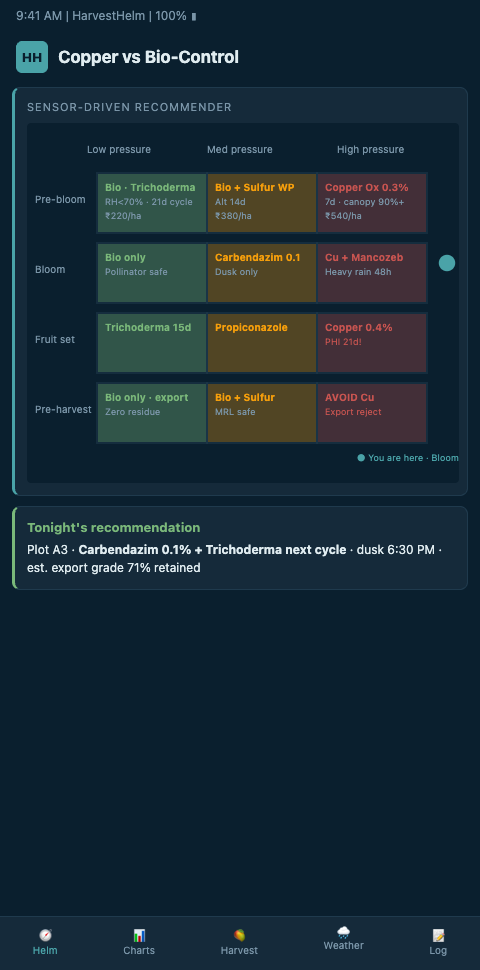
HarvestHelm treats the copper-versus-bio-control decision the way a yacht captain chooses between sail plans for a changing wind. The helm-charted yield forecast pulls canopy humidity, leaf wetness duration, temperature, residue budget remaining, and days-to-harvest from the dashboard sensor stack, and routes each detected infection window to the appropriate chemistry. A grower does not get a single fungicide program for the season — the grower gets a dynamic deployment plan where each trigger event selects copper, bio-control, or systemic triazole based on the specific constraints at that moment.
The decision logic rests on four sensor inputs. Canopy humidity and leaf wetness drive infection-window detection — same threshold logic that fires any spray rig alert. Temperature shapes the biological agent decision because Trichoderma and Bacillus strains have defined activity ranges (roughly 22-32°C for most strains), and a cold front pushing canopy temperature below 20°C makes bio-control deployment pointless. Days-to-harvest drives the residue constraint: a window more than 21 days from harvest accepts copper; a window within 14 days of harvest must route to bio-control or a residue-cleared systemic. Research from the Springer review of fungal, bacterial, and yeast antagonists confirms that timing-integrated bio-control achieves disease control competitive with copper across the season when deployed into the right windows.
The fourth input is season-to-date residue load. HarvestHelm tracks every copper pass by date, concentration, and coverage area, computing a running kg-per-hectare copper budget against the EU threshold. Once a block approaches 75 percent of the residue budget, the dashboard automatically re-weights infection-window responses toward bio-control unless the alternative is confirmed as unviable by the other three inputs. This is the navigational equivalent of watching the fuel gauge — the captain does not wait until the tank runs dry before adjusting course. A UF/IFAS mango anthracnose extension article confirms that copper sprays should be timed against confirmed infection windows and integrated with alternative chemistries to manage resistance and residue.
The dashboard output is a specific recommendation per trigger event: "infection window detected, canopy RH 94 percent for 3 hours, temperature 27°C, days to harvest 28, copper budget at 58 percent — recommend copper oxychloride at 2.5 g/L." Or: "infection window detected, canopy RH 93 percent for 2.5 hours, temperature 29°C, days to harvest 11, copper budget at 71 percent — recommend Bacillus licheniformis application." The grower sees the logic chain alongside the recommendation and can override per block if their judgement differs. The same trigger infrastructure that runs spray rig humidity triggers extends naturally into chemistry selection.
Advanced Tactics for Integrated Fungal Mitigation
The advanced layer of tactics separates plantations that achieve 95 percent export clearance rates from those that average 84 percent. The first tactic is antagonist succession planning. Research on integrated copper management from Cornell documents that bio-control agents establish best when applied during early infection pressure rather than after anthracnose lesions have appeared. HarvestHelm's dashboard schedules Trichoderma applications ahead of the pre-bloom flush window even in the absence of an active infection trigger, because pre-emptive colonization primes the canopy for the heavy-pressure events that follow.
The second advanced tactic is block-specific chemistry routing. A mixed-cultivar plantation typically has Alphonso blocks on the most copper-sensitive side of the residue budget (because those blocks ship to EU), Kesar blocks on a middle risk tier (mixed EU/Gulf export), and Tommy Atkins blocks on a looser tier (primarily domestic market). HarvestHelm lets plantation managers assign per-block residue budgets and chemistry tier rules, so the same trigger event can route to bio-control on an Alphonso block and to copper on an adjacent Tommy Atkins block. This integrates with leaf wetness calibration because cultivar-specific wetness thresholds drive the infection window detection before chemistry selection happens downstream.
The third advanced tactic is residue-driven timing for pre-harvest sprays. The final 10 to 14 days before harvest is the highest-risk period for residue flags at port inspection, and it also tends to coincide with peak monsoon-adjacent infection pressure on Indian plantations. Bio-control offers the clean-MRL option, but the window is tight and the MDPI review of intelligent orchard sprayers confirms that real-time canopy sensing is essential for precise deployment. A related defensive playbook — reactive versus predictive mitigation — extends the same logic to salt ingress on citrus groves facing brine intrusion, where trigger-driven chemistry selection also gates export eligibility. The mango version of that tactic books bio-control passes during the pre-harvest window and reserves copper for the earlier-season windows with enough time for residue degradation before harvest.
Supply Chain Considerations for Bio-Control Chemistry
Bio-control adoption on Indian mango plantations hits a practical supply chain constraint that copper-heavy programs do not face. Trichoderma harzianum and Bacillus licheniformis products have shorter shelf life, require cold-chain handling, and come from a narrower supplier base than generic copper oxychloride. A plantation building a sensor-guided program has to secure bio-control inventory 2 to 3 weeks ahead of projected deployment windows, or risk running out of the right chemistry at the moment the dashboard triggers a bio-control recommendation. HarvestHelm's dashboard includes a chemistry inventory tracking module that monitors remaining doses against projected trigger events, alerting the plantation manager when inventory runs below the projected window demand.
The supplier relationship matters more than price on bio-control chemistry. A plantation that relies on spot purchases from whoever has stock available at the time ends up with inconsistent strain variants, varying efficacy, and compromised program results. Plantations that build relationships with 2 to 3 reliable bio-control suppliers — including at least one with consistent strain sourcing documented through batch records — get more predictable field performance and better support during tight inventory windows. The dashboard's chemistry log tracks batch numbers per application, so when a specific supply performs differently from baseline, the plantation can trace the variance back to its source.
Transitioning From Copper-Heavy to Sensor-Guided Programs
Most Indian mango plantations currently run copper-heavy programs out of habit, supply-chain familiarity, and the hard economics of biological agents that cost 2 to 4 times more per application than copper oxychloride. The transition to sensor-guided integrated programs takes 2 to 3 seasons of disciplined implementation rather than a single-season flip. Season one typically shifts 20 to 30 percent of infection windows to bio-control while maintaining copper as the default chemistry — the plantation learns bio-control timing and deployment logistics while still relying on familiar chemistry for most pressure windows. Season two shifts another 20 to 30 percent, with bio-control handling most pre-harvest windows and copper retreating to the early-season pressure periods. Season three reaches the integrated endpoint where trigger logic drives both chemistries with residue budget management.
The learning curve costs real money in season one. Bio-control application requires specific humidity and temperature ranges at deployment, proper mixing protocols, and shorter spray-to-next-spray intervals to avoid biological antagonism. Plantations skipping the training layer often see disappointing bio-control results in year one, which tempts them to revert to copper-heavy programs before the learning investment pays off. HarvestHelm's dashboard includes deployment-specific guidance for each bio-control application — optimal humidity window, temperature check, pre-application canopy condition — so the operational learning compresses from 3 seasons to 18 to 24 months.
The hard numbers shift the economics. A plantation paying 40 percent more per application for bio-control but running 45 percent fewer applications overall (because sensor-guided triggering eliminates low-pressure calendar passes) ends up with total chemistry cost roughly equivalent to a copper-heavy program — while gaining residue budget, export compliance, and disease control all at once. The transition is not cost-neutral in every season, but the three-season total consistently comes out ahead.
Winning at the Port Means Deciding at the Canopy
The choice between copper and bio-control is not a philosophical preference — it is a sensor-driven economic decision that determines which of your mango containers clear inspection at EU ports. HarvestHelm's kilo-cut revenue model aligns the platform directly with your export outcomes: you pay only on fruit that actually clears customs, so every recommendation the dashboard makes carries the same financial incentive you carry.
A plantation running season-long copper programs faces rising residue flags; a plantation running season-long bio-control faces intermittent disease breakthroughs during heavy pressure; a plantation running sensor-guided integration of both chemistries gets the clean MRL and the disease control. Ratnagiri, Devgad, and Valsad export specialists who have moved to integrated sensor-guided mitigation report 12 to 18 percent improvements in EU container clearance rates and 22 to 28 percent reductions in total fungicide cost. The port inspector will check your fruit. Your dashboard decides whether they find copper or clean pulp.