Integrating Spray Rig Triggers With Canopy Humidity Thresholds
The Calendar Spray Trap Costing Alphonso Growers Lakhs
Most mango plantations still run fungicide programs the same way they did in 1995: a printed calendar, a tractor-mounted airblast rig, and a driver who starts engines at dawn regardless of what the canopy is actually doing. UF/IFAS extension pathologists have documented that anthracnose pressure spikes above 90 percent relative humidity during flowering, yet calendar schedules hit the canopy whether humidity sits at 62 percent or 97 percent. The conidia of Colletotrichum gloeosporioides, according to research compiled in PMC, germinate only when RH stays between 95 and 100 percent for sustained windows, meaning roughly half of scheduled passes land on dry panicles where infection is physiologically impossible.
The cost ladder climbs fast. A 40-acre Alphonso block in Devgad burns through 180 to 220 litres of copper oxychloride concentrate across a typical pre-monsoon program, plus 60 to 80 litres of systemic triazoles during panicle emergence. When two-thirds of those sprays hit below the infection threshold, you are not just wasting chemistry — you are accelerating copper residue buildup that EU importers increasingly flag, and compressing re-entry intervals that prevent panicle hand work exactly when crews need access. The UF/IFAS mango anthracnose guide notes that preventive sprays become valuable only when humidity signals a genuine infection window, not when the week on a calendar happens to end in an even number.
Wiring Humidity Thresholds Into the Helm-Charted Yield Forecast
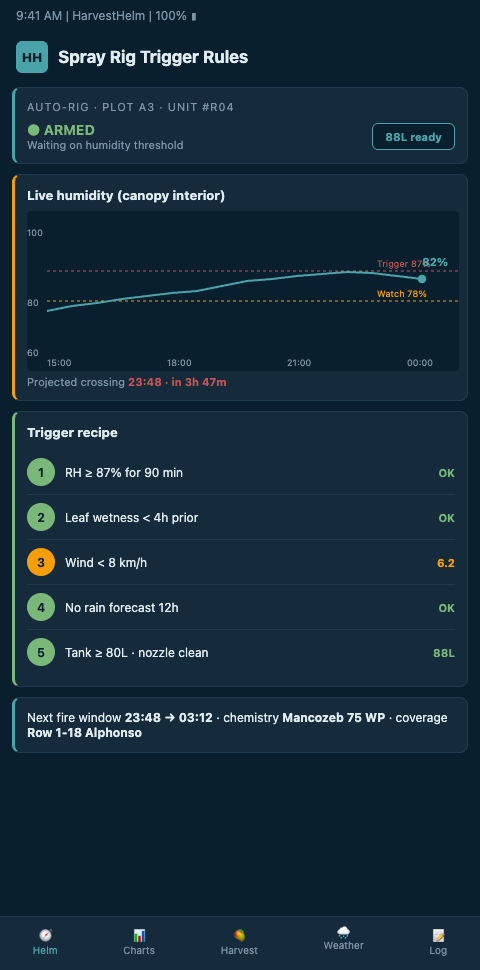
HarvestHelm approaches fungicide triggering the way a yacht captain reads the chart plotter before adjusting course. The helm-charted yield forecast pulls canopy-level RH, leaf wetness duration, and temperature from sensor clusters spaced roughly every 200 metres inside the canopy — not from the 50-km regional grid that satellite products rely on. When the dashboard registers sustained RH above 92 percent for two consecutive hours during flowering, the system fires a trigger flag to the spray rig queue. The grower still sees the recommendation on the yacht-style dashboard and confirms the pass, but the rig no longer rolls out on calendar autopilot.
The mechanics matter because anthracnose infection follows a dose-response curve that calendar sprays cannot track. Research summarized in the Fitzell model for mango anthracnose shows that wet-period duration multiplied by temperature drives infection levels in measurable stepwise jumps. A humidity-triggered spray program treats these jumps as actionable events. The sensor stack reads leaf wetness directly, confirms that free water is present on the panicle surface for the minimum duration, and only then moves the rig from standby to rolling. Growers who have adopted microprocessor-based forecasting — as documented across regional MAE trials — cut fungicide passes by four to eight per season while holding disease incidence flat or better.
Rig integration happens on two levels. The first level is the alert layer: canopy sensors push RH, temperature, and leaf wetness to the dashboard, which translates threshold crossings into spray recommendations with a specific rationale (infection window open, anthracnose pressure rising, 14-hour wet-period confirmed). The second level is the control-valve layer, where the dashboard either sends trigger signals to variable-rate sprayers or flags the rig operator through a mobile alert. Both levels lean on the same canopy-density spray research from Penn State Extension, which confirms that real-time canopy sensing reduces chemical volume and drift while holding disease control steady.
What separates this from simple weather-station forecasting is placement. A single met station reading 73 percent RH at two-metre height does not capture what is happening eight metres up inside an Alphonso canopy with a fresh panicle flush. Sensors belong inside the fruiting zone, clipped to scaffold branches, reading microclimate that 50-km regional grids fly straight past. The yacht analogy holds: a captain does not steer by the weather report from the next port — the captain reads wind, temperature, and sea state from instruments on the actual vessel. Plantation managers looking to extend this approach across varietal blocks often tie the spray trigger logic to leaf wetness calibration so thresholds shift per cultivar sensitivity.
Advanced Tactics for Threshold Tuning and Audit Trails
Once the base trigger loop is running, the next layer of tactics separates growers who cut spray volume by 30 percent from those who cut it by 60 percent. The first advanced move is threshold stratification by phenological stage. During panicle emergence, trigger RH might sit at 88 percent with a two-hour sustained window. At full bloom, when stigma receptivity opens the infection pathway, the threshold tightens to 85 percent with a 90-minute window. Post-fruit-set, once the cuticle thickens, you can relax the threshold back to 92 percent. HarvestHelm lets growers set stage-specific thresholds directly on the dashboard rather than hard-coding a single plantation-wide number.
The second tactic is integrating copper spray versus bio-control decisions into the same trigger logic. A humidity spike during early panicle emergence might call for a Trichoderma harzianum pass rather than copper, because the biological agent colonizes the tissue ahead of the pathogen without the residue issues. The trigger is identical — RH threshold crossed — but the chemistry selection shifts based on residue timing and export compliance constraints. Research summarized by OSU's intelligent sprayer program shows canopy-density-aware rigs can cut chemical usage up to 80 percent while maintaining equivalent disease control, and the integration with trigger logic amplifies that reduction.
The third tactic is audit-grade logging. Every trigger event — RH reading, leaf wetness duration, trigger time, rig response time, material applied, litres per tree — gets logged to the dashboard with a timestamp. When an export shipment faces rejection at Dubai or Rotterdam, that log becomes the evidence trail that shows you sprayed based on measured infection risk, not blind calendar adherence. This is the same principle that wind machine triggers on apple orchards apply for frost defence: sensor-driven trigger logic produces an auditable decision chain that regulators and buyers both accept. A meta-analysis of 80 decision-support-system experiments found that DSS-triggered fungicide programs cut treatments by 50 percent or more without compromising disease control.
Integration Patterns for Existing Rig Inventories
Most mid-sized Indian mango plantations already own 2 to 5 airblast sprayers of various ages, and the cost of replacing them with fully integrated smart rigs is prohibitive. The practical path is retrofit integration where existing rigs receive trigger signals from the dashboard through mobile alerts or in-cab display units rather than direct valve control. HarvestHelm's alert-layer integration works with any rig — the operator sees the trigger recommendation on a tablet or phone mounted in the cab, confirms the pass, and then runs the rig manually with the specified chemistry and volume. The alert integration captures 70 to 80 percent of the savings that full valve integration would deliver, at roughly 15 percent of the capital cost.
For plantations planning capital upgrades, the next rig purchase becomes the entry point for full valve-level integration. Most current-generation variable-rate sprayers from Indian manufacturers ship with ISOBUS or proprietary trigger interfaces that HarvestHelm can communicate with directly. The integration moves the trigger decision from operator confirmation to rig-level automation — when canopy humidity crosses the threshold and the sensor stack confirms the infection window, the dashboard sends a trigger signal that cues the rig for deployment on the specified blocks. Operator confirmation still happens, but the rig is pre-loaded for the pass rather than starting from cold.
The third pattern is multi-rig coordination. Plantations running 3 or more rigs simultaneously during peak pressure benefit from rig-level deployment optimization — which rig covers which block, which chemistry each rig carries, and what sequence produces the fastest plantation-wide coverage. HarvestHelm's dashboard treats the rig fleet as a coordinated system and assigns block coverage based on current rig position, chemistry inventory, and remaining shift hours. This coordination layer alone cuts plantation-wide spray coverage time by 20 to 30 percent during peak windows.
Field-Level Implementation Patterns That Actually Hold Up
Translating humidity-triggered spray logic from the dashboard into a working field operation takes two structural commitments beyond the hardware install. The first is operator training on the trigger rationale — rig operators who understand why a pass was recommended (infection window open, 14-hour wet period confirmed) apply the pass with more care than operators who just follow calendar orders. HarvestHelm's dashboard renders the trigger rationale alongside the recommendation, which means the operator sees the canopy condition that drove the alert before rolling the rig out. Research compiled through the Nature precision spraying study confirms that real-time precision spraying reduced pesticide volume significantly versus constant-rate application, and the gains are larger when operators understand the underlying logic rather than treating the rig as a black box.
The second commitment is a weekly calibration check during peak pressure season. Sensor drift is real — dust accumulation, canopy shading shifts as new flush emerges, and humidity sensor response curves degrade slightly across the season. A 5-minute weekly walk-through of the sensor network catches drift before it corrupts trigger decisions. HarvestHelm's dashboard flags sensor nodes that deviate from the network median by more than 4 percentage points of RH, which narrows the weekly walk-through to just the flagged nodes rather than the full grid. Plantations that skip calibration checks watch their trigger accuracy degrade over the season until the system stops firing appropriately around weeks 6 to 8.
Aligning Your Spray Program With Export-Grade Economics
The math for Indian mango plantations targeting EU or GCC export markets runs on thin margins. A single rejected container at Jebel Ali costs 4 to 6 lakh rupees in reshipment, plus the reputational damage that caps future quotas. HarvestHelm monetizes only on the export-grade fruit that actually clears — the kilo-cut model — which means the incentives line up directly with the grower's. Fewer spurious sprays mean lower residue, cleaner phytosanitary inspections, and more kilos clearing the customs gate.
The spray rig trigger system is not a bolt-on convenience; it is the navigation instrument that keeps the plantation on course through monsoon-variable infection pressure. Plantation managers in Ratnagiri, Devgad, and Vijayapura who have wired canopy humidity thresholds into their rigs report cutting fungicide passes from 14 down to 7 per season while raising export-grade tonnage. The helm is already on your dashboard — the question is whether your spray rig takes orders from it.