Calibrating Leaf Wetness Sensors to Cultivar-Specific Disease Risk
Why Default Wetness Thresholds Fail Mixed-Cultivar Plantations
Leaf wetness sensors measure the accumulated duration of free water on foliar surfaces. That measurement alone does not tell you anything about infection risk — the relationship between wetness duration and Colletotrichum gloeosporioides infection is mediated by temperature, cultivar susceptibility, and tissue age. Most off-the-shelf agricultural sensor platforms ship with a single wetness-duration threshold (typically 6 to 8 hours) paired with a single temperature range, and call it a universal anthracnose indicator. On a mixed-cultivar mango plantation that threshold is wrong for at least two of the three cultivars, and often wrong for all three.
The ScienceDirect screening of 30 mango cultivars against anthracnose maps measurable susceptibility differences across commercially important varieties. Alphonso and Kesar score on the susceptible end of the spectrum, meaning infection can occur at shorter wetness durations and lower temperature thresholds than the population average. Tommy Atkins scores moderately resistant. The classic Fitzell 1984 model for mango anthracnose captures the wet-period duration and temperature interaction mathematically, showing that infection probability climbs in non-linear steps as wetness extends past critical thresholds. Feeding a Fitzell-type model with uncalibrated, cultivar-flat wetness data produces infection risk estimates that are systematically wrong on both ends — over-estimating risk on resistant cultivars and under-estimating risk on susceptible ones.
The cost hits export packhouses in a specific way. A plantation that runs uniform spray timing on all cultivars because the leaf wetness alerts fire uniformly ends up with residue-over-limit issues on Tommy Atkins blocks (because the system flagged infection windows that did not actually pose risk) and anthracnose breakthroughs on Alphonso blocks (because the system missed windows where the shorter susceptibility threshold was crossed). Both failures land at port inspection, either as residue rejections or as latent anthracnose lesions emerging during transit. The CTAHR mango anthracnose guide documents that environmental thresholds for infection must be interpreted against cultivar epidemiology rather than treated as universal numbers.
Building Cultivar-Calibrated Wetness Thresholds on the Helm-Charted Yield Forecast
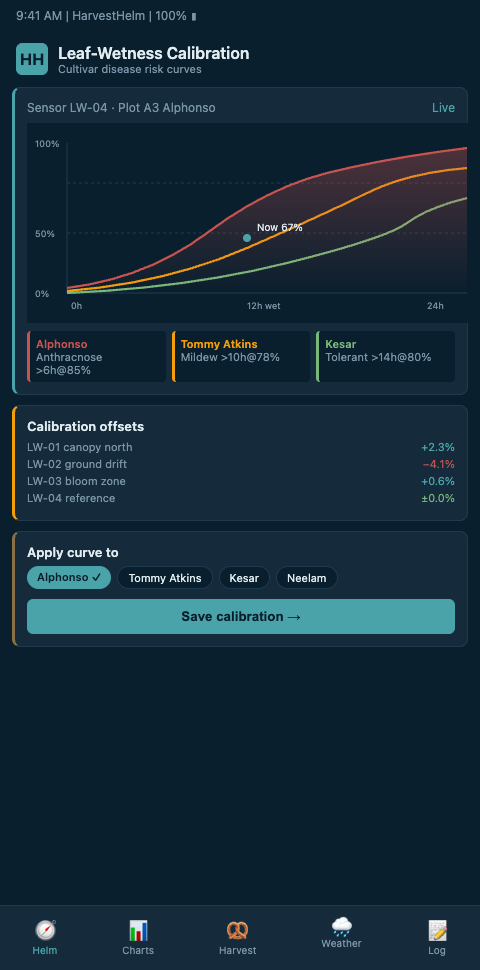
HarvestHelm treats leaf wetness calibration the way a yacht navigator calibrates instruments against known conditions before a passage. The helm-charted yield forecast pulls raw wetness duration readings, filters them through cultivar-specific risk curves, and outputs per-block infection probability with a confidence band. The dashboard renders each block with its own wetness threshold and its own temperature-wetness response surface, so the same 4-hour wetness event triggers different alert states depending on which cultivar is being measured. A captain does not use the same speed-over-ground calibration for every vessel — the calibration reflects the specific ship.
The calibration process begins with reference data. HarvestHelm stores the published susceptibility spread from sources like the ScienceDirect cultivar screening plus plantation-specific historical data from the growers' own records. For Alphonso, the default wetness threshold shifts from 6 hours (factory) to 3.5 hours above RH 90 percent paired with temperature 24-29°C. For Kesar, the threshold sits around 4 hours at the same RH and temperature ranges. For Tommy Atkins, the threshold stretches to 7 hours because the tissue is meaningfully more tolerant. Research on the APS Plant Disease reconsidering leaf wetness duration framework confirms that wetness duration must be interpreted alongside cultivar-specific epidemiological parameters to produce actionable disease management decisions.
The sensor hardware itself needs calibration too. Research from PMC on predicting leaf wetness duration with machine learning documents that 86 percent RH and 3°C dewpoint thresholds provide the most reliable leaf wetness duration estimates, with Random Forest models achieving R²=0.97 against direct measurement. HarvestHelm cross-validates each canopy sensor reading against the RH-dewpoint model output to catch sensor drift, calibration offset, and positioning errors. A sensor that consistently reads wetness 30 minutes longer than the RH-dewpoint model predicts is either contaminated with dust, tilted off the reference angle, or drifting toward failure — all of which require field correction before the wetness reading feeds into disease risk calculations.
The third calibration layer is temperature-wetness response surface tuning. The Springer model of temperature and leaf wetness on monocyclic infection provides the mathematical framework for the joint temperature-wetness interaction, and HarvestHelm fits that framework to the specific cultivar mix on each plantation. For plantations with Alphonso and Kesar side by side (the susceptibility-dominant mix on most Maharashtra and Karnataka estates), the response surface gets tuned to catch the narrow temperature-wetness bands where both cultivars cross into infection territory simultaneously. Plantations that also grow Tommy Atkins tune a second response surface with wider thresholds, so the alarm system differentiates between windows that threaten only the susceptible cultivars versus windows that threaten the whole plantation. This integrates directly with Alphonso vs Kesar fungal vulnerability analysis to make sure the response surface captures the specific differences between the two dominant Indian export cultivars.
Advanced Tactics for Wetness Threshold Refinement
The advanced layer of calibration tactics separates plantations that run at 7 percent false-positive alerts from those that run at 25 percent. The first tactic is tissue-age correction. Young flush on a mango tree is more susceptible to anthracnose infection than fully hardened leaves, and the susceptibility difference can be as large as the cultivar difference. HarvestHelm's dashboard tracks flush emergence dates per block and applies a tissue-age weight to the wetness threshold: a 10-day-old flush gets a more conservative threshold than a 35-day-old flush on the same cultivar. The APS Plant Disease validated tool on strawberry anthracnose demonstrates the same principle in a different crop — leaf wetness and temperature thresholds must integrate with developmental stage to produce accurate infection timing.
The second advanced tactic is chemistry-response calibration. Different fungicide modes of action have different residual windows, which means the effective wetness threshold shifts depending on which chemistry was last applied. A copper application creates a protective barrier that tolerates 1.5 to 2 additional hours of leaf wetness before infection breakthrough becomes likely; a systemic triazole provides longer protection but degrades on a different schedule. HarvestHelm's dashboard tracks last-spray chemistry per block and adjusts wetness thresholds accordingly, so the alert system remains sensitive to actual breakthrough risk rather than to generic wetness events. This integrates naturally with copper spray versus bio-control decision logic, because the chemistry-response calibration feeds back into the next trigger decision.
The third advanced tactic is cross-crop calibration for mixed operations. Plantations that grow mango alongside citrus, pomegranate, or other export crops can leverage calibration frameworks across crop systems. Coastal citrus operations calibrate sensor thresholds for rootstock salt thresholds using similar response-surface methods, and the underlying calibration infrastructure transfers across crops with cultivar-specific parameter replacement. The PMC leaf wetness duration ML research framework handles both crops through the same 86 percent RH / 3°C dewpoint sensor cross-check, making cross-crop calibration technically straightforward even when the disease risk curves differ substantially. A plantation that has already invested in calibration infrastructure for mango extends that infrastructure across the rest of its export portfolio at incremental cost.
Calibration Protocols for New and Replacement Sensors
When a plantation adds new sensor nodes mid-season — because a storm took out a node, or because the audit revealed a coverage gap in a high-pressure block — the new node needs proper calibration against the existing network before it starts driving trigger decisions. A factory-fresh sensor typically reads 1.5 to 3 percentage points different on RH and 0.5 to 1°C different on temperature compared to an established sensor at the same location. Those differences are small enough to look trivial on a single reading but large enough to shift threshold crossings by 30 to 45 minutes during infection windows — the exact precision that matters most.
The calibration protocol runs over 72 hours. The new sensor gets mounted adjacent to a verified reference sensor in the same canopy zone, both nodes report readings at 5-minute intervals, and HarvestHelm's dashboard computes the offset between the two time series. If the new node's offset stays within plus or minus 1.5 percentage points RH across the 72 hours, the calibration passes and the node joins the network. If the offset drifts or exceeds threshold, the node gets flagged for hardware inspection before being added to operational trigger logic. Research from the APS Plant Disease strawberry anthracnose tool on leaf wetness and temperature timing confirms that infection-timing tools require sensor accuracy tighter than raw factory specifications typically provide.
Replacement nodes for failed sensors get an abbreviated 24-hour calibration because the location profile is already known. Swap nodes for seasonal refresh cycles typically run the full 72-hour protocol because the plantation's calibration baseline may have drifted since the previous season's reference. Plantations that treat sensor swaps as routine hardware replacement without running calibration protocols introduce invisible threshold errors that degrade decision quality for weeks before anyone notices — usually only after an infection window gets missed or a false alarm triggers an unnecessary spray pass.
Calibration Is the Difference Between Sensor Data and Sensor Decisions
Uncalibrated leaf wetness data is a noisy signal that looks like actionable information. Calibrated leaf wetness data — tuned to cultivar susceptibility, tissue age, chemistry state, and sensor drift — is actual decision support. HarvestHelm's kilo-cut monetization means the platform earns only when calibrated recommendations produce export-grade fruit that clears customs. That alignment pushes calibration quality toward the plantation's actual risk surface rather than toward whatever the sensor manufacturer shipped as factory defaults. Ratnagiri, Kolar, and Junagadh plantation managers who have moved to cultivar-calibrated wetness thresholds report 28 to 34 percent reductions in spray alerts with equivalent or better disease control. The leaf wetness reading is the raw input. Calibration is what turns it into a navigation instrument for your specific plantation.