Calibrating Salt Deposition Thresholds for Different Rootstocks
One Threshold Across Seven Rootstocks Breaks Every Alert
A mid-size Lee County grove running four rootstocks — Swingle, Carrizo, Cleopatra, and sour orange — set its salt-alert threshold at the industry average and spent two seasons chasing phantom alerts on Cleopatra blocks while missing two actual deposition events on Swingle. The problem was not the sensor. It was the absence of per-rootstock calibration. Florida Citrus Production Guide: Rootstock and Scion Selection (UF/IFAS EDIS HS1308) publishes the Florida rankings cleanly: Cleopatra > Rangpur > Volkameriana > sour orange > Swingle > Carrizo for salinity tolerance. The spread between the most tolerant and least tolerant rootstock in that list is roughly a factor of three on deposition tolerance.
The operational cost of mismatched thresholds compounds. Each phantom alert on a Cleopatra block burned crew-hours on fresh-water rinse that the block did not need. Each missed alert on a Swingle block let salt accumulate to 1,700 to 1,900 ppm foliar levels before anyone noticed. Over two seasons, the grove lost an estimated 240 crew-hours on unnecessary rinses and an estimated $24,000 in downstream yield on the missed Swingle events. Both costs trace back to one decision: applying a single threshold across rootstocks with three-times spread in tolerance.
Boron (B) and Chlorine (Cl) for Citrus Trees (UF/IFAS EDIS SS619) quantifies the toxicity endpoint: chloride accumulation above 0.5 to 0.7 percent leaf dry weight causes necrosis, and sodium above 0.2 to 0.5 percent does the same through a different pathway. What the damage endpoint does not tell you is the deposition rate that gets a given rootstock to that endpoint. For that, you need the intake side — and intake varies enormously.
Salinity tolerance of citrus rootstocks: root and leaf mineral concentrations (Plant and Soil) published peer-reviewed quantification of root and leaf chloride and sodium accumulation across rootstock genotypes. Salinity tolerance of 'Valencia' orange trees on contrasting rootstocks (J. Experimental Botany) showed trifoliate-based rootstocks exhibit slower photosynthetic dysfunction than Cleopatra under equivalent salt stress, because trifoliata excludes sodium at the root better. A single threshold applied across both rootstocks guarantees alert miscalibration.
Helm-Charted Per-Rootstock Thresholds on the Block Map
HarvestHelm solves the mixed-rootstock alerting problem by storing per-block rootstock metadata and applying rootstock-specific deposition thresholds to each block's sensor feed. The helm-charted yield forecast displays a unified grove view, but the underlying threshold math runs independently per block. A 85 ppm-hour salt-aerosol integral triggers a Tier 1 alert on Carrizo blocks, a Tier 2 alert on sour orange, and no alert on Cleopatra — same grove, same sensor network, different threshold math.
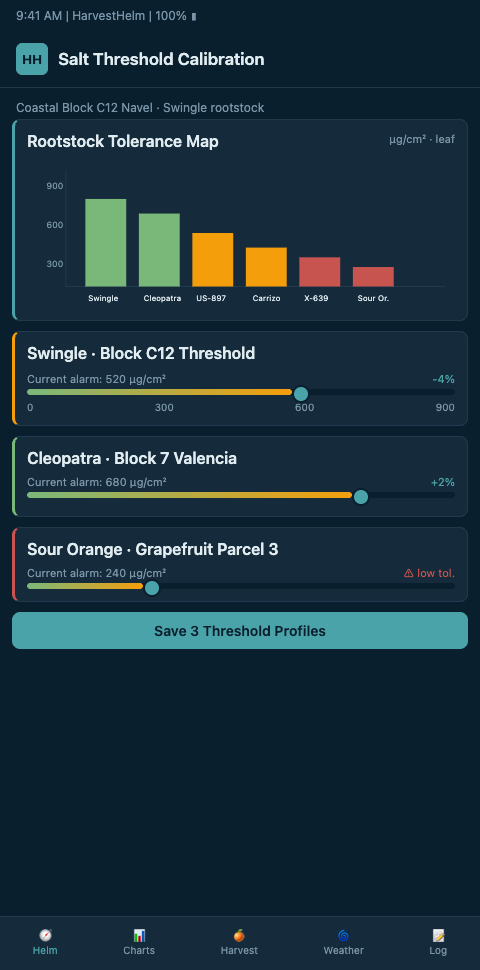
The yacht metaphor is the captain managing multiple engines with different fuel-burn curves. A single-engine boat has one fuel threshold. A twin-engine boat with a diesel main and a gas kicker needs separate thresholds per engine or the fuel-management system is wrong by default. Mixed-rootstock groves are multi-engine systems. Physiological analysis of salt stress behaviour of citrus species (ScienceDirect) makes the physiological case that low chloride accumulation is the mechanistic indicator of salt tolerance — and the accumulation rate is rootstock-specific.
HarvestHelm's calibration workflow pulls three inputs per block. First, rootstock identity from the planting records. Second, grove-installed conductivity and soil-salinity sensors updated at 15-minute intervals during active tracks. Third, seasonal baseline calibration runs conducted during low-risk periods to establish the background deposition rate under normal coastal conditions. The 2025 QTL study in Salt Tolerance Diversity in Citrus Rootstocks (MDPI Genes) confirmed genotypic diversity at the LCl-6 locus drives measurable tolerance calibration differences, which means even within a rootstock cultivar, regional variety differences may shift thresholds by 10 to 20 percent.
The threshold values HarvestHelm uses as starting points: Cleopatra Tier 1 at 160 ppm-hour salt-aerosol integral; Rangpur at 140; Volkameriana at 120; sour orange at 100; Swingle at 75; Carrizo at 65. These are seed values — actual deployment tunes the thresholds per grove based on three seasons of observed deposition-to-damage correlation. Managing Salinity in Florida Citrus (CREC publication) provides field-deployable salinity thresholds tuned to Florida rootstock inventory that anchor the starting-value math.
Cross-cultivar note: the scion matters too. Our mandarin navel salt workflow quantifies how Murcott mandarins on Cleopatra rootstock behave differently from Navel oranges on the same rootstock — both the leaf chemistry and the fruit-salt sensitivity differ. HarvestHelm threshold math layers scion sensitivity on top of rootstock tolerance for blocks where the combination matters.
Advanced Tactics: Seasonal Recalibration and Sensor-Validated Thresholds
Threshold calibration drifts. A Swingle block that tolerated 75 ppm-hour deposition three years ago may now fail at 60 ppm-hour because cumulative soil chloride loading has moved the base-state chemistry. HarvestHelm re-runs calibration every off-season, pulling soil samples from each block and adjusting the block-level threshold against the measured soil chloride baseline.
Sensor validation matters. Two conductivity sensors 200 meters apart in the same block can read different absolute values because of microtopography, wind shadow, and canopy density gradients. HarvestHelm cross-references sensor readings against known deposition events from prior seasons and flags sensor drift when the relative-to-absolute relationship shifts more than 8 percent between calibrations.
Upstream feed: the salt deposition patterns workflow covers how aerosol plume geometry drops salt onto the grove in ways that sensor placement must account for. Rootstock-specific thresholds work only if the sensor network captures the deposition gradient correctly. Blocks on the leeward side of a windbreak row have systematically lower deposition than windward blocks even at the same rootstock.
Cross-crop pattern: mango plantations running leaf wetness calibration programs face the same multi-cultivar threshold problem for fungal disease pressure. The calibration architecture — per-cultivar baseline, seasonal recalibration, sensor cross-validation — generalizes across agricultural threshold-management problems. HarvestHelm applies the same threshold-tuning framework across niche-specific deployments.
Documentation is the calibration's durability. Every threshold adjustment should log the data that drove the change, the expected effect, and the validation window. Two seasons of documented tuning produces a threshold library that survives personnel turnover and supports regulatory or insurance-audit inquiries.
Root Zone Versus Foliar Thresholds Tune Independently
Rootstock calibration splits into two distinct threshold systems: root zone (soil chloride and sodium) and foliar (leaf-surface deposition). The two systems respond to different mitigation levers and operate on different time scales. Root-zone accumulation develops over weeks to months as irrigation-water salinity and deposited aerosol gradually integrate into soil chemistry. Foliar deposition triggers on hours to days during active salt events and can push leaves past the 1,500 ppm threshold before root-zone changes are measurable.
HarvestHelm maintains separate threshold models for each system per rootstock. A Swingle block might have a root-zone chloride threshold of 1,800 ppm in soil water and a foliar threshold of 1,400 ppm equivalent — two numbers that trigger two different mitigation responses. Leaching irrigation addresses the root-zone; fresh-water rinse and kaolin coating address the foliar. The dashboard shows both thresholds with their current values and projected trajectories.
Seasonal rhythms matter. Root-zone chloride tends to accumulate during summer irrigation periods when evapotranspiration concentrates soluble salts, then partially flushes during winter rain events. Foliar deposition follows the tropical storm season cadence. The calibration model accounts for seasonal baseline shifts so a "normal" reading in August differs from a "normal" reading in February.
Rootstock Database Maintenance
The threshold model is only as good as the underlying rootstock data. Planting records from older blocks often have rootstock uncertainty — "Cleopatra or sour orange" entries from plantings 20+ years ago are common. HarvestHelm supports leaf-sample based rootstock verification during off-season audits, pulling leaf chemistry profiles that can narrow ambiguous rootstock identity.
Mixed plantings within a single block require sub-block threshold math. A 40-acre block originally planted uniformly on Swingle but replanted with 15 percent Cleopatra after citrus greening losses has two threshold populations inside what the harvest crew treats as one block. HarvestHelm supports sub-block polygons with distinct rootstock metadata, so the threshold map reflects the actual planting heterogeneity rather than an assumed uniformity.
Propagation lineage occasionally matters at the next level down. Two sour-orange rootstocks from different nurseries can exhibit 10 to 15 percent tolerance variation due to selection differences. Grove records that track nursery source by block support the fine-grained threshold tuning that turns a "good" calibration into a "grove-specific" one.
Integration with Irrigation and Mitigation Systems
Per-rootstock thresholds drive per-rootstock mitigation responses. HarvestHelm integrates the threshold model with the irrigation control system so night-irrigation cycling activates on a rootstock-specific trigger rather than a uniform grove-wide trigger. A Cleopatra block hitting 140 ppm-hour aerosol integral gets a 2-hour night-irrigation cycle; a Swingle block hitting 65 ppm-hour triggers the same cycle. The irrigation response is proportional to rootstock sensitivity.
Kaolin application routing works the same way. The spray-rig dispatch queue routes to blocks based on their rootstock-specific threshold-crossing likelihood over the next 24 to 48 hours. A windward Swingle block with a high probability of crossing threshold gets the earliest spray slot; a leeward Cleopatra block with lower probability moves down the queue. The dispatcher does not need to manually rank blocks each event — the dashboard pre-ranks them from the threshold math.
Stop Alerting the Whole Grove at the Same Threshold
Mixed-rootstock coastal citrus groves running Valencia, Hamlin, Murcott, and Navel on Cleopatra, Swingle, Carrizo, and sour orange cannot share a single salt-alert threshold without generating false positives on tolerant blocks and missing critical events on sensitive blocks. HarvestHelm runs per-rootstock, per-block threshold math against your grove sensor network, with seasonal recalibration and sensor cross-validation baked into the helm-charted yield forecast. Book a rootstock-calibration walk with us before the next onshore event and we will install per-quadrant probes on your Cleopatra, Swingle, Carrizo, and sour-orange blocks for a one-season validation. Zero upfront. The kilo-cut on successful harvest keeps the tool honest about which rootstock-threshold combination saves fruit and which one burns canopy.