Alphonso vs Kesar: Fungal Vulnerability in Heavy Monsoon Regions
The Cultivar Split: Why Alphonso and Kesar Need Different Spray Calendars
Alphonso and Kesar are both high-value Indian mango cultivars, both anchor the export trade for major producers, and both get treated as a single "Indian mango" in generic disease guidance. They should not be. Fungal vulnerability in heavy monsoon regions differs between them in ways that translate directly into spray decisions, yield outcomes, and export-grade proportions.
Springer research on climatic variables and disease incidence in commercial cultivars conducted during the 2017 to 2018 seasons documented differential disease response across six commercial cultivars under the same climate variables. SCIRP's evaluation of mango varieties against powdery mildew provided cultivar-specific infection dynamics data, showing how humidity and temperature drive uneven outcomes.
The National Horticulture Board of India guidance on mango diseases reported powdery mildew losses up to 90% with significant variance across cultivars. IgMin Research warned that a 0.7 to 1.0 degree Celsius temperature rise could render parts of Maharashtra and Karnataka unsuitable for quality Alphonso production, underscoring that Alphonso's vulnerability profile is not symmetric with Kesar's.
The practical consequence: a plantation running both cultivars on identical spray schedules is either over-spraying one or under-spraying the other, or both. The captain cannot steer two boats on one chart. Helm-charted yield forecasts built around cultivar differentiation fix this.
The cost of ignoring cultivar differences shows up in unexpected places. Alphonso's premium export price is tightly tied to blemish-free skin, so even minor anthracnose lesions can drop a crate from export to domestic grade, cutting the kilo realization by half or more. Kesar pricing is more forgiving of minor cosmetic issues but is sharply sensitive to internal quality, which powdery mildew-stressed flowers can compromise at fruit set. The two cultivars have different failure modes with different economic tails. One spray calendar cannot serve both.
Helm-Charted Cultivar-Specific Spray Protocols
HarvestHelm runs per-cultivar fungal vulnerability models on the helm-charted yield forecast, so Alphonso blocks receive Alphonso-calibrated spray schedules and Kesar blocks receive Kesar-calibrated schedules. Like a yacht that trims the sails differently for a headsail versus a mainsail in the same wind, the helm adjusts fungicide timing, dosing, and chemistry per cultivar within one unified dashboard.
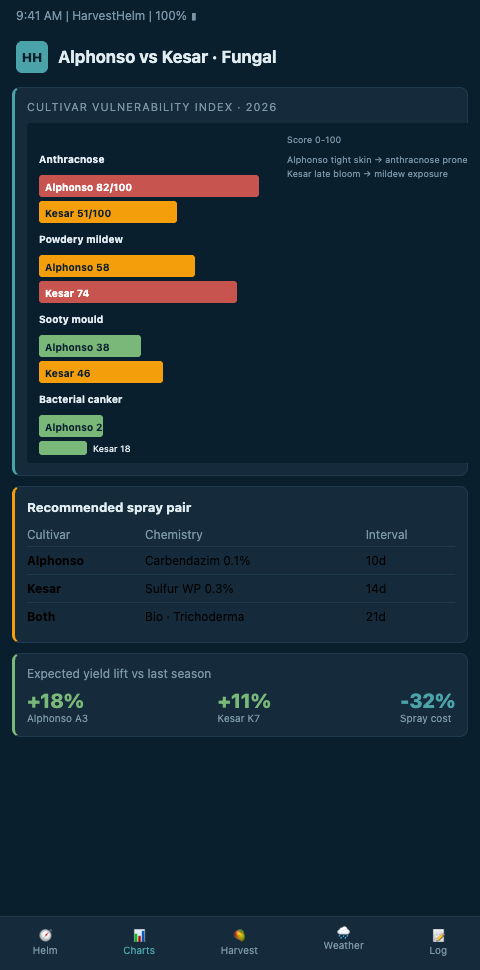
The first layer is anthracnose susceptibility mapping. Frontiers Microbiology research on mango anthracnose documented that anthracnose is endemic wherever mangoes grow, with some cultivars showing moderate genetic resistance. Alphonso tends to be more susceptible during early panicle emergence under high canopy humidity; Kesar maintains relative resistance during panicle stages but shows heightened susceptibility during late fruit development in heavy-rainfall weeks. The helm tracks canopy conditions against cultivar-specific vulnerability curves, so alerts trigger based on what each cultivar actually needs.
The second layer is powdery mildew differentiation. Per SCIRP's cultivar evaluation data, powdery mildew infection dynamics vary sharply by cultivar. Kesar shows stage-specific susceptibility that often peaks during pre-monsoon flush, while Alphonso carries risk across a broader flowering-to-early-fruit window. The helm applies separate powdery mildew pressure indices per cultivar, with canopy temperature and humidity thresholds tuned to each.
The third layer is spray chemistry selection. Copper-based sprays work well for Alphonso anthracnose prevention during pre-emergence but can stress Kesar during hot-humid periods. Sulfur-based applications are effective against powdery mildew but have cultivar-specific phytotoxicity thresholds. The helm recommends chemistry choices per cultivar, per stage, not one spray recipe for the whole plantation. This is where the block-level helm view saves both fungicide cost and fruit damage.
The fourth layer is economic weighting. Alphonso commands significantly higher export price than Kesar in most markets, so the economic cost of a lost kilo differs. The helm weights intervention ROI per cultivar: an Alphonso kilo protected might justify more aggressive preventive spray than a Kesar kilo protected, depending on current market pricing fed through APEDA's mango export portal and other trade data. Plantations use this weighting to allocate finite spray rig time optimally across cultivars.
The fifth layer is micro-regional calibration. Alphonso grown in Konkan versus Alphonso grown in Karnataka shows different vulnerability profiles due to soil, slope, and regional climate patterns. The helm layers micro-regional corrections onto cultivar vulnerability curves, so your Ratnagiri Alphonso block is not treated like a Devgad Alphonso block even when the cultivar is identical. This level of calibration catches the subtleties that generic cultivar guidance papers over.
CISH ICAR, the Central Institute for Subtropical Horticulture, maintains a 755-germplasm genebank and publishes cultivar research that HarvestHelm integrates into vulnerability models. When new cultivar-specific research updates the model, the helm's per-cultivar curves update too. You are not locked into 2020 vulnerability assumptions in a 2026 climate.
The kilo-cut pricing makes this cultivar-specific intelligence free at the point of adoption. HarvestHelm earns only on export-grade tonnage shipped, so the cost of cultivar-specific sensing and modeling is absorbed by the platform until the fruit actually lands at buyer grade. Plantation managers running mixed Alphonso-Kesar operations have more to lose from generic spray programs than from cultivar-specific ones, yet the switch is cost-free.
Advanced Tactics: Cultivar-Level Season Planning
Three advanced practices compound the cultivar-specific view.
First, allocate blocks by cultivar risk profile. Heavy-monsoon slopes with high canopy humidity suit Kesar's broader tolerance better than Alphonso's anthracnose-sensitive profile. The helm's archived block-level canopy data informs long-run cultivar allocation decisions: which blocks to replant with which cultivar over a 5- to 10-year horizon. This is capital-allocation guidance that pays off over decades, grounded in actual canopy observations rather than regional-average assumptions.
Block-by-block cultivar rebalancing is a slow but high-ROI lever. Replacing underperforming Alphonso blocks in chronically humid zones with Kesar, or introducing Tommy Atkins on the more exposed ridge blocks, can lift plantation-wide export-grade proportions year over year. The helm's cultivar vulnerability data makes these decisions evidence-based rather than intuition-driven. Five years of archived block-cultivar-canopy data is a planning asset that no consulting firm can replicate from satellite data alone.
Second, integrate with leaf wetness calibration workflows. Leaf wetness duration drives fungal risk for both cultivars, but the duration thresholds differ. Alphonso's anthracnose-conducive threshold is different from Kesar's. The helm maintains cultivar-specific leaf wetness models so the same sensor data produces different spray advice per cultivar. This is the precision that turns a generic orchard weather station into a cultivar-specific decision engine.
Third, feed cultivar-specific spray data into powdery mildew prevention playbooks. Pre-monsoon flush is the critical window for powdery mildew, and cultivars differ in how their flush responds. The helm integrates flush timing, cultivar vulnerability, and canopy humidity into a unified pre-monsoon spray protocol that minimizes overspray while protecting both cultivars.
The compound effect of cultivar-specific protocols is measurable over time. A plantation that tracks its own cultivar-level fungal outcomes across seasons builds a proprietary dataset that beats any generic guidance. After three seasons, the helm will know your Block 4 Alphonso responds best to a specific sulfur-copper rotation while your Block 11 Kesar benefits from a different cadence. That plantation-specific intelligence is the asset that compounds season after season.
Cross-crop parallel: desert date palm cultivars, particularly Medjool and Deglet Noor, face analogous wind-shear vulnerability splits that drive medjool deglet wind shear advisory workflows. The principle generalizes: cultivar-level calibration beats crop-level averages, every time.
Fourth, build cultivar-labeled audit trails for export compliance. When a buyer rejects a crate citing disease, the plantation with cultivar-labeled sensor data, spray logs, and stage-level records can respond with evidence and negotiate. Plantations without that trail absorb rejections silently and lose leverage. The helm's archive supports export-compliance conversations at a level of specificity that generic farm records cannot match. This is especially valuable when dealing with EU and Middle East buyers who request phytosanitary documentation.
Fifth, close the loop with post-season audits. After each season, run a cultivar-level audit comparing predicted vulnerability scores against observed disease incidence and export-grade outcomes. The helm tightens vulnerability curves per cultivar, per block, over time. Your second season is measurably more accurate than your first; your third season is more accurate than your second.
CTA: Separate Your Alphonso and Kesar Spray Programs Before the Next Monsoon
If your current spray program treats Alphonso and Kesar identically and your season-end disease audit shows uneven outcomes, HarvestHelm can deploy cultivar-specific sensor-based spray protocols before your next pre-monsoon window. We calibrate vulnerability curves to your plantation's cultivar mix, integrate with spray rig logistics, and run the dashboard through your full disease season. Zero upfront cost. We only take a share of export-grade tonnage that actually ships. Ratnagiri Alphonso and Junagadh Kesar operators running side-by-side cultivars have the most to gain. Book a block walkthrough to map cultivar-specific sensor placement before pre-monsoon humidity spikes start accumulating.
Day one of the helm view displays parallel vulnerability curves for Alphonso anthracnose and Kesar powdery mildew on one chart, with chemistry recommendations weighted by current APEDA export-price differentials. Waitlist slots prioritize plantations running at least 30 acres of Alphonso against 30 acres of Kesar or Totapuri, where cultivar-split spray economics produce the widest first-season margin lift. Reserve coverage at least seven weeks before pre-monsoon flush so we can baseline each cultivar's canopy seal coefficient and archive a first-season inoculum snapshot across every block.