Preventing Powdery Mildew Outbreaks During Pre-Monsoon Flush
90% Loss on the Line: Why Pre-Monsoon Flush Is Mildew's Favorite Window
Mango powdery mildew moves fast during pre-monsoon flush. CTAHR Hawaii research on mango powdery mildew documented that populations of Oidium mangiferae build rapidly during seasonal flushes, with young leaves highly susceptible. The National Horticulture Board of India reports powdery mildew losses reaching 90% during severe outbreaks, with cool nights and rain or mist driving pre-monsoon flush infections.
Wikipedia documentation on Oidium mangiferae confirms the disease thrives at 10 to 31 degrees Celsius and 60 to 90% RH, with sulfur and copper the most common treatments. SCIRP's evaluation of mango varieties and powdery mildew infection dynamics showed cultivar-specific susceptibility during flush stage with temperature/humidity correlations. The point: the combination of cool nights and humid canopy, common during pre-monsoon flush, is exactly the pathogen's preferred environment.
Regional forecasts rarely capture these conditions at canopy scale. A district might report "partly cloudy, 22 to 28 degrees Celsius, light showers possible," and the plantation's pre-monsoon flush is sitting in the 68 to 82% canopy RH range at night with cool enough temperatures for rapid conidia production. By the time a grower sees white fungal bloom on young leaves or flower panicles, the outbreak has colonized substantial canopy area and defensive options are costly and often late.
The asymmetry of the problem matters: prevention at the pre-flush stage costs a fraction of curative interventions post-outbreak, and prevention preserves bloom potential while curative sprays often cannot restore damaged tender tissue. Plantations that recognize this asymmetry move their capital upstream, toward sensors and early-warning systems, and downstream costs collapse. Plantations stuck in calendar-reactive spray modes spend more on chemicals every year without matching yield gains. The pre-monsoon flush window is the single highest-leverage period in the mango calendar for this strategic shift.
Helm-Charted Mildew Prevention: Pre-Flush Staging and Canopy Alerts
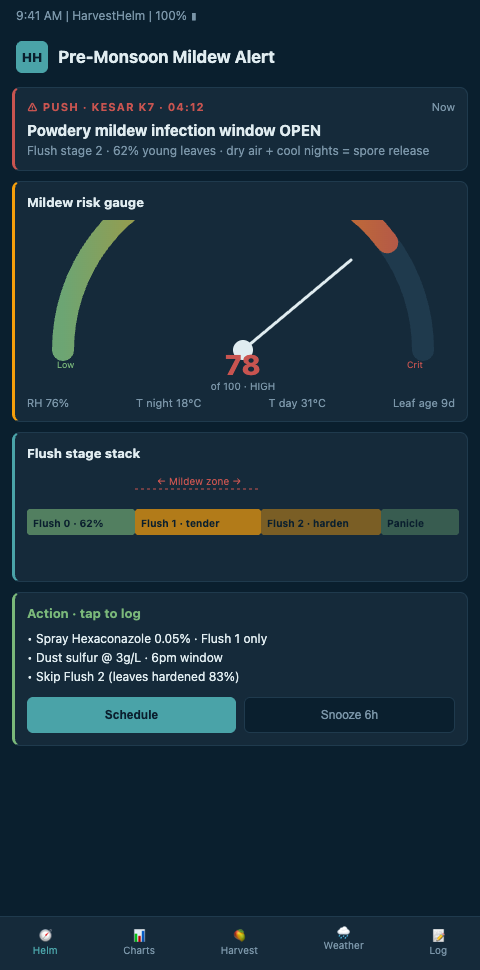
HarvestHelm structures powdery mildew prevention around canopy-level sensors, cultivar-specific susceptibility curves, and flush-stage phenology, all displayed on the helm-charted yield forecast dashboard. Like a yacht that watches barometric pressure for incoming storms rather than waiting for the rain to hit, the helm watches canopy conditions for mildew-conducive signatures before visible symptoms emerge.
The first layer is pre-flush susceptibility mapping. Different cultivars show different flush-stage susceptibility to powdery mildew. Using SCIRP's cultivar evaluation data, the helm builds per-cultivar susceptibility curves tied to temperature, humidity, and flush maturity. A young Alphonso flush with tender leaves at 65 to 75% canopy RH and cool nights presents a high-risk profile. The helm flags this combination 48 to 72 hours before traditional spray schedules would call for intervention.
The second layer is canopy condition tracking. UF/IFAS Florida extension on managing anthracnose and powdery mildew on mango emphasized preventive management timing around flush and bloom stages. Sensors track night lows, morning humidity decay rates, and leaf wetness integrals, building a mildew pressure index per block. The helm translates these into action tiers: safe, watch, prevention, urgent.
The third layer is spray chemistry selection. Nature Scientific Reports research on sulfur nanoparticles on powdery mildew in Keitt mango provided recent trial data on sulfur-based prevention strategies. ISHS control of powdery mildew in mango by fungicides supplied peer-reviewed fungicide efficacy evaluations against O. mangiferae. The helm recommends chemistry and dosing per block based on cultivar, flush stage, canopy conditions, and prior-season residue considerations. Sulfur for some blocks, copper for others, rotation schedules for resistance management.
The fourth layer is flush-stage action routing. Every block in pre-monsoon flush gets a personalized prevention playbook: dates for first preventive spray (tied to canopy humidity thresholds, not calendar), dates for follow-up applications (tied to observed mildew pressure trajectory), and stand-down triggers (when canopy conditions move out of conducive zone). Spray rig deployments sequence across blocks by priority, and the helm surfaces trade-offs when resources are finite.
The fifth layer is post-spray efficacy tracking. After each preventive application, canopy sensors measure how quickly mildew-conducive conditions recur and whether disease pressure continued rising despite intervention. When a spray underperforms, the helm flags the miss and recommends a chemistry adjustment or dose change for the next round. When a spray clearly suppressed pressure, the helm extends the stand-down window and avoids unnecessary follow-up applications. Every spray becomes a data point in refining the next one.
The kilo-cut pricing makes adoption simple. HarvestHelm deploys canopy sensors, runs the mildew prevention dashboard through the pre-monsoon flush window, and earns only on the export-grade tonnage that ships. Plantations that have suffered recurring powdery mildew losses despite calendar spray programs typically find that first-season helm deployment recovers significant tonnage while reducing total chemical use. The platform captures a small share of the upside and absorbs cost alongside the plantation if the season underperforms.
Advanced Tactics: Preventing Mildew Across Multiple Flushes
Three advanced practices extend mildew prevention across the multiple flush cycles a mango season typically contains.
First, track flush synchrony across blocks. Pre-monsoon flush is not a single event; different blocks flush at slightly different times based on irrigation, pruning, and canopy management history. The helm maps flush synchrony per block so prevention spray rounds can be staggered rather than plantation-wide. This reduces labor peak demand and improves spray coverage during the actual vulnerability windows.
Staggering also allows smaller plantations to manage pre-monsoon flush without renting extra spray rigs. If Block 3 flushes on March 5 and Block 11 flushes on March 18, a single rig can cover both with proper scheduling. Without helm-driven synchrony mapping, many plantations either mistime the second-wave blocks (spraying too early when canopy conditions have not yet become conducive) or miss them entirely while chasing the first wave.
Second, connect mildew prevention with anthracnose canopy pressure workflows. Anthracnose and powdery mildew often share overlapping canopy condition triggers, and single-spray deployments can sometimes protect against both when chemistry is chosen carefully. The helm integrates both disease pressure indices so managers can identify moments when one spray can cover two threats.
Third, integrate with low-spray panicle strategy planning. Powdery mildew prevention during pre-monsoon flush sets the stage for the main panicle emergence window. Early mildew outbreaks damage tender leaves and weaken the tree's ability to support healthy panicles. Getting pre-monsoon flush protection right is an investment in the main bloom season's yield potential.
Carrying this forward, successful pre-monsoon flush protection also reduces inoculum carry-over into the main bloom season. A plantation that enters panicle emergence with low fungal inoculum benefits from easier disease management through the rest of the season. A plantation that enters with high inoculum spends the entire bloom season fighting fires. The pre-monsoon flush window is effectively a trigger point for the season's overall disease trajectory, which is why helm-driven precision at this stage compounds across the subsequent months.
Cross-crop parallel: citrus growers facing analogous post-event recovery decisions run post-storm fruit split workflows that share the same principle: recovery after stress events depends on pre-event preparation and rapid response. Mango pre-monsoon flush is the equivalent window for getting mildew defenses ready before the heavy-pressure season begins.
Fourth, maintain a seasonal mildew archive per block. The helm logs every conducive hour, every spray deployment, every observed mildew incidence. After two or three seasons, the plantation has a mildew-risk profile per block that informs long-term decisions: which blocks need canopy density pruning, which need drainage improvement, which are candidates for replanting with more tolerant cultivars. This multi-season learning is what separates plantations that trend upward year over year from those that repeat the same mistakes.
Fifth, coordinate with export-packing quality audits. Powdery mildew can compromise fruit surface quality and invite post-harvest pathogens. Helm-archived mildew pressure data per block, mapped against harvest batches, produces traceability that export buyers increasingly request. Plantations with clean, documented records earn first-call access to premium buyers; plantations without them compete at the margin.
CTA: Build Pre-Monsoon Mildew Defenses Before the Next Flush Starts
If your plantation has lost tonnage to powdery mildew during pre-monsoon flush in the last two or three seasons, HarvestHelm can deploy canopy-level mildew pressure tracking and prevention protocols across your Alphonso, Kesar, or Tommy Atkins blocks before the next pre-monsoon window opens. We build cultivar-specific susceptibility curves, time preventive sprays against canopy conditions, and archive decisions for multi-season learning. Zero upfront cost. HarvestHelm earns only on export-grade tonnage that ships through packing.
Plantations running mixed cultivars across 60-plus acres have the most to gain from flush-stage mildew protection that hits conducive windows precisely. Reach out to size sensor coverage before pre-monsoon night temperatures dip below cool-night thresholds. Day one of the dashboard surfaces flush-synchrony maps across every Keitt, Tommy Atkins, and Kesar block, a sulfur-versus-copper chemistry recommender calibrated to tender-leaf phytotoxicity thresholds, and a 48-hour conducive-window forecast anchored to your canopy's cool-night trajectory. Waitlist priority goes to Keitt and Kesar operations that lost more than 25 percent of tender-flush leaves last season.