Panicle Emergence Timing for Low-Spray Mango Bloom Strategies
30 to 50% Spray Reduction: The Prize Waiting on Panicle Emergence Timing
Calendar-based fungicide schedules are relics of a time before canopy sensors. PubMed research on weather-based fungicide spray programs showed weather-driven programs can cut fungicide inputs 30 to 50% compared to calendar applications, while maintaining equivalent or better disease control. APS Plant Disease research on leaf wetness temperature time fungicide programs confirmed that weather-based spray timing reduces fungicide applications without yield loss.
The mango-specific version of this logic runs through panicle emergence timing. If you know exactly when panicles are emerging and exactly how canopy conditions are trending, you can time prevention sprays to maximize efficacy while minimizing total applications. Miss the emergence window and every subsequent spray is playing catch-up. R4PDE's overview of plant disease prediction and warning systems documents how decision support systems substitute risk-based timing for calendar sprays across many crops, and mango is an ideal candidate.
The economic stakes are high. For Indian mango plantations, MIDH's IPM schedule on mango from the Mission for Integrated Development of Horticulture outlines stage-based IPM with specific chemical applications. When plantations default to calendar schedules, they spray whether or not panicle emergence has actually begun, often over-applying during vegetative flush and under-applying during actual panicle emergence. The mistimed applications rarely catch infection windows and frequently stress trees.
There is a compounding problem across years. Plantations that spray on calendar schedules tend to develop two patterns: chemical resistance in the local fungal population, and expectation-locked-in budgets that resist downward adjustment even when disease pressure is mild. Low-spray strategies fix both patterns by tying chemical use to observed canopy conditions. When pressure is low, you spray less. When pressure is high, you spray more, but on the right panicle stage, with the right chemistry, in the right window. The total ledger improves.
Helm-Charted Panicle Emergence: Timing Low-Spray Strategies
HarvestHelm times panicle emergence per block using canopy sensors and phenology models, displayed on the helm-charted yield forecast dashboard. The yacht metaphor holds: like reading true wind from apparent wind and boat speed, the helm derives panicle emergence timing from canopy temperature, humidity, and cumulative degree-hour progressions rather than a generic calendar date.
The first layer is a canopy-based emergence model. Using degree-hour accumulations from cool-period induction through panicle bud swell, the helm projects per-block emergence windows with confidence bands. A block might project "panicle emergence between Feb 14 and Feb 19, 75% confidence" rather than "emergence around mid-February, roughly." This precision lets you stage sprays to hit the actual emergence window, not a calendar proxy.
The second layer is paclobutrazol dosing integration. MDPI research on combined effects of fertilizer, irrigation, and paclobutrazol on mango established that paclobutrazol application advances floral bud break and controls panicle emergence timing. The helm factors paclobutrazol application history into the emergence projection, so blocks treated earlier show shifted emergence windows compared to untreated blocks. Dosing becomes a knob you turn with canopy feedback, rather than a one-size fixed dose.
The third layer is pre-emergence preventive spray scheduling. ITFNet's mango pest and disease management guidance from the International Tropical Fruits Network details copper/sulfur timing during panicle stages. The helm schedules preventive spray deployments for the 48-hour window before projected emergence when canopy humidity is trending to anthracnose-conducive. This is the window where prevention is cheapest and most effective.
The fourth layer is post-emergence monitoring. Once panicles emerge, canopy sensors track leaf wetness, humidity, and temperature against panicle-stage fungal vulnerability curves. Frontiers Environmental Science research on model-based forecasting of agricultural disease risk supports the principle of integrating inoculum, environmental, and satellite data for regional-scale spray decisions, and HarvestHelm operationalizes this at the block level. Each panicle stage gets its own threshold profile, and sprays trigger only when conditions warrant.
The fifth layer is rig deployment optimization. Spray rigs have limited daily capacity, and the helm sequences deployments by a combination of canopy pressure, emergence stage, cultivar economic value, and accessibility. The system proposes a daily rig plan rather than leaving the foreman to juggle paper schedules. This operational layer is where the dashboard meets the ground: the captain issues orders, the crew executes, and the plantation moves through the bloom season with deliberate cadence rather than improvised scramble.
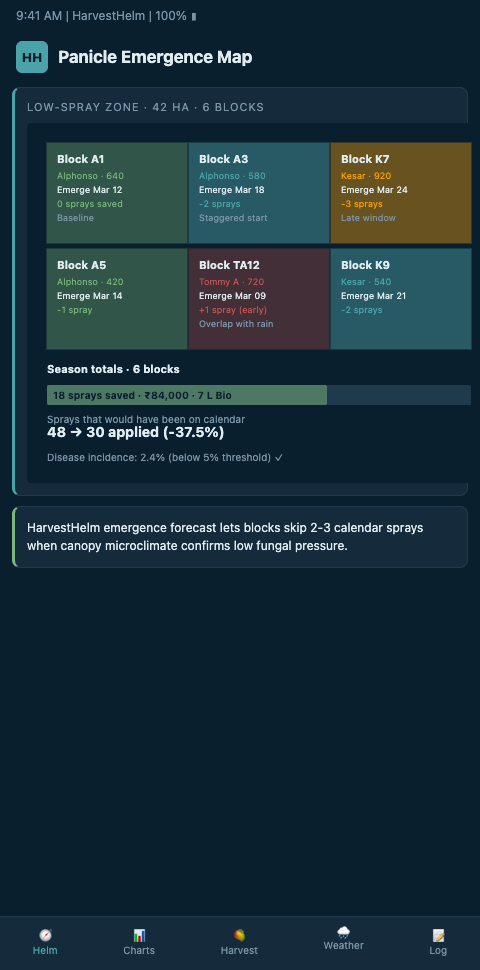
The kilo-cut pricing makes adoption frictionless. HarvestHelm earns only on export-grade tonnage that ships. For plantations using calendar-based spray programs that consume heavy chemical inputs without matching yield improvements, the switch to helm-driven timing typically reduces spray cost while lifting export-grade tonnage, and the platform captures only a share of the upside.
Critically, the low-spray philosophy is not about spraying less for its own sake. It is about spraying smarter. Some blocks in some seasons will receive more spray under the helm's guidance than under the calendar schedule, because canopy conditions warrant it. Other blocks will receive substantially less. The total program is data-driven, and across a season, typical plantations see 25 to 40% reduction in total fungicide use with equivalent or better disease outcomes.
Advanced Tactics: Compounding the Low-Spray Strategy
Three advanced practices extend the low-spray approach across multiple seasons.
First, archive spray decisions and outcomes per block per season. The helm tracks every spray trigger, every stand-down, every disease observation, and every export-grade outcome. After two or three seasons, you can quantify which blocks responded best to low-spray protocols and which needed more intervention. This feedback loop refines the model year over year and builds institutional knowledge that does not walk out the door when a staff member leaves.
The archived data also becomes the backbone of your insurance and bank conversations. Lenders and insurers value documented disease management records. A helm-archived three-year history of weather-based spray decisions, disease outcomes, and yield realizations is stronger than a set of paper logs and informal notes. When you apply for crop-insurance adjustments or harvest-backed credit, the helm archive supports your case with structured evidence.
Second, connect panicle emergence timing with Tommy Atkins sensors workflows for cultivars grown alongside Alphonso and Kesar. Tommy Atkins emergence timing differs from Alphonso's, and synchronizing the helm's emergence projections across cultivars lets you stage spray rigs for overlapping or sequential emergence waves.
Cross-cultivar staging is a subtle but high-value capability. If three cultivars emerge in three distinct windows, your spray rig can cover all three with careful sequencing. If the windows overlap significantly, you may need rented rigs or additional crew, and knowing weeks in advance lets you secure them at normal pricing rather than peak-demand premiums.
Third, couple emergence timing with pre-monsoon mildew prevention playbooks. Emergence during pre-monsoon flush carries elevated powdery mildew risk, and the helm integrates emergence timing with flush-stage mildew pressure so prevention sprays hit both the emergence window and the mildew-conducive conditions when they overlap.
Cross-crop parallel: citrus growers run predictive brine mitigation workflows that prioritize pre-event intervention over reactive response, the same philosophy that drives low-spray mango bloom strategies. The cross-crop lesson: interventions timed ahead of the physiological window cost less and accomplish more than reactive interventions after damage has begun.
Fourth, pair emergence-timing precision with export-compliance documentation. Buyers increasingly demand traceability on chemical applications. Helm-archived spray decisions tied to canopy-observed emergence timing produce documentation that holds up in phytosanitary audits. This matters for EU buyers and Gulf importers who conduct supplier audits and price accordingly. Plantations with clean records earn trust and repeat contracts; plantations without them compete on spot-market price alone.
Fifth, extend low-spray economics into supplier relationships. When your spray program tightens, your chemical supplier learns to expect narrower ordering windows and more variable volumes. Share forecasts from the helm to keep supply steady while volumes drop, and renegotiate unit pricing as your overall chemical consumption declines. Plantations that do this effectively see price-per-unit reductions in parallel with volume reductions, double-compounding the savings.
CTA: Time Panicle Emergence Precisely Before Your Next Bloom Cycle
If your current spray program runs on calendar dates and your fungicide bills are climbing without matching export-tonnage gains, HarvestHelm can deploy canopy-level panicle emergence tracking across your Alphonso, Kesar, or Tommy Atkins blocks before the next bloom cycle. The helm builds per-block emergence windows, times preventive sprays against canopy conditions, and archives decisions for season-over-season refinement. Zero upfront cost. We earn a small share only on export-grade tonnage that ships. Plantation managers running 80-plus acres across multiple cultivars stand to cut spray cost 25 to 40% in the first season while maintaining or improving disease outcomes.
Book a sensor walk-through to scope emergence timing coverage before the next bloom window opens. Day one of the helm view shows degree-hour accumulation per block against cultivar-specific emergence thresholds, plus a rig-route proposal that sequences deployments across Alphonso and Totapuri blocks entering emergence on different days. Waitlist priority goes to plantations whose fungicide cost per acre has climbed above the regional median while their packhouse export-grade ratio has stayed flat, since this is where calendar-to-canopy switching generates the fastest ROI.