5 Panicle Stage Sensor Checks for Tommy Atkins Bloom Tracking
The 3-Week Thermal Window That Decides Your Tommy Atkins Season
Tommy Atkins is the export workhorse of tropical mango: heat-tolerant, long-shelf-life, and bankable for overseas buyers when the bloom produces. But the cultivar has exacting physiology. ScienceDirect research on floral induction in Tommy Atkins by temperature established that floral induction requires 18 degrees Celsius day temperatures and 10 degrees Celsius night temperatures sustained for at least three weeks. Miss that window and the trees stay vegetative. Hit it partially and you get erratic panicles, high staminate flower ratios, and poor fruit set.
SCIRP data on growth and flowering of five mango cultivars in Brazil showed Tommy Atkins flowering onset in May with end in October across a 75-day average duration in subtropical environments. That window is tight, and it is exactly where canopy-level sensor checks at discrete panicle stages earn their cost. UF/IFAS Mango Science's Tommy Atkins phenology program confirms the staged development pattern that makes five checks, not one, the right cadence.
The failure mode is familiar. A plantation relies on district-scale forecasts, sees "cool front arriving next week," and writes off the induction question. Three weeks later, half the blocks have panicles, a third of those have irregular emergence, and the export contract target sits unreachable. By the time the failure shows up, you are weeks past the decision window. The remedy is staged sensor checks that flag the drift before it compounds.
The economic stakes are specific for Tommy Atkins growers running export programs. Missing the induction window rolls the season toward late, compressed bloom and reduces harvest-ready trees when export slots are locked in. A block shifting from 60% hermaphrodite ratio to 35% means a third less shippable fruit from that block. Multiplied across 40 to 300 acres of a typical Tommy Atkins operation, this is the difference between hitting export targets and scrambling for spot-market fruit to honor contracts.
Helm-Charted Bloom Tracking: 5 Sensor Checks That Keep Tommy Atkins on Course
HarvestHelm structures Tommy Atkins bloom tracking around five sensor checks per block, each mapped to a defined panicle stage from the ScienceDirect BBCH phenological scale for mango. The helm-charted yield forecast treats each check as a waypoint on the yacht-style dashboard: miss a waypoint, and the dashboard tells you the bearing correction before the next stage.
Check one: induction threshold. During weeks preceding expected bud break, canopy sensors track degree-hour accumulation against the 18C/10C profile. The helm computes a cumulative induction score, flagging blocks that drift below threshold. Tommy Atkins needing induction support may get targeted paclobutrazol or night-temperature manipulation via windbreak adjustments. The goal: confirm induction or act before the three-week window closes.
Check two: bud swell and elongation. Once induction is confirmed, canopy sensors watch for the temperature and moisture profile that drives healthy bud swell. A ResearchGate study on mango panicle parameters and weather showed measurable weather effects on panicle length, branching, and flower count. The helm tracks block-level sensor readings against expected bud development trajectories, flagging blocks where swell is lagging or advancing ahead of schedule.
Check three: panicle emergence uniformity. Block-scale cameras and sensor-density maps track whether panicles emerge synchronously. Asynchronous emergence (greater than 10-day spread within a block) signals underlying canopy heterogeneity, usually from irrigation imbalance or slope-driven microclimate. The helm flags this asynchrony so you can stage labor and spray crews for the drawn-out bloom rather than defaulting to a single deployment.
Check four: hermaphrodite ratio indicator. During flowering, canopy temperature profiles drive the hermaphrodite-to-staminate flower ratio. ScienceDirect research on varietal variations in hermaphrodite response found a mean minimum of 15 to 17 degrees Celsius maximizes hermaphrodite ratio, while sub-15 temperatures skew toward staminate and cut fruit set. The helm integrates night minimums across the flowering window and projects the hermaphrodite ratio per block. A block trending below 40% hermaphrodite flowers signals a probable fruit-set shortfall weeks before you could observe it physically.
Check five: pre-fruit-set pressure and panicle retention. Just after flowering, canopy sensors shift to tracking leaf wetness integrals, rainfall, and fungal pressure indices that drive panicle abortion risk. Semios in-canopy climate monitoring illustrates the per-acre, 10-minute interval precision that makes this stage actionable. The helm surfaces blocks where retention is at risk and routes protective spray deployments accordingly.
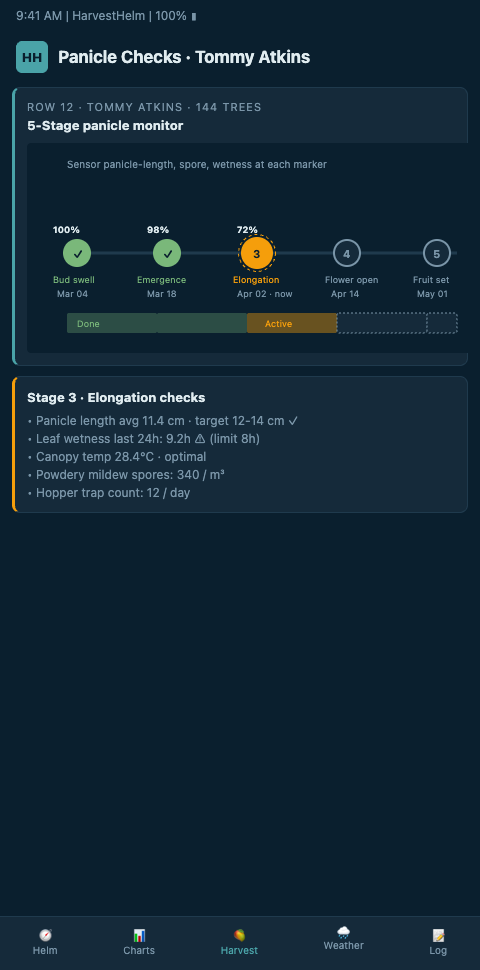
The five checks are not run once; they run continuously, with the helm refreshing block-level scores on the dashboard every 10 minutes. Managers check the board at dawn, mid-morning, and before dusk, catching drift that district-scale forecasts would never flag. The kilo-cut economics mean HarvestHelm only earns on Tommy Atkins tonnage that ships at export grade, so the interests of the plantation and the platform stay aligned through every sensor check.
A sixth ancillary check, often surfaced by the helm but not officially part of the five-stage workflow, tracks hopper and midge pressure. Mango hopper-midge scouts historically rely on trap counts and visual inspection, but the helm correlates sensor data (humidity profiles, temperature swings, wind direction) with known hopper-midge outbreak patterns. When the helm flags conducive insect pressure during panicle emergence, bloom-stage integrated pest management gets a sensor-informed nudge. This reduces both over-spraying of insecticides and missed infestations that reduce panicle retention.
Advanced Tactics: Scaling the Checks Across Multi-Cultivar Plantations
Three advanced practices compound the value of staged sensor checks.
First, run Tommy Atkins checks alongside Kesar and Alphonso on the same helm view. Different cultivars have different threshold curves, but they share the same canopy sensors. The helm translates a single stream of sensor data into per-cultivar pressure and phenology indicators. A manager watching three cultivars on one dashboard makes better staging decisions than one jumping between three spreadsheets. This is especially useful when you cross-reference with the multi-variety canopy map to plan labor rotation across varieties.
Plantations running four or five cultivars with overlapping bloom windows see the cumulative benefit fastest. Checks that would be error-prone when managed manually across cultivars become routine when a single helm runs parallel pipelines on the same sensor feed. Managers who have made this shift report that their first bloom season under the helm was the first time in years their phenology notes, spray schedule, and labor logs all agreed with each other at season end.
Second, link check outcomes to paclobutrazol dosing. ResearchGate work on BBCH scale phenology documents the mesostages where paclobutrazol timing matters. When induction scores from check one suggest marginal thermal accumulation, the helm adjusts the paclobutrazol dose recommendation to compensate. Dosing becomes data-driven rather than calendar-driven, reducing over-application and its carry-over effects.
Third, use hermaphrodite ratio projections from check four to gate thinning and labor decisions. If the helm projects a 35% hermaphrodite ratio in Block 4 Tommy Atkins, you know fruit set will be thin. Thinning labor can be reallocated; picking crews can be re-scheduled; forward contracts can be renegotiated before the buyer sees the shortfall. This is precisely the value of the low-spray panicle timing approach: decisions upstream of actual bloom, informed by canopy signals.
Cross-crop parallels matter here too. Date palm operators run analogous staged checks for pollination and early fruit set. The medjool deglet wind shear workflow captures the same principle: critical decisions staged across a narrow physiological window, driven by canopy signals rather than district averages.
A final check layer worth building in: labor and logistics staging. Tommy Atkins blooms span 75 days on average. If the helm shows block-level check outcomes trending differently (Block 3 induction confirmed early, Block 8 lagging by 12 days), you can stage crews, spray rigs, and harvest preparations to match the canopy-defined calendar instead of a single plantation-wide timeline. This staging alone can reduce labor costs 15 to 20% across a season, because idle days compress and peak days spread out. The kilo-cut pricing means the plantation captures all of that operational efficiency without paying HarvestHelm a dollar until shipped tonnage lands.
CTA: Put Canopy Checks on Every Tommy Atkins Block Before Induction Drifts
If your Tommy Atkins blocks have produced thin or irregular bloom in recent seasons despite favorable district weather, HarvestHelm can deploy a canopy-level sensor lattice tuned to the five-stage Tommy Atkins workflow before next induction window opens. We set up the checks, calibrate against your historical bloom records, and run the bloom tracking dashboard through flowering. Zero upfront charge. We earn only on Tommy Atkins tonnage that ships export-grade. Plantations operating Tommy Atkins alongside Alphonso or Kesar benefit most from running all cultivars on one helm. Book a sensor walk-through before pre-induction night temperatures arrive.
Day one of the deployment displays a cumulative 18C-day, 10C-night induction counter per block with a projected hermaphrodite ratio band that tightens as night temperatures accumulate. Waitlist slots favor Keitt and Tommy Atkins operations running 40-plus acres with historical fruit-set variance above 25 percent between adjacent blocks, since those plantations see the largest export-grade lift from staged spray routing. Lock coverage at least eight weeks before your region's traditional floral induction window so we can capture pre-induction baseline night temperature profiles and calibrate paclobutrazol dosing against your packhouse brix records from prior harvests.