Reading Anthracnose Pressure Signals Across a Humid Mango Canopy
The 5-Hour Germination Window Your District Sensor Cannot See
Mango anthracnose moves fast. A PMC review on anthracnose current situation documented that infection occurs within 5 to 7 hours of canopy conditions entering the 10 to 31 degree Celsius band with 60 to 90% relative humidity. Wiley research on climatic factors affecting Colletotrichum gloeosporioides in the Philippines found that conidia germinate at 95 to 100% RH, with dispersal tied directly to rainfall and canopy wetness. If your district station reports 68% RH and partly cloudy, the canopy interior can still be sitting at 96% with leaf wetness accumulating hour by hour.
The economic weight is heavy. A ScienceDirect review on postharvest losses documented that anthracnose accounts for 30 to 40% of annual losses in global mango trade, with 39% yield loss figures cited for India. For Alphonso and Kesar export programs where every kilo shipped commands premium pricing, even a single missed infection window can wipe the margin on an entire block.
The structural problem: anthracnose signals live inside the canopy, and the signals are temporal, not just spatial. A block might cross the 95% RH threshold at 03:00, hold it until 11:00, fall below it by afternoon, and cross it again after sunset. That pressure profile is invisible to once-daily forecasts, and it is the real driver of when spraying is worth the effort or pointless.
Compounding the hidden risk: multiple infection pulses can overlap inside a single week. Growers who react only when they see black lesions on panicles or fruit are responding to an outcome, not a signal. By the time a scout flags lesions in Block 4, the entire canopy has likely been exposed for days. You cannot unspray the past, so the economic logic all runs forward from early detection.
Helm-Charted Pressure Reading: From Canopy Signals to Spray Orders
HarvestHelm builds a canopy-level anthracnose pressure index using in-canopy sensors that read temperature, RH, leaf wetness duration, and wind flow at 10-minute intervals. The helm-charted yield forecast converts those raw feeds into a single pressure gauge per block, familiar to anyone who has stood behind a yacht's helm reading depth, heading, and wind speed in parallel. You see current pressure, 24-hour trajectory, and probable spray windows in one view.
The first input is the infection window counter. Using the Springer European Journal of Plant Pathology model on temperature and leaf wetness, the helm increments a counter every hour the canopy sits in the conducive zone. Hit 5 hours and the counter turns amber. Hit 7 and it turns red. This matches the physiological window for conidial germination and first-stage appressorium formation, which is when a spray intervention still has high ROI. Past that point, curative decisions get more expensive and less effective.
The second input is conidia load estimation. A Wiley Annals of Applied Biology Fitzell paper on mango anthracnose epidemiology demonstrated that conidia trap counts during prolonged rain explain outbreak timing better than almost any other variable. The helm estimates conidia load from recent rainfall depth plus canopy inoculum history, giving a weighted pressure score that reflects both environmental conditions and pathogen presence. A humid canopy with no rainfall in 14 days presents lower pressure than the same humidity after two days of leaf-splashing rain.
The third input is cultivar response. Alphonso, Kesar, and Tommy Atkins differ in susceptibility and in panicle stage timing. CTAHR Hawaii extension guidance documented canopy-level disease spread and symptom diagnosis patterns that let the helm calibrate cultivar-specific pressure curves. Your Alphonso Block 2 at early panicle emergence shows a different pressure response than your Kesar Block 7 at full bloom, even when canopy humidity is identical.
The fourth input is spray window optimization. The helm does not just alert; it proposes the optimal spray time given forecast wind, expected leaf drying after application, and labor logistics. If the conducive window is 02:00 to 09:00 today but you can only deploy a rig at 07:00, the helm tells you the value lost versus a 04:00 application, so you can make the labor decision with full economic context.
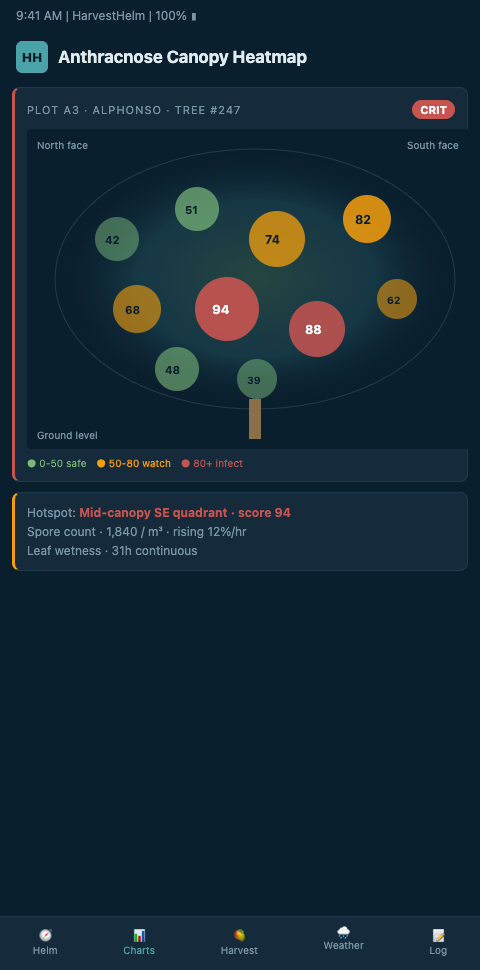
The output is a block-level pressure board. Each block shows current state (safe, elevated, conducive, critical), hours into the conducive zone, recent rain accumulation, predicted next conducive window, and suggested action. Managers walk the plantation at dawn with this board on their phone, confirming canopy conditions against sensor readings and signing off on spray rig deployments. The captain and the deck crew share the same chart.
A critical feature for multi-block plantations: the helm schedules spray rig routes by pressure priority. If Blocks 4 and 11 are both critical and Block 7 is elevated, but you have one rig for the day, the helm proposes a route that deploys on 4 and 11 first, leaves margin for 7 if canopy conditions drift further, and factors in fuel, water-refill points, and crew rotation. The captain is making trade-off decisions with the full board in view, not juggling paper schedules and WhatsApp messages.
UF/IFAS Florida extension research on mango anthracnose management emphasized that prolonged periods above 90% humidity create ideal conditions for anthracnose development. HarvestHelm logs every 90%-plus hour per block and weights cumulative exposure across the flowering-to-fruit-set timeline, so your season-end pressure history becomes a planning asset for the following season. The kilo-cut pricing means you pay nothing for this logging unless it translates into shipped export-grade tonnage.
Advanced Tactics: Mapping Canopy Pressure Across Panicle Stages
Three advanced practices separate plantations that merely react to anthracnose from those that actively manage it with helm-charted precision.
First, stage-weighted pressure tracking. Panicles are most vulnerable at early emergence and during full bloom. The same canopy pressure reading in late fruit set is physiologically different from the same reading during panicle emergence. HarvestHelm maintains stage-weighted pressure integrals that automatically adjust thresholds as blocks progress through phenology. A pressure score of 60 means something different in April than in January, and the helm knows.
Second, spatial pressure mapping. Mount a pair of paired sensors per block (mid-canopy inner, canopy-top outer). The delta surfaces where a block's humidity sealing is concentrated. High-seal zones get prioritized spray coverage; low-seal zones may need only perimeter treatment. This is where leaf wetness calibration cross-references with pressure reading to reduce over-spraying.
Third, inoculum memory carry-over. Anthracnose inoculum persists on infected twigs, mummified fruits, and leaf litter. Blocks with higher prior-season disease incidence carry elevated pressure baseline into the new season. HarvestHelm tracks prior incidence as a modifier on the current-season pressure model, so that a historically clean block and a historically infected block do not receive identical advice for identical current-season canopy humidity. This inoculum memory is the bridge between current conditions and realistic infection probability.
When you integrate these practices, the spray rig becomes a precision instrument. Some plantations drop total spray volume 20 to 35% while improving disease control, because stand-down calls on low-pressure blocks free the rig to deploy more aggressively on critical blocks. The precision-pressure philosophy also translates directly into powdery mildew prevention workflows, where the same pressure-index logic applies with different threshold curves.
Cross-crop analogy helps the intuition: citrus operators track salt ingress signals through leaf-level ion sensors before visible damage appears. The idea is the same across crops: capture the upstream signal before the downstream symptom, and your decision window widens from hours to days.
A final practice: archive canopy pressure histories per block per season. After three cycles, the helm can surface the blocks consistently running hot. Those become candidates for canopy-density pruning, irrigation rerouting, or drainage work. You are not just treating disease with sprays; you are reshaping the blocks that generate the highest pressure signals, investing capital where it compounds across future seasons. Helm-charted pressure reading is not a single-season trick. It is an instrument that teaches your plantation about itself.
CTA: Build Your Anthracnose Pressure Dashboard Before the Next Flush
If anthracnose is your recurring yield gap and you are still scheduling sprays off district RH readings, HarvestHelm can deploy canopy pressure monitoring across your Alphonso, Kesar, or Tommy Atkins blocks before the next panicle emergence stage. We build the pressure index, integrate your spray rig logistics, and surface 5-to-7-hour windows before germination is fait accompli. Zero upfront cost. We earn only on the export-grade tonnage that clears packing-house grading because your sprays hit canopy truth rather than district averages. Konkan and Ratnagiri operators running multi-cultivar blocks across 80-plus acres have the most to gain. Reach out to scope sensor placement before the pre-monsoon conducive windows start stacking up.
Day one of the dashboard shows a live pressure gauge per block, the current hour count in the conducive zone, and a proposed spray-rig deployment sequence weighted by cultivar export value. Waitlist priority goes to plantations carrying heavy anthracnose inoculum memory from the prior season, where early-stage pressure readings reshape the copper-sulfur rotation within the first 14 days. Book a scouting walk at least four weeks before your earliest block crosses into early panicle emergence so we can anchor the inoculum-history modifier against your packhouse rejection records and align canopy sensors with your existing mummified-twig cleanup map.