Integrating Wind Machine Triggers With Slope-Level Temperature Data
The Wind Machine That Ran All Night and Still Lost Block 14
A grower in Washington fired both wind machines at 33F based on a centrally mounted thermistor and burned through a full tank of diesel before dawn. When the sun came up, Block 14 Gala on the lower terrace showed 45% king-bloom kill while Block 22 Honeycrisp two rows uphill came through untouched. The lesson was hard: a single ambient reading cannot drive fan logic across a slope that holds three distinct cold-air pools. A ScienceDirect field study on wind machine operation at Washington apple sites documented a 60% cut in flower damage in 1999 and 37% in 2000 when fans were triggered against in-canopy readings, not average regional temperature.
The miss comes from how wind machines actually work. They pull warmer air from the inversion layer aloft down into the canopy, so they only help when an inversion is present and the lower canopy is the colder zone. Fire too early and the warmer pocket you are protecting is still warm. Fire too late and the critical bud temperature has already been crossed. Penn State Extension's orchard frost protection guidance recommends starting fans roughly 4F above the critical bud temperature, but that rule only works if the probe is reading the block that is actually exposed — not the warm ridge overhead.
Diesel cost compounds the error. A single 100-horsepower wind machine burns 5-7 gallons per hour. Running for an unnecessary 4 hours across two fans costs roughly $120-180 per event at current fuel prices. Over a 30-night frost-exposure season, a poorly-triggered setup can burn $2,000-4,000 in fuel protecting zones that never needed it while under-protecting zones that did. The grower in the opening scenario paid twice: once in diesel, once in lost Gala buds.
Wiring the Helm-Charted Yield Forecast to Fan Control
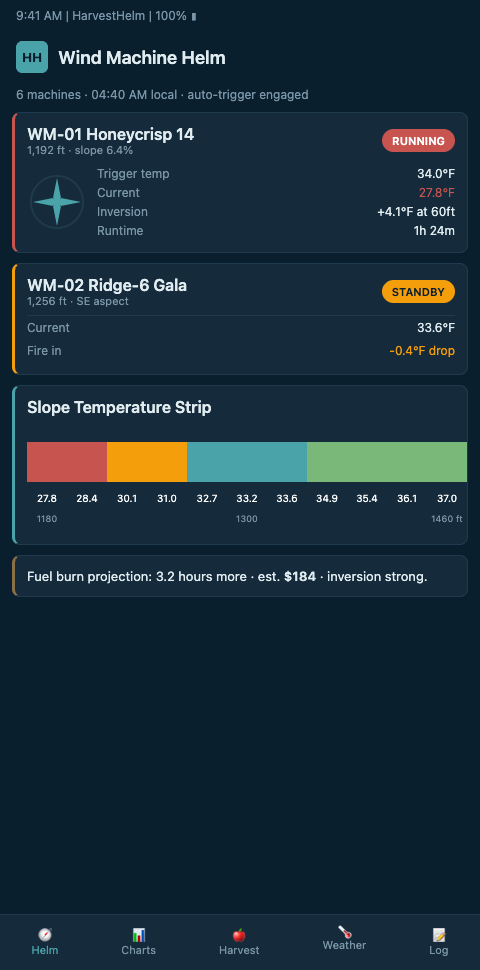
HarvestHelm treats each block as a station on a yacht-style helm display, and wind machine triggers are the throttle levers on that chart. The core design principle: a frost fan is a per-block actuator, and its trigger should come from the coldest certified probe inside its coverage ellipse, not from an orchard-wide average. When the helm-charted yield forecast runs, it is simultaneously asking two questions — what is the inversion strength between the canopy and the air 15 meters above, and which block is about to cross its cultivar-specific kill threshold. Both answers come from the same slope-level temperature data stream.
Inversion strength matters as much as canopy temperature. A Google Patents filing on wind machine control specifies a 1.5-6.0C top-bottom temperature delta as a trigger input, because a fan without inversion is pushing cold air horizontally into cold air — no heating benefit. A ScienceDirect 3D investigation found that for every 1C increase in inversion strength between 1.5 and 15 meters, fan operation raised canopy-level temperature by 0.3C. That is a measurable and bankable number when you are deciding whether diesel is worth burning on a marginal night.
Sensor frequency matters too. Rutgers NJAES E363 guidance on active frost protection recommends in-canopy sensors poll at least every 10 minutes so alerts reliably auto-start fans before critical temperatures are crossed. A 30-minute polling interval can miss the crossover on a fast-drop radiation frost night where canopy temperature falls 3F in 20 minutes. On a yacht, you do not check the wind vane every half hour when the weather is turning — you watch it continuously. The helm display in HarvestHelm mirrors that discipline. Block-level probes feed into a decision engine that cross-checks canopy temp, inversion strength, dew point trajectory, and cultivar bud stage before releasing the fan start signal. This is the same logic that earlier work on hyperlocal mapping during thinning windows frost established for uphill pockets where frost returns after midnight and the overnight forecast missed it.
Coverage geometry is where siting becomes a math problem. A FrostBoss analysis of katabatic drift describes the effective coverage ellipse as roughly 250m downslope and 90m upslope — asymmetric because gravity-driven drainage carries warmed air into the lower pocket. If you site a fan centered on a property line, half the ellipse protects the neighbor's block. HarvestHelm's siting view overlays the ellipse against elevation contours so the trigger probe is placed at the geometric cold sink of the protected zone, not the center of the fan's footprint.
Dew-point trajectory is the underappreciated third input. A radiation-frost night where dew point is under 30F loses heat faster than a night where dew point sits at 36F, because dew deposition releases latent heat as moisture condenses on leaves. HarvestHelm's trigger engine reads the 6-hour dew-point trajectory and adjusts the fan-start lead time — starting 15 minutes earlier on a rapidly drying night, 15 minutes later on a moist night. That fine-grained timing saves roughly 30 minutes of runtime per marginal event across a typical April-May season.
Calibrating Triggers by Block and Cultivar
Once block-level wiring is in place, the calibration work is about matching trigger thresholds to the cultivar inside each ellipse. Honeycrisp king bloom at pink stage fails at 28F. Gala at the same stage has a modestly different kill curve. Fuji, which blooms later, sits in a different calendar window entirely. A single orchard-wide trigger set to Honeycrisp protects nothing well — it fires too aggressively for Fuji and not aggressively enough for a fully open Gala block. HarvestHelm loads per-block cultivar metadata and phenology stage so the trigger temperature floats by 2-3F across the season, tightening as buds advance.
Adjacent tooling helps here. Orchard-Rite's ORCell remote monitoring pairs Auto-Start temperature triggers accurate to +/-0.5F with remote gateway telemetry per fan, which is the hardware class HarvestHelm integrates for block-level fan control. Semios's frost management platform is another commercial system that triggers wind machines from in-canopy sensor data per block — the industry is converging on this approach.
Override modes matter for the grower who wants a human in the loop. HarvestHelm supports three modes per block: fully automated (the system starts and stops fans without confirmation), advisory (the system alerts the grower and requests confirmation before start), and manual (the system provides probe data but does not touch the fan relay). Most operations begin in advisory mode, build trust with the trigger logic over 2-3 frost events, then migrate blocks to automated mode individually. A 3am frost alert that fires before the grower is out of bed is exactly when automation earns its value — but only after the probe grid has been validated.
The failure mode to avoid is over-reliance on a single probe. Install at least two probes per protected block — one at the expected cold sink, one at mid-canopy — and set the trigger to fire on the colder of the two plus a dew-point check. If either probe fails, the other maintains coverage without manual intervention. Cross-referencing against the cold-sink-informed multi-block harvest schedule means the same geometry that drives pick order also drives fan siting, so you are not maintaining two mental models.
Integration with over-tree sprinkler systems is the next frontier. Some orchards pair wind machines with over-tree sprinklers for extreme-event protection. The trigger logic has to coordinate: sprinklers should start before the fan if temperatures are falling fast, because wet blades freezing in warm air can mask the actual canopy temperature. HarvestHelm's combined-actuator mode treats the sprinkler and fan as a two-stage protection ladder, firing the sprinkler at a higher threshold and the fan at a lower threshold, with both driven by the same probe grid.
Documentation of trigger events matters too. Every fan start and stop is logged with probe readings, dew point, inversion delta, and cultivar bud stage. That log feeds two downstream workflows — diesel reconciliation, so the grower knows fuel spend by event, and crop insurance documentation if a frost exceeds the fan's protective envelope and bud damage occurs anyway. The parallel work in arid climates is instructive. HarvestHelm's sister approach for desert groves uses drip irrigation telemetry tied to diurnal swings to trigger actuators off the same hyperlocal sensor grid principle — different threat, same sensor-to-actuator logic.
Maintenance discipline protects the system. A probe that drifts out of calibration by 1.5F during the off-season will over-trigger or under-trigger fans next spring. HarvestHelm's pre-season check schedules a 48-hour calibration window where every probe is benchmarked against a reference thermometer, and drift beyond 0.3F triggers a replacement recommendation. The same discipline applies to fan-start relays and temperature-sensor wiring — a corroded terminal that adds 2F of error is as damaging as a dead probe.
Ready to Run Wind Machine Logic off Slope-Level Probes?
Mountain orchardists running Honeycrisp, Gala, and Fuji across variable elevation are spending too much on diesel and losing too many buds to one-size-fits-all fan control. HarvestHelm deploys in-canopy probes, wires them into your existing wind machines, and turns every frost night into a block-level yield decision. There is no cash out of pocket — we take a kilo-cut only when the packhouse scale clears. Join the waitlist and tell us which terraces lost buds last spring so we can map the fan-ellipse overlays against your elevation profile first. Pilots starting in October capture at least two inversion-strength events at 15-meter height before bud-swell, which is what builds the dew-point trajectory baseline the trigger engine needs to time fan starts by 15-minute precision.
Day-one dashboard views show each wind-machine's 250-meter-downslope ellipse overlaid on your elevation contour, the trigger probe's current reading versus the cultivar-specific kill threshold, and an advisory-mode toggle so the grower confirms each start for the first two or three events. Onboarding includes a diesel-reconciliation log that ties every fan-start event to probe readings, inversion delta, and bud stage, so a $2,000-to-$4,000 fuel-variance claim is documented for insurance or lender conversations. The kilo-cut contract settles only on cleared Honeycrisp, Gala, and Fuji tonnage from protected blocks, so if a $180 marginal event fires when no real frost was forming, HarvestHelm absorbs the miss before the packhouse scale reflects it.