Thinning Windows: Timing Hand-Pulls Against Uphill Frost Return
When Thinning and Frost Collide
Penn State's apple chemical thinning guide documents the 10-12 mm fruitlet stage as the vulnerable post-bloom thinning window. Miss it and the tree holds too many fruit, producing a biennial-bearing alternate-year pattern. Hit it and then catch an uphill frost return two nights later, and the tree has lost both the fruitlets the thinner pulled and the king bloom that was supposed to remain. That double-loss scenario is the specific danger mountain orchardists face because of how cold air circulates on a slope.
Michigan State Extension's guidance on freeze response covers the pre- and post-frost decisions that affect thinning windows directly. A frost after chemical thinning is a different management problem than a frost before thinning, and a frost that re-enters the orchard from upslope is a different problem again — because the damage path is not uniform across the block.
Mountain orchards face the compound problem more often than flat orchards because of how cold air pools and then re-emerges from basins as morning sun warms the valley floor. A typical return-flow event starts 45-90 minutes after sunrise and lasts 30-60 minutes. That window lines up precisely with the morning crew arrival time — meaning the damage is often happening as the crew walks into the block, and nobody sees it form.
Cornell's Jentsch bloom research explains why preserving king bloom is crucial when frost return threatens post-bloom thinning plans. The king flower has the best fruit potential. If you thin assuming the kings will set and then a frost kills 40% of kings, you have just thinned a reduced crop down to a crop failure. Mountain blocks see uphill frost return patterns that make this risk acute — cold air that pooled below the block overnight flows back upslope as the sun warms the basin, hitting thinned trees at the worst moment.
Reading the Uphill Frost Return With a Helm Chart
A yacht captain navigating through an inlet reads both the outgoing and returning tide. The returning tide is often the stronger danger because it reshapes the hazards the captain already thought they had cleared. Uphill frost return works the same way on a mountain orchard. Cold air that drained down to a basin overnight can re-enter the orchard in early morning as a return flow, hitting elevation bands that the overnight drainage map marked as safe. A helm-charted yield forecast has to chart both directions of air movement, not just the overnight drainage path. HarvestHelm builds both layers into the thinning-window dashboard.
Start with the thinning-window timing baseline. Virginia Tech's extension research on optimal apple thinning timing covers the carbohydrate-based models that tell you when the tree will respond to thinner. The model is reliable when fed accurate canopy-height temperature data block by block. WSU's apple chemical thinning guidance adds the temperature risk for overthinning — warm days after thinner application amplify the pull, so the thinning call has to be calibrated to the week's actual forecast, not a historical average.
Next, layer the uphill frost return forecast. Cold air that drained to the valley basin overnight often flows back upslope as the sun warms the valley floor. The return wave can drop temperature 2-4°F at mid-slope elevation bands for 30-60 minutes in the critical 6-9 a.m. window. That window is exactly when king-bloom fruitlet tissue is most vulnerable. Your probe network should have upslope-facing temperature probes set to capture this return flow — and the dashboard should alert when the return-wave probability crosses a threshold.
Third, integrate rescue tactic readiness. Virginia Tech's research on rescuing apple crops after frost shows 6-BA + GA treatments can rescue crop load after frost, which shifts the thinning decision. If your dashboard signals high uphill frost return probability within 72 hours of the thinning window, delay the thinner or plan for a rescue spray. The false-positive frost alerts walkthrough covers how to filter the alerts so you are not spraying on a phantom threat.
The decision sequence matters. Before applying chemical thinner, check three signals on your dashboard: current fruitlet size by block, 72-hour uphill frost return probability, and the 5-day forecast temperature range. If all three are in the safe zone, proceed. If any one flags caution, delay the spray or shift to hand-thinning on the high-risk block. This sequence is how the helm-charted yield forecast translates into actual chemistry decisions. HarvestHelm's dashboard consolidates the three signals into one view so the grower is not pulling data from separate sources at a critical decision point.
WSU's broader crop load management overview puts the thinning-frost-return decision in context: crop load is not one decision, it is a season-long sequence of chemistry and mechanical interventions that have to account for weather. The wind machine triggers discussion covers how to pair wind-machine operation with the return-flow signal so you can protect the thinned block through the vulnerable window.
The helm-charted yield forecast for thinning windows produces a visible decision hierarchy: each block displays its current fruitlet size, its next thinning window, the frost-return risk score for that window, and a recommended action (proceed, delay, or switch to hand-pull). Crews scheduling the work can read the view directly without needing the orchard manager to interpret three different data sources. The workflow efficiency is where probe-driven thinning pays back: fewer re-scheduled crews, fewer rescue sprays applied without evidence, fewer king-bloom losses to premature thinning calls.
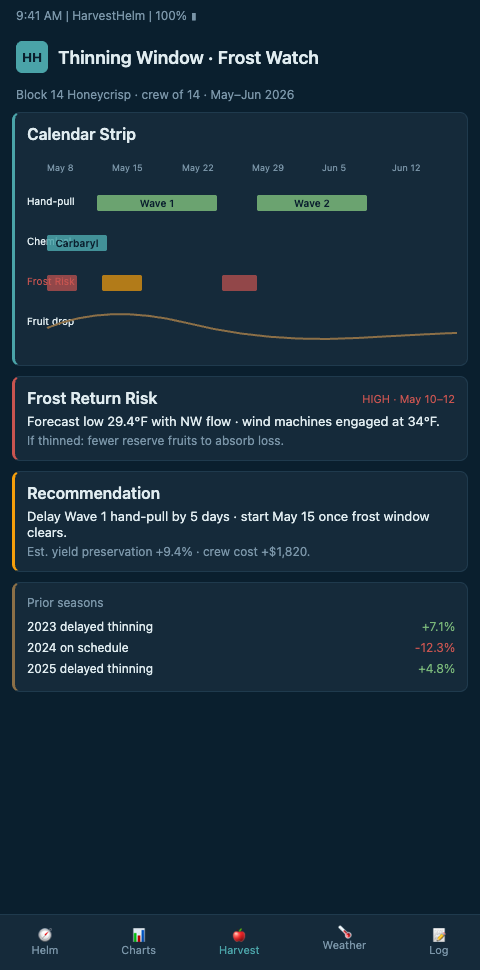
Beyond chemistry, the return-flow forecast also drives whether to run wind machines through the thinning window even when the overnight forecast looked safe. A moderate overnight minima followed by a strong morning return flow can damage thinned trees more than the overnight event alone would have. Running the wind machine during the return-flow window protects the vulnerable fruitlets during their most exposed two hours. The dashboard should flag these compound events so the grower is not learning about them from damage observations.
Advanced Tactics: Block-by-Block Thinning Under Mixed-Risk Conditions
The thinning call gets harder when blocks are in different elevation bands with different return-flow profiles. Block 22 Honeycrisp on the ridge may face a different return-flow timing than Block 14 Gala at the basin edge. Set thinner application windows block by block — do not treat the orchard as one thinning event.
The most common mistake is thinning on the calendar rather than the probe data. A 10-12 mm fruitlet window in the forecast model may not actually have arrived at the canopy-height temperature the block is running. If canopy temps averaged 5°F below forecast for two weeks, your fruitlet stage is lagging. Thin when the probes say fruitlets are there, not when the calendar says they should be.
The second mistake is assuming a frost event that missed the orchard overnight will not come back. On slopes with strong basin-to-ridge morning return flow, it often does — and thinned trees are the ones that pay. Set your dashboard to flag return-flow probability separately from overnight minima, so the two alerts do not collapse into one.
Third tactic: cross-reference with heat-stress responses on adjacent crops. Date palm growers tracking heat stress fruit drop face a structurally similar problem — fruit drop happens at the intersection of crop-load decisions and acute weather events, and the sensor-driven timing logic is transferable.
A fourth tactic: adjust rescue-spray readiness by return-flow probability. If your dashboard shows a 60% or higher probability of uphill frost return within 72 hours of chemical thinner application, have 6-BA and GA on-site and sprayers charged before you apply the thinner. The rescue window after a frost is short — 48 to 72 hours — and a grower who has to order the rescue spray after the frost hits often misses the window. Pre-position the rescue stack based on the dashboard's return-flow forecast.
A fifth tactic: record the king-bloom preservation outcome every time you delay a thinning decision because of return-flow risk. Two seasons of data showing king-bloom preservation rates against delayed-thinning decisions gives you the empirical record to calibrate when delaying is worth it. Growers who skip this data collection keep second-guessing themselves at every decision point; growers who build the record develop confidence in the playbook.
A sixth tactic: run post-thinning counts by block within 10 days of chemical spray so the dashboard can compare actual fruit-set drop against projected drop. If the block thinned heavier than projected, rescue-spray decisions can land earlier. If the block thinned lighter than projected, hand-pull crews can be dispatched to finish the job before fruitlets pass the effective hand-thinning size. Post-thinning validation is the data point that closes the feedback loop on the whole thinning workflow.
Chart Your Thinning Window Against the Return Flow
Mountain apple growers running post-bloom thinning on elevation-band Honeycrisp and Gala blocks should have uphill frost return modeled before next season's thinner spray. HarvestHelm installs the upslope-facing probe layer specifically to capture return-flow signals, integrates it with the canopy-height fruitlet-stage probes, and delivers block-by-block thinning windows with frost-return risk scores. Kilo-cut pricing means you only pay after the thinned crop actually delivers bins to the packhouse scale. Block-level growers running mixed Honeycrisp, Gala, and Fuji plantings gain the most — the return-flow variance across elevation bands is where traditional thinning playbooks most often break. Pilots signing before April get the upslope-facing probe pairs installed before the 10-12 mm fruitlet window opens, so the return-flow baseline is captured under real bloom-week conditions rather than extrapolated from post-bloom data.
Day-one dashboard views show each block's current fruitlet size, the 72-hour return-flow probability, and a proceed-delay-hand-pull recommendation tied to the king-bloom preservation target. Onboarding includes a pre-positioned rescue-spray kit — 6-BA and GA charged and ready — tied to dashboard alerts that cross the 60-percent return-flow threshold, since the 48-to-72-hour rescue window is too short for post-event ordering. The kilo-cut contract settles only on the cleared tonnage from thinning-decision blocks, so a missed return-flow call on Block 22 Honeycrisp costs us before it costs your 10-day post-thinning count. Thinning-crew scheduling pulled from block-level windows typically saves two to three re-scheduled crew days per season, which is where the workflow pays back in labor alone.