Preventing False-Positive Frost Alerts on South-Facing Apple Blocks
The Cry-Wolf Problem in Mountain Orchards
A mountain orchardist who runs frost alerts off a single regional threshold will get woken up three times for every real frost event on a south-facing block — and the EyeQ research on false alarm fatigue documents exactly what happens next: people start ignoring the alerts. The night the real frost hits, no one is responding because the system lost credibility over six weeks of false positives. South-facing apple blocks are the worst offender because they warm fast during the day, drop fast at sunset, and set off sensors calibrated on north-slope thresholds — but recover before fruit tissue actually freezes.
The cost of false positives is not just sleep. Wind machines run on diesel. Over-tree sprinklers run on water pumped from a limited reservoir. Crew callouts cost money whether the frost is real or imagined. A 40-acre orchard running three false alarms a month through bloom season is spending real money on events that never happened, and each one erodes trust in the system.
Research on frost detection methods in ScienceDirect shows that requiring dew point below 0°C and tightening threshold logic reduces false alarms in operational systems. Regional thresholds do not encode this logic. Neither do single-probe alert systems. The fix is aspect-specific calibration — which means the sensor grid itself has to be aware of whether a probe is on a north, south, east, or west slope, and the threshold has to adjust.
Calibrating by Aspect Like a Captain Trims for Wind
A yacht captain sailing through a wind shift adjusts the sail trim automatically — a different angle of attack for each point of sail, because one setting across all conditions costs either speed or safety. Alert threshold calibration works the same way. A helm-charted yield forecast cannot use one frost threshold for south-facing and north-facing blocks. The physical conditions are different; the threshold must be different. HarvestHelm applies aspect-aware alert calibration as a core feature of the frost-alert system.
Start with dew point logic. The ScienceDirect research on frost detection methods emphasizes dew point below 0°C as a gating criterion — meaning no frost alert fires unless both temperature and dew point cross thresholds. South-facing blocks often see air temperature drop fast after sunset while dew point stays elevated from afternoon warmth, creating a false-positive condition where ambient temp crosses threshold but frost is not actually forming. Dew point gating filters these out.
Next, layer leaf-temperature sensing. The Apogee Radiation Frost Detector provides leaf-temperature-based alerts specifically to reduce false positives. Radiation frost damages tissue at leaf temperature, not ambient temperature. South-facing blocks with residual afternoon radiation on the bark and leaves often show leaf temperatures 2-3°F above ambient, which is enough to prevent actual frost damage. An alert system that reads leaf temperature is more accurate than one reading air temp at 2 m.
Third, feed a machine-learning model the probe history. Research from MDPI on ML-based hourly frost prediction shows ML models trained on weather station plus digital camera imagery reduce false alarms substantially when they learn the block's specific aspect-driven temperature profile. Frontiers research on deep-learning frost models reports 1.53-1.72°C RMSE at 6-hour lead time using DNN frost prediction — tight enough to call frost events before the false-positive window even opens. HarvestHelm trains aspect-specific models so south-facing blocks are evaluated against their own historical frost-damage curve, not a pooled orchard one.
The training data requirement matters: the model needs at least 2-3 dormant seasons of probe data plus verified damage records before it outperforms a simpler rule-based system. Growers who deploy the ML model without that training foundation often see worse false-positive rates than they started with — because the model is extrapolating from too-little data. HarvestHelm maintains a regional training pool that new customers can bootstrap from while their own probe history accumulates, which shortens the time to reliable ML performance.
Fourth, apply calibration protocols. The climate control guidance on sensor calibration and data validation protocols lays out the calibration discipline that prevents drift-driven false alarms. Probes drift over time. Uncalibrated probes on south aspects are the most common source of chronic false positives. Schedule quarterly calibration checks and run the models against validated probe output, not raw. The Gala Fuji sensor strategy walkthrough covers how cultivar differences further shape alert thresholds once aspect is calibrated.
A fifth calibration step: validate against a reference thermometer on the day of the calibration check. A single low-cost reference-grade thermometer swept across every probe position in one morning costs less than a single false-positive wind-machine run. The sweep takes about 90 minutes on a 40-acre orchard, and it catches drift that would otherwise accumulate silently through the season. Quarterly sweeps in the dormant season plus one sweep during peak bloom season is sufficient.
The ScienceDirect review of frost management with AI summarizes the current state of advanced sensing, modeling, and AI for frost management — calibration-by-aspect is covered there as a standard operational practice, not an experimental one.
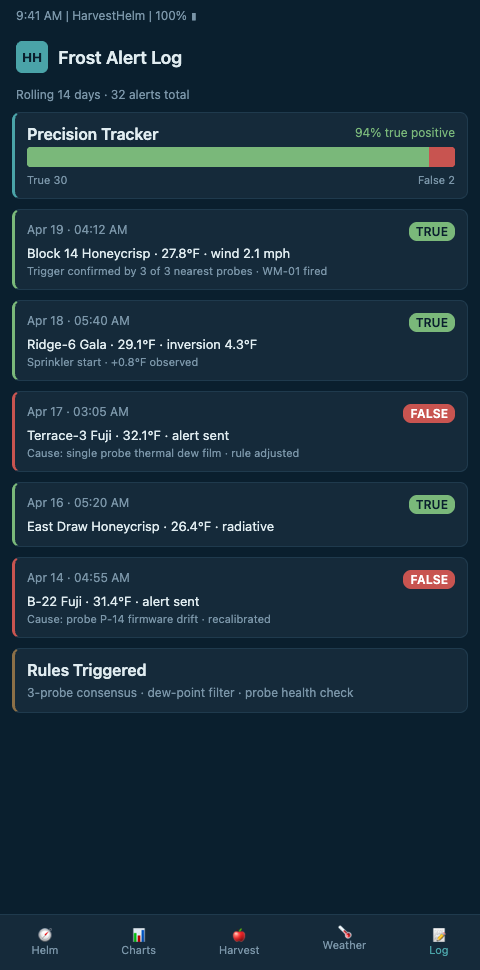
The helm-charted yield forecast's alert layer is what makes the whole dashboard trustworthy. A grower who trusts the alerts responds fast when they fire, which means a genuine frost event gets protective response in the window when protection actually works. A grower who has learned to ignore alerts from chronic false positives responds slowly or not at all — and even a system that is technically accurate becomes operationally useless. Trust is the engineering outcome of aspect-calibrated thresholds.
Advanced Tactics: Beyond Aspect — Compound Calibration
Once aspect-specific calibration is running, the next tier is compound calibration against additional variables: cultivar phenology stage, canopy density, wind exposure, and soil moisture. A south-facing Honeycrisp block at tight-cluster stage has a different frost risk profile than the same block at petal-fall. The alert threshold should shift with phenology stage, not stay fixed through the season. Cornell and Penn State extension work has long documented these stage-specific critical temperatures; your dashboard should encode them.
The most common mistake in calibration is tuning thresholds to eliminate all false positives. A system with zero false positives is also a system with suppressed real alerts — the bar is too high. The target is a false-positive rate low enough to preserve credibility (roughly 1 false positive per 5-8 real events) while catching every real event. Measure both.
The second mistake is not logging alert response actions. Every alert that fires should log whether crews responded, what temperature was observed at canopy height, and what damage occurred. Those logs are the training data your ML model improves on. Without them, calibration stays static.
Third tactic: read the cross-niche literature on alert-signal masking. Coastal citrus growers deal with salt masks frost signals where wind-driven salt aerosol obscures actual frost damage patterns. The parallel lesson: alert signals need to be isolated from the confounding variables that mask them, and aspect is one of the biggest confounders on mountain slopes. The drainage overrides NOAA walkthrough covers the related problem of regional forecasts firing alerts that local probe data would have filtered out.
A fourth advanced tactic: tier alerts by response cost. An alert that requires only wind-machine standby costs less than one requiring sprinkler deployment, which costs less than one requiring full crew callout. The alert system should publish tiers that match the cost, so lower-confidence alerts trigger lower-cost responses and only high-confidence events escalate to the expensive ones. This tiered approach is how HarvestHelm keeps the system credible even during variable-weather stretches where false-positive risk runs higher.
A fifth tactic: publish alert performance metrics to the team weekly. False-positive rate, false-negative rate, average lead time on true positives — these numbers keep crews engaged with the system and give the orchard manager a record for continuous improvement. Growers who publish the metrics find crew responsiveness improves because the team sees the system is honest about its performance.
A sixth tactic specific to multi-block mountain orchards: publish block-level alert histories so growers can see which blocks generated false positives over the last 5 seasons. That history becomes the argument for where additional calibration effort is worth investing. Blocks that generate 8-10 false positives per season get priority for ML retraining, dew-point gating tuning, and leaf-temperature probe additions. Blocks that generate 1-2 per season stay on current configuration.
Stop the Cry-Wolf Alert on Your South Blocks
Mountain apple growers whose south-facing blocks generate most of their false alarms should rebuild the alert logic this dormant season. HarvestHelm installs aspect-calibrated probes, runs dew-point-gated and leaf-temperature-aware frost alerts, and trains aspect-specific ML models against your block history. Kilo-cut pricing means the aspect-aware alert system costs nothing until the saved crop clears the packhouse scale — so the diesel and water you save on false alarms flows straight to the bottom line. Block-level growers and packhouse operators working with mountain supply gain the same credibility boost — when the alert system stops crying wolf, the downstream conversations about protection readiness and harvest scheduling get easier.
Pilots starting before December bootstrap from HarvestHelm's regional training pool so south-facing Honeycrisp and Enterprise blocks get ML-tuned thresholds before 2-3 seasons of in-house history accumulate. Day-one dashboard views show dew-point-gated and leaf-temperature-aware alerts tiered by response cost — wind-machine standby, sprinkler deployment, full crew callout — so a marginal night never escalates the $120-180-per-event diesel burn beyond what the actual frost signal justifies. The onboarding quarterly-calibration schedule sweeps every probe against a reference thermometer across a 90-minute morning, catching drift before it builds six weeks of false alarms. The kilo-cut contract settles only on cleared Honeycrisp, Gala, and Enterprise tonnage that the credible alert layer protected, so a chronic false-positive block costs us before it costs your crew trust.