Gala vs Fuji Frost Risk: How Cultivar Mix Changes Sensor Strategy
The Gala Block That Lost 38% While the Fuji Block Watched Safely
A Washington grower lost 38% of king bloom on a Gala block during an April 12 radiation frost event while an adjacent Fuji block — same elevation, same rootstock, 20 yards away — came through at 4% bud loss because Fuji was still at tight cluster while Gala was at full pink. The sensor layout had been identical across both blocks: four probes on a 30-meter grid, all reading to the same threshold table. The grower had effectively under-monitored the cultivar that was at risk and over-monitored the one that was not. A North Carolina Extension plant toolbox entry on Gala documents Gala's April bloom window, while an Orange Pippin Trees pollination reference for Fuji places Fuji in pollination groups 3-4 — later, and often out of the highest-risk April window.
The underlying bud-stage sensitivity matters more than calendar date. A WSU Tree Fruit reference on critical bud temperatures establishes that king bloom is more susceptible than side blooms at every apple bud stage — the first flower killed. And a Virginia Tech Extension study of rootstock effects on flower bud mortality in Gala and Fuji found that B.9 rootstock consistently showed lower mortality than M.9 rootstock for both cultivars at king and side blooms. So the sensor strategy has to capture cultivar, rootstock, and stage — three variables, not one.
The orchard-layout reality makes this harder. Most mountain orchards plant Gala, Fuji, Honeycrisp, and a few other cultivars on interspersed blocks for pollination and market diversification. A single radiation frost on May 2 might find Gala at full pink, Honeycrisp at pink, Fuji at tight cluster, and Pink Lady at half-inch green — four cultivars with four different kill thresholds active simultaneously across the same parcel. A sensor strategy that ignores this diversity either over-protects the hardy cultivars or under-protects the vulnerable ones.
Cultivar-Weighted Sensor Strategy on the Helm-Charted Yield Forecast
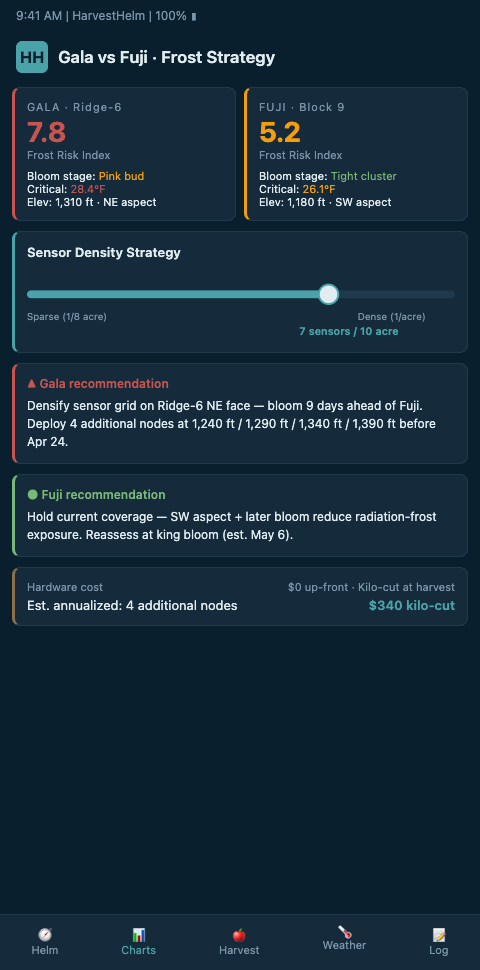
HarvestHelm treats sensor density as a cultivar-and-stage-driven variable rather than a parcel-wide constant. The helm-charted yield forecast ingests a cultivar map, rootstock inventory, and current bud-stage telemetry per block, then assigns a risk weight that drives probe density. Early-blooming Gala blocks get higher probe density — typically a 20-meter grid with at least one probe at the known cold-sink within each block. Fuji blocks get a 40-meter grid with one anchor probe at the cold sink, because the later bloom window places most of the critical nights outside the peak radiation-frost season.
The yacht metaphor lines up cleanly. On a yacht, instrument density follows risk — you carry more depth soundings through a narrow channel than across an open bay. The same principle applies to mixed-cultivar orchards. Gala is the narrow channel, Fuji is the open bay. HarvestHelm's probe deployment tool calculates recommended density from the cultivar map and the historical frost-event log, and the grower can see the marginal protection value of each additional probe before deployment.
Threshold tables should also differ by cultivar and stage. MSU Extension's picture table of critical spring temperatures for tree fruit bud development provides bud-stage-by-temperature kill tables that vary by cultivar phenology — and the appropriate threshold floats 1-3F across the stages. A ScienceDirect paper on frost hardiness of apple flowers in different phenological phases confirms the principle: late-flowering cultivars are more frost-tolerant, and flower buds can tolerate down to -30C at the end of endodormancy. HarvestHelm's threshold engine pulls the cultivar-specific curve and advances the trigger temperature as bud stage advances — no manual re-entry required.
Alert message customization per cultivar helps the grower act correctly under pressure. A 3am frost alert that reads "temperature 29F at Block 14" requires the grower to remember what stage Block 14 is at and what the kill threshold is for that cultivar. HarvestHelm's alerts include the cultivar, bud stage, current kill threshold, and current canopy temperature — all four variables in one line. The manager acting on the alert does not have to cross-reference a table; the alert itself carries the decision context.
Rootstock adds a second layer. The Virginia Tech data above documents that B.9 rootstock blocks tolerate slightly more cold at the same bud stage than M.9 rootstock blocks. HarvestHelm's block metadata layer captures rootstock, and the threshold engine applies a modest offset — typically 0.5-1F — for the more tolerant rootstock. The resulting trigger table is cultivar-and-rootstock-weighted rather than uniform.
Block age also modulates frost sensitivity. Young trees (3-5 years) with less root mass and less carbohydrate reserve typically show 1-2F less frost tolerance than mature trees of the same cultivar-rootstock pairing. HarvestHelm's block metadata captures planting year alongside cultivar and rootstock, and the threshold engine applies an age-based offset during the block's first 5 years of bearing. Once blocks reach maturity, the age offset drops out and the standard cultivar-rootstock threshold applies.
Calibration of the sensor grid itself is a separate discipline. Onset Comp's orchard monitoring documentation describes deploying data loggers in a grid across rolling topography to map GDD accumulation and frost pressure per block — and the recommendation is to vary grid density by terrain complexity, which HarvestHelm formalizes as a cultivar-weighted overlay on that base grid.
Advanced Tactics for Mixed-Cultivar Sensor Strategy
Cultivar-specific responses to microclimate aren't limited to frost. A ScienceDirect study on fruit quality of Gala and Fuji under different cultivation conditions documented cultivar-specific responses that justify cultivar-weighted probe placement even outside the bloom window — during the fruit-set and pre-harvest windows, Gala is more sensitive to temperature swings that affect sugar accumulation than Fuji. So the sensor grid designed for frost also supports quality telemetry. HarvestHelm's probe deployment is future-proofed: the same nodes that trigger frost fans in April feed fruit quality models in August.
Year-over-year sensor-data archives build cultivar-specific frost-risk fingerprints. After three seasons of probe data, each cultivar-rootstock combination on the orchard has a measured frost-exposure profile: how often the kill threshold was approached, how often it was crossed, and which blocks repeatedly showed up as the coldest. That history feeds both the sensor-density recommendation (dense grids where history shows repeated cold events) and cultivar-replanting decisions (consider replacing frost-intolerant cultivars on repeatedly cold blocks).
Rootstock-by-cultivar pairing deserves a separate matrix view. HarvestHelm's block metadata panel surfaces every unique cultivar-rootstock combination on the parcel and displays the deployed probe density against the recommended density per combination. Gaps become visible at a glance, so the grower can prioritize redeployment at winter shutdown rather than discovering the gap during a live frost event. This connects directly to sensor placement rules for terraced apple rows — the terrace geometry defines where probes physically fit, while the cultivar matrix defines how dense they need to be.
Phenology tracking drives the trigger threshold across the season. Each block's bud stage is logged weekly during the bloom window via in-canopy imagers plus manual spot checks. As buds advance from silver-tip through green-tip, half-inch green, tight cluster, pink, full pink, bloom, and petal fall, the kill threshold rises roughly 1F per stage. HarvestHelm's threshold engine pulls the current stage automatically and advances the trigger without manual re-entry, so the grower is never running an out-of-date threshold on a live frost night.
Selection decisions upstream of sensor strategy are the right place to start. A grower choosing between Gala, Fuji, and Honeycrisp for a new planting can use HarvestHelm's cultivar-selection module — which pairs with cultivar selection for high-elevation frost zones — to see projected frost exposure before committing to rootstock orders. The sensor-strategy work is downstream of those decisions, not upstream.
Coastal citrus growers face a parallel problem with cultivar salt tolerance rather than frost tolerance. Rootstock salt thresholds in coastal citrus groves applies the same cultivar-plus-rootstock-weighted threshold logic to a different environmental threat — the structural approach transfers directly.
Cross-cultivar pollination dependencies add a practical wrinkle. Fuji requires a pollinator, and Gala is a common pollinator for Fuji. If a frost event wipes out Gala king bloom but Fuji is still at tight cluster, the Fuji fruit set depends on whatever Gala side bloom survives. The grower has to protect the side bloom harder than they would if Gala were a stand-alone block, because the Fuji set depends on it. HarvestHelm's pollination-dependency map annotates which blocks depend on which pollinators and adjusts protection priorities during a frost event when pollinator blocks are at risk.
The failure mode is assuming Gala and Fuji can share a single probe-to-block ratio. They cannot, and the cost shows up on a bad frost year. HarvestHelm enforces per-cultivar density minimums during deployment planning, and the helm-charted yield forecast flags under-probed cultivars before the frost window opens.
Ready to Right-Size Sensor Density by Cultivar?
Mountain orchardists running mixed Gala-Fuji-Honeycrisp blocks need probe density that reflects actual cultivar risk, not a parcel-wide default. HarvestHelm builds the cultivar-and-rootstock-weighted sensor grid, sets bud-stage-adjusted threshold tables, and alerts per block at the right temperature for the right cultivar. No cash up front — kilo-cut at packhouse scale only. Share your cultivar map and rootstock inventory when you join the waitlist, and we will return a cultivar-weighted probe grid against your existing block layout for review. Pilots signing before winter shutdown get gap analysis showing every cultivar-rootstock combination against recommended versus deployed probe density, with Gala blocks on M.9 rootstock flagged at the top of the priority list because early bloom plus frost-sensitive rootstock carries the most downside risk.
Day-one dashboard views include alerts pre-configured to carry cultivar, bud stage, current kill threshold, and canopy temperature on one line, so a 3am Honeycrisp alert does not require cross-referencing a stage table. Onboarding includes pollination-dependency annotation so if a frost kills Gala king bloom, the dashboard knows the Fuji protection priority shifts to preserve the Gala side bloom that feeds Fuji fruit set. The kilo-cut contract settles only on cleared tonnage from cultivar-weighted protected blocks, so an under-probed Gala block that lost 38 percent to an April radiation frost costs us before it costs the grader's packout sheet. Block-age offsets apply during the first five bearing years, which captures the 1-to-2F frost-tolerance gap that young Honeycrisp trees show before mature-tree thresholds take over.