Apple Cultivar Selection for High-Elevation Frost Pocket Zones
A 20-Year Mistake That Sensors Cannot Fix
A mountain orchardist who plants a standard Honeycrisp block on a M.9 rootstock at the bottom of a known frost pocket has locked in 20 years of annual frost-protection spending to save a planting that should have been a different cultivar on a different rootstock. No sensor, no wind machine, no over-tree sprinkler makes up for cultivar mismatch at planting. The APFGA research on cultivar hardiness to -40°F documents the varieties bred to withstand extreme cold — the available market for high-elevation frost zones. Choosing outside that list in a real frost pocket is a compounding mistake.
The scope of the mistake is larger than people think. Extension content on rootstock-driven winter hardiness notes that rootstock choice affects scion survival through the winter, meaning scion-rootstock combinations matter more than scion alone. A cold-hardy scion on a cold-sensitive rootstock can still die at the graft union in a hard winter. The Cornell Geneva apple rootstocks comparison chart documents cold hardiness ratings across Geneva series rootstocks — which is the first reference mountain growers should consult before planting in a frost pocket.
Utah State's extension guide on apple production and variety recommendations covers variety choice for frost-prone high-elevation growing specifically. The guidance reinforces a hard truth: in a real frost pocket, you either plant for the pocket or you move the block somewhere else. Pretending a frost-sensitive cultivar will tolerate the pocket is how growers end up spending $500 per acre annually on frost protection for a block that will never carry its weight.
Charting the Cultivar by the Cold Profile
A yacht captain selecting an anchor does not pick the one they prefer — they pick the one that matches bottom type, current, and wind exposure. Cultivar selection for a frost pocket follows the same logic. A helm-charted yield forecast for new plantings starts with the pocket's cold profile: minimum overnight temperatures, duration of sub-28°F events, post-bud-break frost probability, and recovery capacity. HarvestHelm compiles that profile from probe data before the planting decision is made, so the cultivar choice matches the site.
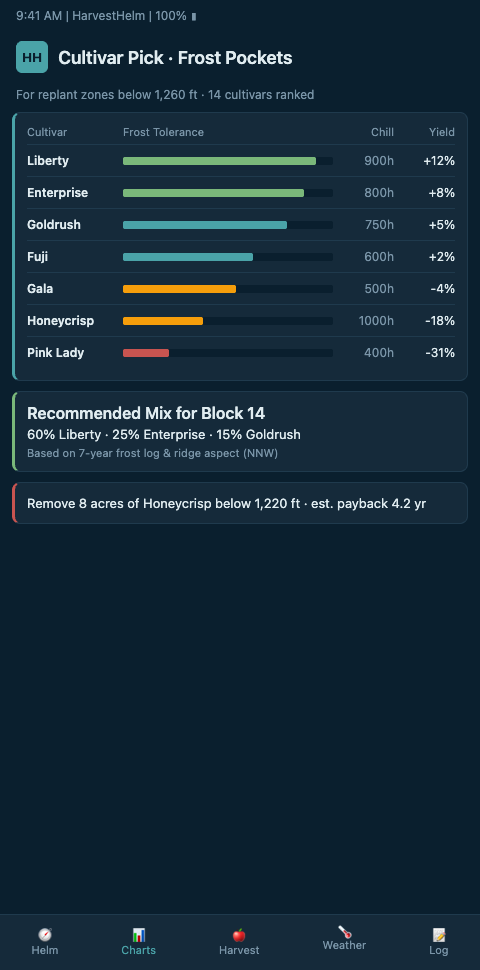
Start with the bloom timing criterion. Late-blooming varieties escape spring frost by simply being dormant when the frost events happen. Cummins Nursery's fruit tree bloom dates chart shows which varieties are reliably late-blooming — Arkansas Black, Enterprise, Rome Beauty, Goldrush. In a frost pocket that regularly sees 28°F in late April, a bloom calendar that pushes full bloom into the second week of May is worth more than any frost-protection system.
The bloom-escape strategy has one important caveat: a late-blooming cultivar in a frost pocket still bears risk from late-May frost events, which are getting more frequent as climate variability increases. Probe data from your pocket should capture the latest dates of sub-28°F events over the last 10 years. If those dates extend into the second week of May, even Goldrush is not safe. Cultivar selection then has to either move to even later-blooming varieties or shift to frost-resistant tissue traits (for example, varieties with thicker floral scales that tolerate short sub-freezing excursions).
Next, layer scab and fire blight resistance. Penn State's apple scab resistant cultivar list includes Enterprise as a mid-late-blooming, disease-resistant cultivar suited to difficult sites. The MU extension disease-resistant apples guide covers similar selections. Mountain blocks in frost pockets tend to be harder to spray reliably because of access and wind, so disease resistance carries additional weight in cultivar selection.
Third, choose the rootstock. The Cornell Geneva rootstock chart covers the hardiness rankings. For frost-pocket sites, G.11 and G.41 generally outperform M.9 on cold hardiness while still providing dwarfing. Do not mix a cold-hardy scion with a cold-sensitive rootstock and assume the scion wins — graft-union cold damage is where the tree actually fails.
Root-zone temperature deserves probe coverage too. A frost pocket cold enough to damage scion tissue is often also cold enough to damage rootstock tissue if the soil is saturated or if snow cover is thin. Install soil-temperature probes at root depth on pocket blocks during the first dormant season after planting; use that data to validate whether the rootstock choice actually survived winter conditions, not just whether the top of the tree came through.
Fourth, feed the forecast engine the candidate cultivars and let it back-test. HarvestHelm runs the candidate cultivar's bloom-date profile against the block's historical frost data and reports the expected years-per-decade the block would produce a full crop. A candidate that clears 8 years out of 10 is planting-worthy. A candidate that clears 4 years out of 10 is a mistake that sensors will not fix. The Gala Fuji strategy post walks through cultivar-specific sensor and forecast differences once the planting decision is locked. For growers weighing chill-hour implications on Honeycrisp specifically, the Honeycrisp chill hours post covers why aspect-driven chill gaps should feed the cultivar decision.
Fifth, match the cultivar to the market your packhouse can actually move. A late-blooming Goldrush block is great for frost escape but commands a different price point than a Honeycrisp block, and your packhouse may have limited capacity to grade and store it at peak premium. Cross-check the cultivar shortlist against your packhouse's packout mix and downstream buyer relationships before committing. Cultivar selection is both a horticultural decision and a market decision, and on frost-pocket blocks where horticulture forces the decision toward the edges of the variety list, the market dimension gets harder.
Advanced Tactics: Scion-Rootstock Stacking and Edge Cases
Once the cultivar list is narrowed, the next tier is scion-rootstock stacking for specific pocket behaviors. A pocket with extreme overnight minima but short duration (2-3 hour sub-28°F events) tolerates a moderately hardy scion on a hardy rootstock, because the tree recovers quickly. A pocket with long-duration events (8-plus hours sub-28°F) needs the hardiest available scion on the hardiest available rootstock. Match the stack to the event profile, not to a generic hardiness zone.
The most common mistake is selecting cultivars by yield potential instead of frost resilience. A frost-pocket Honeycrisp that averages 40 bins per acre sounds great on paper, but if it only delivers 4 years out of 10, the 10-year average drags below a Enterprise block at 32 bins per acre delivering 8 years out of 10. Compute decade-average bin yield, not single-year best case.
The second mistake is ignoring pollination compatibility when selecting late-blooming varieties. If your pocket cultivar blooms in the second week of May, it needs a pollinator that also blooms then — otherwise you have planted a block that self-limits its own crop. Cummins Nursery's bloom chart is useful for identifying compatible late-bloom pollinators.
Third tactic: read the cross-niche frost-resilience literature. Coastal citrus growers facing salt-aerosol stress use similar logic for cultivar selection, documented in the mandarin navel resilience comparison. The parallel teaches a useful lesson: plant cultivars selected for the stress, not cultivars selected for a friendly market.
A fourth advanced tactic: plan the replant in staged blocks rather than all at once. A frost-pocket replant spread across three years gives you two advantages — you absorb the productivity gap over several seasons instead of one, and you learn from each staged planting whether the cultivar choice is performing as projected. If the first stage shows unexpected frost damage, adjust the remaining stages before committing more trees. Staged replants also keep probe data flowing from the surrounding blocks so the forecast engine keeps improving as the new trees come online.
A fifth consideration: document the cultivar selection rationale and the probe data behind it. Over a 20-year orchard life, ownership changes and staff turnover create amnesia about why a block was planted to a specific variety. A documented decision record with probe data attached is the artifact that lets the next operator understand the logic — and avoid undoing it. This becomes especially important when a new manager considers grafting over a "low-yielding" frost-pocket block that was actually optimally planted for its conditions.
The helm-charted yield forecast for cultivar selection works as a 20-year projection tool. The forecast engine takes the pocket's historical cold profile, projects it forward using climate drift assumptions, and compares the candidate cultivars against the projected event profile. A cultivar that looks marginal on today's data may look solid on the 2040 projection if frost frequency drops in your region, or may look catastrophic if late-spring frost frequency rises. The long projection changes the decision.
Match the Cultivar to the Pocket Before Planting
Mountain apple growers weighing replant decisions on frost-pocket blocks should build the cold profile before the cultivar decision, not after. HarvestHelm installs probes on candidate replant blocks for a full dormant season, builds the pocket's cold profile, and runs candidate cultivars through the forecast engine to show expected years-per-decade of full crop. Kilo-cut pricing keeps the evaluation cost at zero until the replanted block actually starts clearing packhouse bins. Honeycrisp, Gala, and Fuji growers making 20-year replant commitments should not make them from a catalog; they should make them from site data.
The pilot slot includes a decade-projection report for each candidate cultivar-rootstock stack — for example, Enterprise on G.41 versus Goldrush on G.11 — projected against your pocket's actual probe record and climate-drift scenarios through 2040. Onboarding lands before September so soil-temperature probes reach root depth before first frost, which is when the rootstock decision needs its first calibration data. Growers joining this cohort also receive a staged-replant scheduling plan so the productivity gap spreads over three dormant seasons instead of landing in one year. The kilo-cut contract ties explicitly to the replanted block's packhouse clearance, so if the new Enterprise bloom escapes a May 10 frost that wiped your neighbor's Honeycrisp, you pay only on the Enterprise tonnage that actually cleared.