Reading Slope Aspect Signals for Honeycrisp Chill Hour Accumulation
A 300-Hour Gap on the Same Mountain
Two Honeycrisp blocks 600 feet apart on a single mountain orchard can accumulate chill hours at rates that differ by a full month of dormancy. The UBC EOAS resource on slope aspect effects documents exactly why: slope aspect drives solar radiation and ground temperature patterns that compound across an entire dormant season. A north-facing Honeycrisp block on a 12% grade can stay under the dynamic-model chill threshold for 300 more hours than a south-facing block of the same variety at the same elevation. That is the difference between a block that satisfies Honeycrisp's chill requirement cleanly and a block that partially breaks dormancy mid-winter, loses accumulated chill, and stumbles into an uneven bloom.
This variance matters most in the years nobody prepares for. A relatively cold dormant season masks the aspect delta because even the warmest block accumulates enough chill. It is the borderline-warm seasons — which climate data suggests will become more frequent — where the south-facing block falls short and the north-facing block succeeds. Without aspect-specific probe data, the grower attributes the split outcome to something else: spray timing, soil moisture, pollinator activity. The real cause sits in the chill record nobody logged.
Most mountain orchardists track chill with a single weather station near the access road. That station reports a number. The block reports reality. The Wikipedia entry on chilling requirement notes the Utah model counts chill accumulation at 3-9°C but subtracts for warm spells — meaning a south-facing block that gets warm afternoon radiation in January can lose chill it appeared to have banked in December. The station 400 feet away on flat ground never sees that drawdown.
Honeycrisp is the variety where this bites hardest. The University of Minnesota profile documents its cold-climate breeding heritage — it was selected for consistent chill, which means when chill is not consistent, Honeycrisp tells you by producing uneven fruit sizing, patchy bloom, and delayed maturity. If you are running Honeycrisp on a slope with mixed aspects, you already know the pattern: two blocks that look identical from the packhouse report go through June drop on different calendars.
The financial impact reaches the packhouse grade sheet. Honeycrisp blocks that accumulated insufficient chill produce a higher proportion of off-sized fruit, which moves through processing at lower grade premiums. A 10% grade shift on a 4,000-bin Honeycrisp block can erase $80,000 in revenue — and the cause is often just 150 chill units of accumulation difference between the two aspects. Without aspect-aware probes, you do not even know which block is underperforming until the grade sheet lands.
Reading Aspect Like a Captain Reads Wind on the Windward Side
A yacht captain approaching a headland reads wind on the windward side of the hull differently than on the lee. The sail trim that works on one tack is wrong on the other. Apple chill accumulation on slope aspect works the same way. North aspects run lee to the sun; south aspects take the direct strike. A helm-charted yield forecast has to read aspect as a first-class signal — not a footnote to elevation — because the chill delta it produces determines whether Honeycrisp ever gets its dormancy cleanly.
Start with mapping aspect by block, not by orchard. Pull your state GIS or a free LiDAR-derived slope-aspect raster and classify every managed acre into N, NE, E, SE, S, SW, W, NW. For Honeycrisp specifically, the City Fruit guide on planting fruit trees on a slope explains why north-facing slopes delay bloom and keep chill accumulation longer — crucial context for variety choices. On a typical Appalachian or Cascade orchard you will find two to four aspect classes in a single 40-acre parcel. That is four different chill calendars.
Next, install paired probes. UC research summarized in the UC Fruit and Nut Research Information Center guidance on chilling hours, units, and portions covers the three models — Utah, Dynamic, and Positive Utah — and each responds differently to warm afternoon spikes. Run probes at 1.5 m canopy height on each aspect, not ambient stations. The canopy-height temperature is what the buds actually experience. The probe on the south-facing block will show you the warm afternoon drawdowns you lose chill to; the north-facing probe will show you the deep cold overnight accumulation.
Overlay a chill model. The NC State chill models tool delivers location-based chill model output (Utah, Dynamic, Positive Utah) at county resolution — a useful starting calibration before you build the block-specific version. Then feed HarvestHelm's engine the probe data so the helm view shows Block 22 Honeycrisp at 1,247 chill units accumulated by January 15, Block 14 at 1,512, and a flag on Block 22 that it is 90 units behind the five-year average. Without aspect-specific probes, you cannot see that gap until pink-bud reveals it on harvest timing. Calibrating that model for your specific profile is covered in the chill hour calibration walkthrough.
HarvestHelm reads probe data against the selected chill model and highlights aspect deltas before bloom — giving you three to five weeks of warning to shift thinning expectations, adjust harvest staffing, or change packhouse bin allocations. For growers weighing replant decisions, the cultivar frost selection guide covers how to choose varieties when a block's aspect is fundamentally incompatible with the variety planted there.
A practical deployment pattern: install one canopy-height probe per aspect class per block, plus one reference probe at an open upslope site. This gives you both the block-level aspect signal and the comparison baseline. Power each probe with a small solar panel rated for your lowest winter insolation — mountain orchards on north aspects sometimes get one-third the solar input of south aspects during winter, so a single spec across the orchard can leave north-probe batteries discharged in mid-January exactly when chill data matters most. Spec north-aspect power separately.
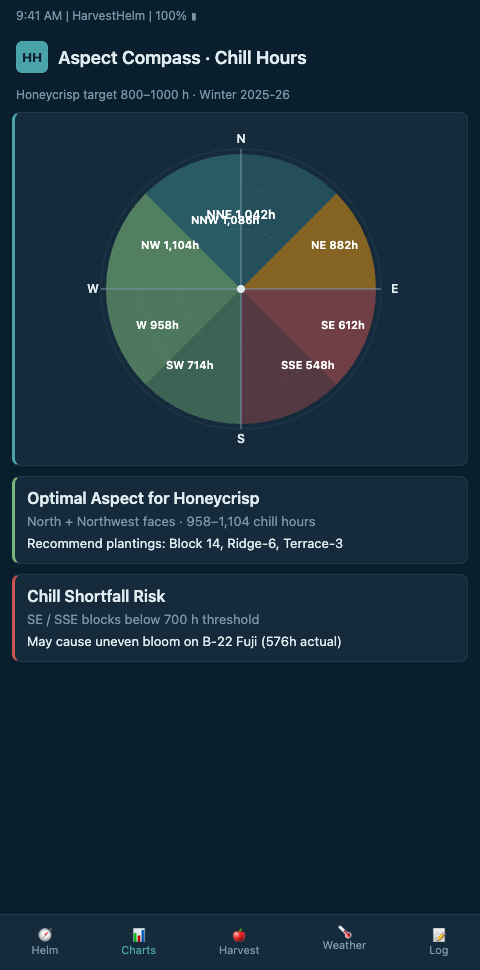
A sixth deployment benefit: the same probe network that tracks chill feeds the spring bloom forecast, the summer GDD accumulation, and the fall maturity timing. One probe grid, four different seasonal use cases, all contributing to the helm-charted yield forecast. The integration is what justifies the initial sensor investment — even though with HarvestHelm's kilo-cut pricing, there is no upfront invoice to justify.
Advanced Tactics: Multi-Cultivar Slope Mixing and Edge Cases
When you run multiple cultivars on the same slope — Honeycrisp high, Gala mid, Fuji low — aspect reading gets harder because each variety has a different chill requirement. A south-facing Gala block can tolerate 200 fewer chill hours than a south-facing Honeycrisp block before showing dormancy break problems. That means your dashboard needs cultivar-aware chill thresholds layered on aspect-specific probe data. Do not reuse a single chill threshold across the orchard.
The second common mistake is reading aspect signal once per season. Aspect effects shift as the sun angle changes through winter. A block that accumulates chill cleanly in December may lose chill in late January as the sun angle rises and south-facing bark warming increases. Track the rate of chill accumulation, not just the total, and watch for aspect-driven drawdowns month by month.
Third tactic: interpret aspect in light of canopy management. Davis Instruments guidance on monitoring chill accumulation notes that pruning severity and canopy density affect which temperature the buds actually experience. A heavily pruned Honeycrisp block on a south aspect behaves like an even warmer block than the probe suggests because more bark is exposed to afternoon radiation. Log pruning dates and severity alongside aspect, so the forecast engine can correct for canopy structure.
The same aspect-versus-regional-forecast logic shows up in other canopy-sensitive crops — growers of tropical varieties running panicle sensor checks during Tommy Atkins bloom face the same problem in reverse: regional humidity numbers hide canopy-internal variance that only in-canopy probes catch.
A fourth tactic specific to Honeycrisp on mixed-aspect slopes: schedule pruning severity by aspect. Heavier pruning on south-facing Honeycrisp blocks can help offset accelerated chill drawdown by reducing the bark surface exposed to afternoon radiation. Lighter pruning on north-facing blocks preserves canopy insulation where it matters. The prune-by-aspect playbook is not common practice yet, but the probe data supports it — and HarvestHelm's dashboard surfaces the aspect-specific chill rate so growers can calibrate pruning decisions to the signal.
A fifth consideration: coordinate aspect-specific chill tracking with your pollination window planning. A north-facing Honeycrisp block that accumulates chill slower than adjacent Gala will bloom later — sometimes late enough that overlapping pollen windows disappear. Your broker-facing bloom forecast needs to account for this aspect-driven stagger three weeks before pink-bud. The probe data and chill-model output feed directly into that forecast; without it, pollination scheduling stays reactive.
Bring Aspect Onto Your Helm Display
Honeycrisp and Gala growers working mountain blocks with mixed aspect will see the chill-hour gap grow as warm winters keep chewing into accumulated chill on south-facing slopes. HarvestHelm is onboarding block-level growers who want aspect-specific probes and cultivar-aware chill dashboards ahead of next dormancy. We install paired sensors on your coldest and warmest aspects, calibrate the chill model to your profile, and take a kilo-cut only after clearing the packhouse scale — so aspect-aware forecasting costs nothing until the Honeycrisp actually grades out. Reach out if you want the aspect-chill analysis running on your slope before the next dormancy window closes.
The pre-dormancy onboarding cycle opens in October with an aspect-class inventory across your Honeycrisp, Gala, and Enterprise blocks, flagging any acre where the planted variety no longer matches the aspect's chill delivery. Day-one dashboard views include the running Utah, Dynamic, and Positive-Utah chill counts side-by-side per aspect, so you can see which model your Honeycrisp tells the truth against and which lies by 200 units. Pilots signing before November lock in a two-dormant-season calibration commitment that refines threshold tuning on south-facing bark warming, which is where most chill drawdowns hide during a borderline-warm January. Contracts tie the kilo-cut trigger to packhouse grade-sheet clearance by block, so a 10-percent grade shift caused by missed chill on a south-aspect Honeycrisp block reduces our revenue before it reduces yours.