Calibrating Chill Hour Models to Your Specific Elevation Profile
The 200-Hour Gap Between Station and Slope
A Blue Ridge grower ran the Utah chill-hour model against the nearest NWS station data for 15 years and built cultivar decisions on that output. In 2022 the grower installed in-canopy temperature loggers across three elevation bands on a 300-acre parcel. The results: the station over-reported chill at the 1200-foot mid-slope blocks by 180 hours, under-reported at the 1700-foot ridge by 95 hours, and over-reported at the 900-foot basin by 220 hours. Every bud-break prediction the grower had used was wrong to some degree. A Fresh Quarterly review of chill models captures the quiet scandal in the field: even the developers of the dynamic chill model recommend per-site and per-cultivar calibration — and the recommendation is widely ignored because growers assume the regional model is close enough.
It is not close enough on variable terrain. A PubMed Central global analysis of chill model comparability concluded that site-specific calibration is preferred because mean temperature and range do not explain the local variance that governs dormancy release. A Wiley paper on elevation-dependent warming in mountain climates further documents that temperature trends vary non-linearly with elevation — so even regional warming adjustments fail at the block level without local calibration.
The downstream cost of uncalibrated models is both obvious and subtle. Obvious: bloom predictions off by 5-10 days lead to misallocated wind-machine fuel, mis-staged crews, and under-protected buds. Subtle: cultivar selection decisions made years earlier on regional chill data may have placed chill-demanding cultivars on blocks that do not actually accumulate sufficient chill hours, yielding reduced fruit set and smaller fruit size for the life of the planting. Calibrating the model often reveals that a grower has been running the wrong cultivar in the wrong place for a decade — not an easy finding to act on, but necessary for long-horizon planning.
Calibrating Chill Hours on the Helm-Charted Yield Forecast
HarvestHelm's calibration workflow treats each block as a distinct chill-accumulation site on a yacht-style helm display. The helm-charted yield forecast ingests in-canopy temperature readings at 10-minute resolution from bud-set through bud-break and computes chill accumulation using the site's actual thermal profile rather than the regional station proxy. The underlying physics come from UC ANR's explanation of chilling hours, units, and portions — peak chill at 6C, zero at -2C and 14C, bell-shaped distribution across the hour — but the local adjustment is where the value lives.
The calibration is a two-phase process. Phase one captures a full dormancy cycle per block: one season of in-canopy probe data against the regional station, producing a per-block correction curve. Phase two loads that correction into the live model so the next season's forecasts respect the local thermal signature. HarvestHelm pre-builds the first-year curve by combining prior-year NWS archive data with the installed probes, shortening the calibration window to about 90 days instead of a full 180-day accumulation season.
The calibration data also teaches the grower about the parcel's thermal physics. A block that accumulates chill hours faster than the regional model projects is likely sitting in a cold-air drainage zone that stays below the critical temperature threshold longer overnight. A block that accumulates chill slower is likely on a thermal belt where inversions park warm air across the canopy through the night. These patterns, visible only after calibration, inform planting decisions, frost-protection priorities, and the geometry of the cold-air drainage work that drives pick scheduling.
The ISHS note on apple chilling requirements and spring flowering regulation frames why this matters downstream — chilling requirement directly sets dormancy release and spring flower timing, which cascades into bloom wave offset, frost exposure window, and ultimately pick stage. An uncalibrated chill-hour model mis-times every decision that follows.
Multiple models running in parallel are the right approach. NC State Climate Office's chill models tool runs the NC Model, 45F Model, and 32-45F Model per site — each captures different aspects of the chill response curve. HarvestHelm runs all three against the calibrated site data and presents the range as a confidence band rather than a single number. Growers can see where the models agree (the mid-range consensus is the planning anchor) and where they diverge (the edge cases require judgment).
The Dynamic Chill Portions model is worth running alongside the classical models, especially in moderate climates where winter warm spells can reverse chill accumulation. The dynamic model's peak-at-6C response curve with a bell-shaped distribution captures the real physiology better than the binary threshold models, but it is computationally demanding and requires high-frequency temperature data. HarvestHelm's per-block probe network provides exactly the 10-minute resolution the dynamic model needs, and growers in warm-winter regions find the dynamic model's predictions align better with observed bloom than the classical models.
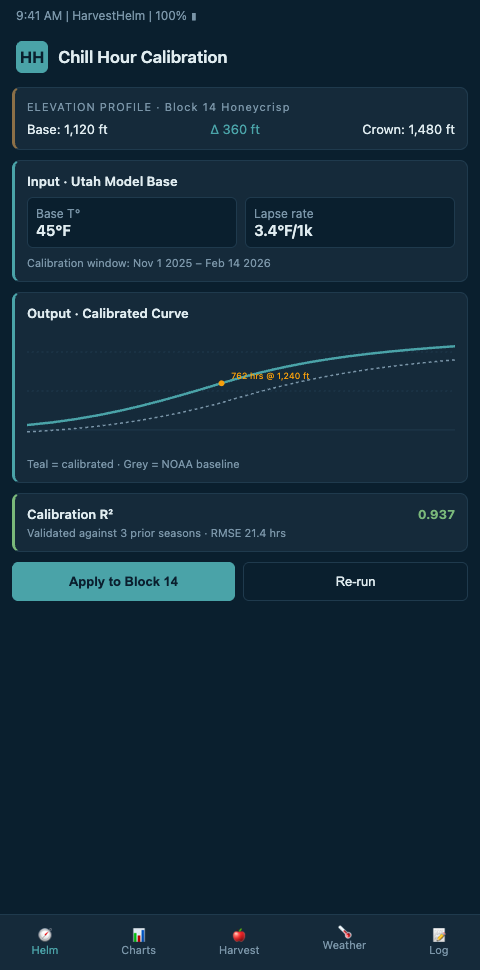
Local topography effects layer on top of elevation. Colorado State Extension's mountain microclimates guidance documents how local topography, slope direction, and nearby water bodies can overwrite average elevation chill effects. A north-facing block at 1500 feet can accumulate chill like a south-facing block at 1800 feet, because aspect matters as much as altitude. HarvestHelm's calibration respects aspect as a first-class variable — the per-block correction curve is anchored to elevation, aspect, and drainage-basin position simultaneously.
Advanced Tactics for Multi-Year Calibration Drift
Calibration is not a one-time exercise. Elevation-dependent warming means the correction curves themselves shift over time. A three-year-old calibration built against 2020-2022 data may be misaligned by 30-50 chill hours against current conditions in 2026 because spring temperatures at the ridge have warmed faster than in the basin. HarvestHelm re-trains the per-block correction curves annually against the previous season's full accumulation log — similar to how multi-year chill hour drift across northeast slopes describes the structural trend that growers have to account for on rolling 5-10 year planning horizons.
Extreme-year handling is worth specific attention in the recalibration loop. A single anomalously warm winter or cold spring can pull the calibration curve in directions that mislead future predictions. HarvestHelm weights recent seasons by similarity to multi-decade climate normals, so an outlier year gets lower weight in the curve update than a typical year. Growers see when the calibration flagged a season as an outlier and can override the weighting if they believe the outlier represents a trend rather than a one-off.
The calibration interacts with aspect-driven chill patterns. Slope aspect and Honeycrisp chill hours covers the cultivar-specific chill sensitivity that the calibrated model expresses — once the site is calibrated, the cultivar decisions become meaningfully different from the regional defaults.
Adjacent commercial tooling is worth integrating. Davis Instruments' chill accumulation tracker is a commercial chill logger that HarvestHelm reads from natively, so growers already running Davis loggers can feed calibration data without re-sensoring. Other manufacturers with open telemetry formats plug in the same way.
Validation against actual bud-break timing closes the loop. The calibrated model predicts a bloom date per block; the observed bloom date tests that prediction. HarvestHelm captures bud-break observations from phenology logging each spring and compares the predicted-vs-actual error per block. Blocks where the error exceeds 5 days across two consecutive seasons get flagged for recalibration, typically because the original calibration captured an anomalous year. The continuous validation keeps the model honest against the orchard's actual seasonal signature rather than a one-time calibration artifact.
Failure modes to avoid: calibrating against only one season, which captures neither a cold year nor a warm year; calibrating against only one block and extrapolating to the whole parcel; and ignoring the end-of-season tail where the model's zero-effective-temperature threshold matters for release timing. HarvestHelm enforces multi-season calibration by default and flags single-season calibrations as provisional.
Snow-cover adjustments deserve explicit handling. A block that sits under 18 inches of snow for three weeks in January accumulates chill hours differently from a block that stayed clear — the snow layer insulates the canopy from extreme cold and from daily fluctuation. HarvestHelm's probe network captures snow-cover duration via canopy-height imagers and adjusts the accumulation curve accordingly. Without the adjustment, blocks with high snow cover appear to over-accumulate chill because the sensor reads under the snow insulation; the correction prevents systematic bias in cold years.
The technique generalizes across heat-accumulation systems. Desert date growers face the same calibration problem in reverse — they need heat-unit calibration against canopy shade rather than chill-hour calibration against elevation. HarvestHelm's sister approach for heat unit canopy calibration uses the same per-site correction-curve machinery against a different accumulation target.
Ready to Calibrate Chill Models to Your Actual Slope?
Mountain orchardists running the regional chill model on variable elevation are carrying a systematic bias into every bud-break prediction. HarvestHelm installs in-canopy probes, calibrates the chill model per block per season, and runs multiple models in parallel so the confidence band is visible — no cash up front, kilo-cut at packhouse scale. Tell us the elevation range across your orchard and your primary cultivar mix when you join the waitlist, and we will benchmark your nearest station against a proposed probe grid so the first-year calibration is ready to run. Pilots signing before bud-set get the 90-day pre-built correction curve loaded from prior-year NWS archives, which shortens the first-season calibration window from 180 days to about 90 days.
Day-one dashboard views show Utah, 45F, 32-45F, and Dynamic Chill Portions models running in parallel against each elevation band, with the consensus mid-range drawn as the planning anchor and the model-divergence flagged on blocks that warrant grower judgment. Onboarding includes snow-cover adjustment via canopy-height imagers so Honeycrisp blocks under 18 inches of January snow do not appear to over-accumulate chill from insulated readings. The kilo-cut contract settles only on calibrated-model-predicted Honeycrisp, Gala, and Enterprise tonnage that cleared the packhouse scale, so a mis-calibrated mid-slope block costs us before the 5-day bud-break error lands on your fan-fuel schedule. Growers joining the March cohort also get the prior three years of bud-break observations back-tested against candidate calibration curves to pick the one that best fits their specific parcel signature.