Forecasting Multi-Year Chill Hour Drift on Northeast Slopes
The Decadal Drift That Quietly Breaks Planting Decisions
A Hudson Valley orchardist who planted Block 14 Gala and Block 22 Honeycrisp in 2008 made those decisions on chill-hour assumptions that were valid for their elevation band. Gala needs around 500-600 chill hours. Honeycrisp needs 800-1,000. At 1,800 feet on a northeast slope, the site was comfortably inside the accumulation envelope. Eighteen years later, that envelope is shifting.
The USDA Climate Hubs chill projections document that winter chill may decline 9-24 chill portions under RCP8.5 by 2085, threatening high-chill apple cultivars. More immediately, the NOAA Climate.gov analysis on Northeast apple sensitivity shows that a single cold day's absence can ripple through bud break timing and final yield. Growers who treat chill as a one-shot baseline check at planting are flying blind to a drift that compounds every winter.
The New York State Climate Impacts Assessment is explicit: warming winters threaten NY apple chill accumulation and bloom timing, and the USDA Climate Hubs Northeast risks report documents that warm winters followed by frost cost NY/VT growers millions in 2010 and 2012 — a decadal risk pattern, not a one-off. For block-level growers running Honeycrisp on northeast slopes, forecasting multi-year chill hour drift is now a planting-life decision, not a curiosity.
The financial stakes compound when considered at orchard-lifetime scale. A Honeycrisp planting represents roughly $35,000-50,000 per acre in establishment investment (nursery stock, trellis, irrigation, labor through year 4), amortized over a 20-25 year productive life. If chill drift reduces that productive life to 15 years, the effective cost per productive acre-year increases by 33-67%. This is a balance-sheet impact that is only visible when the drift forecast is run at the same horizon as the orchard financing. Nobody plants a 20-year asset on a 2-year weather outlook.
Charting Decadal Drift on the Helm
Think of multi-year chill hour drift the way a yacht captain thinks about a multi-season passage across shifting trade winds: the prevailing flow is still there, but it has moved 50 miles south compared to the 1970s chart, and planning a route on the old chart guarantees a slow crossing. A helm-charted yield forecast treats chill accumulation as a drifting trade wind — tracked across rolling 10-year windows, projected forward under multiple climate scenarios, and used to make real planting decisions about when to phase out high-chill cultivars.
HarvestHelm ingests two decades of Northeast chill data per orchard elevation band and runs the drift trajectory through two scenarios: business-as-usual and a warm-bias scenario modeled on Davey's Northeast climate projections, which show winter warming has already exceeded 3F over the last half-century and projects 6F by end-of-century. The dashboard plots each block's projected chill accumulation as a band (10th-90th percentile) extending 15 years forward. Growers see exactly when their Block 22 Honeycrisp is likely to slip below 800 chill hours in a warm winter — not hypothetically, but with a probability date range.
Chill accumulation models are not interchangeable, and the model choice matters for drift detection. The classic Utah Chill Units model overweights hours near freezing; the Dynamic Model (Chill Portions) is more accurate in warm winters because it captures the negation effect of warm daytime temperatures that undo overnight chill. HarvestHelm runs both in parallel and surfaces the discrepancy — when the Utah model says a block hit requirement but the Dynamic Model says it did not, the Dynamic Model is typically correct for Honeycrisp and the grower should plan for delayed or uneven bud break.
The underlying science is validated. A ScienceDirect study on chilling and heat requirements projects that under RCP8.5 by 2085, four high-chill cultivars are projected to fail meeting chill requirements entirely. For Honeycrisp specifically, the risk is not binary — it is a creeping reduction in reliability that first shows up as uneven bud break and prolonged bloom windows, then as chronically reduced fruit set. The MDPI Horticulturae 60-year pome fruit phenology study shows flowering advanced 11-14 days over six decades — a baseline for multi-year drift modeling that the helm integrates directly. This kind of multi-decade phenology record is the gold-standard input for calibrating drift models against real observations rather than projection alone.
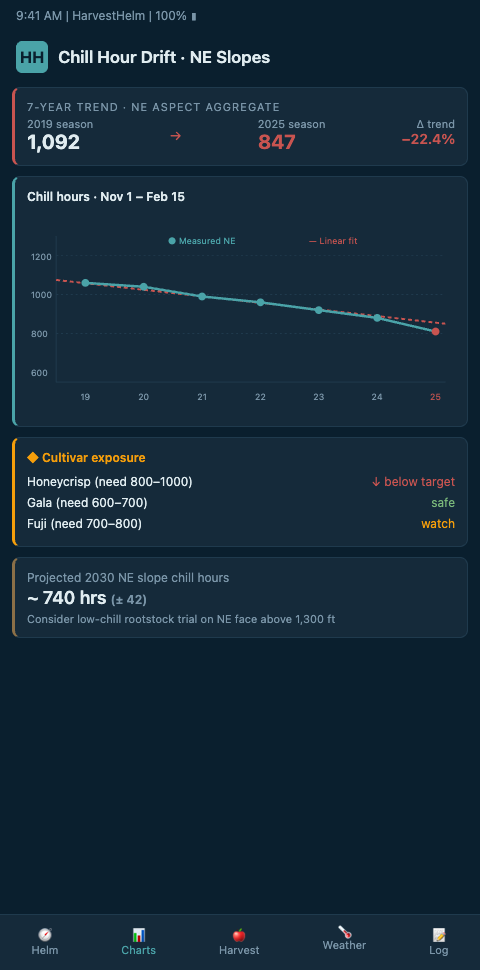
HarvestHelm's approach separates macro-drift (regional warming trend) from micro-drift (block-specific elevation-band accumulation variance). A northeast slope at 2,240 feet in the Green Mountains may gain 80 chill hours per season versus a parallel block at 1,650 feet — which is the buffer that determines whether Honeycrisp stays viable for another 15 years on that specific terrace. The helm shows this block-by-block, so when the time comes to replant, the data already specifies which parcels are the first candidates for lower-chill cultivar rotation.
The dashboard layer turns the forecast into operational guidance. Each block shows three signals: current-season accumulation, 10-year trailing trend, and 15-year forward projection with uncertainty band. A block showing downward-drifting 10-year trend that crosses the 800-hour threshold before 2035 is flagged for explicit replant planning. A block with a stable 10-year trend above threshold is marked safe for current cultivar through the 2040 horizon. The signal is not "chill is declining" — it is "Block 22 Honeycrisp, 7 years to replant decision" at the specific parcel level.
Advanced Tactics for Long-Range Chill Planning
Three advanced moves separate serious multi-year drift forecasting from back-of-envelope guessing. First, ingest at least 15 years of on-site sensor data before extrapolating. Regional climate station data from 40 miles downvalley masks the actual elevation-band accumulation on your slope. Block-level growers need block-level history, and that means sensor deployment needs to start years before the replant decision.
Second, run the drift projection against bloom-timing variance, not just accumulation totals. A block that reaches 800 chill hours reliably but on dates spread across a 14-day window is a different agronomic problem than one hitting 800 hours on a consistent February 22. Bloom synchrony matters for pollination, pest pressure, and harvest sequencing — variance is as important as mean.
Third, integrate the drift forecast with cultivar rotation planning now, not after Honeycrisp starts failing to break dormancy. This connects directly to chill model calibration across the elevation profile and to 10-season cold patterns that reveal whether chill accumulation is drifting consistently or oscillating with large year-to-year variance. Desert date-palm growers face a parallel problem around diurnal temperature swings; the multi-season diurnal drift analysis framework translates directly to chill-hour work on Northeast slopes.
The costly mistake is treating chill drift as a 30-year horizon problem when the decadal signal is already 3F deep. Growers who waited to act until 2020 are now planting trees that will mature into a climate 2F warmer than the one they were bred for.
A fourth tactic deserves attention: using chill drift data to inform rootstock selection, not just scion variety. Certain rootstock genetics moderate chill sensitivity through root-level signaling, and the choice of M.9, Geneva 30, or Budagovsky 9 can shift effective chill requirement by 50-100 hours. This gives growers a middle-path option that does not require a complete variety rotation — replant to the same scion but on a rootstock that buffers chill variability. The helm integrates rootstock records into the drift forecast so the replant decision accounts for both scion and root genetics.
Pollination planning also shifts under drifting chill regimes. If Block 14 Gala bloom-window drifts 6 days earlier over a decade while Block 22 Honeycrisp drifts 9 days earlier, the cross-pollination overlap that used to last 5 days may compress to 2. Orchards that depend on cultivar overlap for pollination need to see the drift signal specifically as a pollinator-mismatch risk, not just a cultivar-viability risk. HarvestHelm's helm surfaces this as a cross-block alignment indicator alongside the chill accumulation data.
The economic backdrop reinforces why getting this right matters now. Northeast apple acreage has been declining for a decade as marginal operations exit under combined pressure from cost inflation and weather volatility. Growers who navigate chill drift with data are the operations that will still be planting in 2035 — and the land values of their orchards will reflect that navigational advantage. The decadal drift is not just an agronomic problem; it is a land-value and exit-valuation signal that is becoming increasingly visible to lenders and buyers who know what to look for.
Future-Proof Your Block Plan Against Chill Drift
Mountain orchardists running Honeycrisp and other high-chill cultivars on Northeast slopes need to see decadal chill drift the same way they see today's frost forecast. HarvestHelm layers 20 years of elevation-band chill history against RCP scenarios to give block-by-block drift projections — so replant decisions stop being guesswork and start being navigated. Our kilo-cut model means no upfront cost until the packhouse scale clears a harvest that proves the forecast worked. Join the HarvestHelm waitlist today to anchor your long-range chill outlook to data, not regional averages, and plant the next decade of your orchard on a drift-aware horizon rather than on a 1990s chill-hour map that has quietly stopped describing your slope.
Pilots signing ahead of the next dormant cycle get the Utah Chill Units and Dynamic Chill Portions models running in parallel on each elevation band so the Honeycrisp-specific negation effect of warm daytime temperatures surfaces before uneven bud break lands in April. Day-one dashboard views show current-season accumulation, 10-year trailing trend, and 15-year forward projection with uncertainty bands per block, flagging parcels where Block 22 Honeycrisp crosses the 800-hour threshold before 2035. Onboarding includes rootstock-by-scion drift modeling so Geneva 30 and Budagovsky 9 options get evaluated as a middle-path against full variety rotation, which preserves Honeycrisp scion economics while buffering 50-to-100 hours of chill variability.
The kilo-cut contract settles only on tonnage that cleared from blocks where the drift forecast actively informed replant or rootstock decisions, so a 15-year forward projection that mispredicted chill drift on a northeast slope costs us before it costs the $35,000-to-$50,000-per-acre replant commitment. Pollinator-overlap tracking surfaces cross-block alignment risks when Gala bloom drifts 6 days earlier while Honeycrisp drifts 9 days earlier, which compresses the 5-day pollination window to 2 days on orchards depending on cultivar mix.