Forecasting Multi-Season Yield From Diurnal Swing Drift Patterns
The Drift That Moves Under Your Feet
Ask a date palm cultivator in Tunisia, Algeria, or the Coachella Valley how their oasis has changed in the last decade, and they rarely describe their climate as "hotter" in simple terms. They describe something more specific: nights that cool off further than they used to, afternoons that hit 45°C a week earlier each spring, and a pollination window that has drifted about 6-9 days earlier than the calendar their grandfathers used. That drift is measurable, and it translates into real yield consequences on Medjool, Deglet Noor, Barhi, and Zahidi blocks.
The Frontiers in Plant Science study on date fruit unripening syndrome in Saudi Arabia explicitly names inter-annual day-night temperature variability as a primary quality driver — fruit that fails to complete khalal-rutab transition often traces back to night-low anomalies during the preceding weeks. The World Bank CCKP ERA5 trend dataset shows Saudi night lows shifting in ways that do not track cleanly with daytime maxima. So an oasis that feels "about the same" on a weather summary can have a fundamentally different diurnal signature than it did eight seasons ago.
The practical problem: a grower who plans 2026 irrigation, crew hiring, and packing-line capacity from 2025 yield is fitting the wrong curve. They're forecasting a season whose diurnal envelope no longer matches the season they're recalling. Over a 4-5 year horizon, that forecasting mismatch stacks to 15-25% yield variance that has nothing to do with the specific season's weather and everything to do with ignoring drift.
The Helm-Charted Yield Forecast Across Seasons
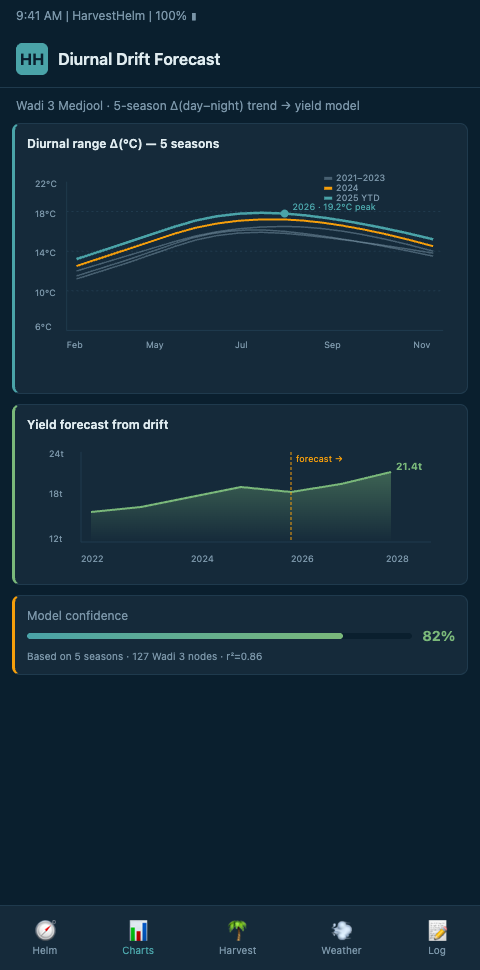
HarvestHelm's helm-charted yield forecast is built for the multi-season horizon, not just the current bloom. The yacht dashboard treats each season as a completed voyage whose log is retained, and the captain steers the next voyage with the accumulated chart rather than a fresh map. Concretely: every season, the helm retains a full-resolution record of hourly temperature, RH, wind, dust AOD, and pollination-window traces for every sensor in the operation. That record feeds a drift model that decomposes the diurnal swing into its daytime-max and nighttime-min components and tracks each separately.
The PMC intelligent yield prediction study documents hybrid ML models using temperature, humidity, and wind history to forecast date yield with high accuracy across scenarios. We extend that framework with an explicit drift decomposition. When a grower in the Draa Valley asks what to expect for 2026, the forecast does not average 2021-2025 yields. It fits a trend line through 2021-2025 diurnal envelopes, projects the 2026 envelope, and then asks: given the cultivar mix and parcel geography, what yield does a 2026-like diurnal envelope imply?
This matters because the diurnal envelope drives specific physiological decisions. FAO's Chapter IV on date palm climatic requirements specifies 3,300 heat units (base 10°C) for full maturity in fine cultivars. If your night lows are dropping faster than your day highs are rising, your cumulative heat units might look similar in raw totals while your khalal-rutab transition rates shift materially — because the cold-night penalty on fruit biochemistry does not reverse with a warm afternoon. The helm makes that decomposition visible on the yacht dashboard as two independent trend lines, each with a confidence envelope and each annotated with the phenological stage that's most sensitive to it.
A practical example: a Kebili operator running 6,400 Deglet Noor palms saw her night lows drop 1.8°C between 2020 and 2024 while daytime maxima rose only 0.4°C. Her cumulative heat units over that period were stable within 2%. Her raw totals told her the climate was "fine." The helm's drift decomposition told her something different — her khalal transition was happening 4-6 days later each season, pushing harvest into a higher sandstorm-exposure window. Armed with that, she shifted her pick order to start with Deglet Noor blocks that historically matured first, reassigning crew capacity to accommodate the later transition cohort. Her export-grade fraction held steady in 2024 while regional peers saw 8-12 point drops.
The Nature Scientific Reports paper on climate-based palm yield predictability validates the 3-month lead time for yield forecasts from temperature anomaly data, and that finding transfers cleanly from oil palm to date palm physiology. Three months of lead time is enough to renegotiate packing contracts, rebalance export-grade allocations, and stage pollen banks for the cultivars that will run long. Our pollination 12-season analysis explores the same multi-year signal from the bloom side; this post looks at the harvest tail.
Advanced Tactics for Drift-Aware Multi-Season Forecasting
The first advanced move is cultivar-specific drift sensitivity. The PMC study on hormones and antioxidant status in UAE early-mid-late date varieties documents that Medjool, Khenaizi, and Barhi respond differently to seasonal temperature profiles because they flower and ripen on different calendars. A 1°C night-low drift in March affects early-flowering cultivars differently than late-flowering ones. The helm fits cultivar-specific regression coefficients to your orchard's specific history, so the forecast for your Deglet Noor is calibrated against your Deglet Noor readings — not a regional average that lumps six cultivars together.
The second tactic is sandstorm-drift coupling. The ScienceDirect CLIMEX study projects 27.98-33% range contraction in MENA date production under A1B/A2 climate scenarios, and that contraction is not driven purely by temperature. Sandstorm frequency and khamsin intensity are coupled to the larger diurnal drift signal. When the helm projects a 2026 yield, it conditions on the forward-looking dust plume frequency from CAMS dust forecast assimilation and the regional dust-AOD trend. A grower planning pollen bank capacity for 2027 should size the bank against the forecast sandstorm days, not last year's count.
The third tactic is trust-region forecasting. When historical data thins — say, a brand-new parcel with only 18 months of telemetry — the helm explicitly widens the forecast uncertainty and surfaces that on the yacht dashboard. A captain does not confuse a chart that says "depth uncertain" with one that says "depth 40 feet." Our drift model does the same. If your new 2024 parcel has an 18-month diurnal record, the 2026 forecast for that parcel carries a wider confidence band than the 2026 forecast for a parcel with eight years of history. This discipline matters because over-confident forecasts get you wrong just often enough to lose trust, and then you stop steering by them. The same drift logic applies across perennial crops — we document the parallel pattern in multi-year fungal drift on tropical mango plantations.
The fourth tactic is night-low integration with harvest-window prediction. The PMC study on date palm physiological response and storage documents how harvest-stage temperature affects fruit biochemistry and post-harvest quality. When your night lows drift, your optimal pick date drifts with them. We connect diurnal drift to harvest-window prediction in our post on night-low harvest windows, where five-year night-low datasets directly drive pick-date scheduling. The two forecasts share data and calibration, so a grower sees consistent answers whether they ask about bloom timing or pick timing.
The fifth tactic is forward-rolling scenario testing. Rather than deliver a single 2026 yield forecast, the helm produces three scenarios — "drift continues at current rate," "drift accelerates 25%," and "drift stabilizes" — each with yield distributions and operational implications. A grower evaluating whether to expand into a new 400-palm Barhi block can see the yield expectations under each scenario, including the bad cases. This scenario discipline beats single-point forecasts at supporting capital decisions that need to survive multiple plausible futures. The drift signal alone tells you where things are going; scenarios tell you how much runway you have if the signal shifts.
The sixth tactic is anomaly-detection anchoring. When a current season's diurnal envelope starts diverging from the trended expectation — say, March 2026 running 1.8°C colder at night than the drift line suggests — the helm flags the anomaly and tightens its regional sanity-checks. An anomaly could indicate a real regime shift or a sensor problem, and the helm does not confuse the two. A sensor drift that produces a fake "colder nights" signal gets caught by cross-sensor consistency checks before it biases the forecast; a real atmospheric shift gets escalated as a forecast-revision event with an explicit note explaining the divergence. This diagnostic layer is how we avoid silently miscalibrating the long-run drift estimate on the back of a bad week of telemetry.
Forecast the Season After Next, Not the Season Before
If you're planning 2027 from 2026's yield totals, you're forecasting a diurnal envelope that no longer exists. HarvestHelm charts multi-season drift on a yacht-style helm that shows your day-max and night-min trend lines separately, conditions the yield projection on cultivar-specific sensitivities, and ties sandstorm frequency directly into your pollen bank and crew capacity planning. Because our kilo-cut pricing takes only a share of the successful harvest, we have direct incentive to call drift right — if we forecast too optimistically, we lose.
If you run Medjool, Deglet Noor, Barhi, or Zahidi blocks and you want a multi-season forecast built from your oasis's actual diurnal history rather than a regional average, we'll ingest your historical telemetry (or install fresh instruments on a no-upfront basis) and deliver a drift-aware forecast for your next three seasons. Join the drift-forecast waitlist before the next Medjool bunch-thinning cycle, and on day one your dashboard will display decomposed day-max and night-min trend lines alongside scenario-based khalal-rutab transition projections for each block. Kebili and Draa Valley operators who joined ahead of last season identified cultivar-specific drift gaps that let them adjust pick order and packhouse capacity against the emerging envelope.