Predicting Harvest Windows From Five-Year Night-Low Temperature Data
Why Night Lows Quietly Drive the Harvest Calendar
Date palm harvest windows depend on completion of the khalal-to-rutab-to-tamar ripening sequence, and that sequence is driven by cumulative thermal load rather than peak daytime temperature. FAO Chapter IV on date palm climatic requirements specifies 3,300 heat units base 10°C for full maturity in fine cultivars, along with warm-night requirements for tamar-stage transitions. The UC Davis Postharvest Research and Extension Center reference on dates documents cultivar-specific harvest timing and optimal thermal conditions pre-picking.
The practical implication growers tend to miss: an oasis with identical daytime maxima across two consecutive seasons can have materially different harvest calendars if the overnight lows differ. A season with 28°C daytime highs and 16°C overnight lows delivers less integrated thermal time than a season with 28°C highs and 21°C overnight lows — because the warm nights keep fruit metabolism running while the cool nights slow it. Over a 60-90 day maturation window, the difference between 16°C and 21°C night lows accumulates to roughly 10-14 days of phenological shift for the same cultivar in the same parcel.
The PMC study on date palm physiological response under different storage and harvesting temperatures quantifies how harvesting-stage temperature affects fruit biochemistry — confirming that the pick-date decision depends on both pre-harvest and at-harvest temperature context. The MDPI paper on precision temperature and RH effects on artificial ripening and quality of date fruit documents temperature and RH thresholds for khalal-rutab-tamar transitions that a prediction algorithm must honor. The Frontiers Saudi unripening-syndrome study presents inter-annual night-temperature variability as a driver of unripening syndrome — a documented failure mode for harvest timing based on day-max assumptions alone.
The Helm-Charted Yield Forecast for Harvest Windows
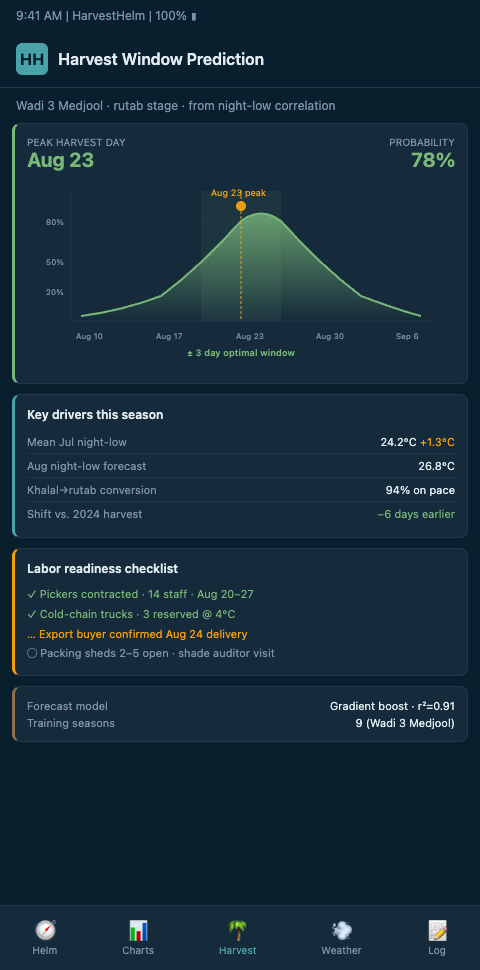
HarvestHelm's helm-charted yield forecast treats harvest-window prediction as a direct output of the sensor stack. The yacht dashboard shows a grower the projected pick-date distribution for each cultivar block, conditioned on the current season's diurnal envelope and calibrated against the operation's five-year night-low record. Instead of a fixed calendar date, the forecast delivers a 4-8 day window with central estimate and confidence band — reflecting the actual physiological uncertainty.
The prediction pipeline stacks four inputs. First, a five-year continuous night-low record for the specific parcel, sourced from the grower's own telemetry where available and from reanalysis downscaling where historical gaps exist. Second, a cultivar-specific thermal-response curve — Medjool, Deglet Noor, Barhi, and Zahidi each have different khalal-rutab-tamar transition profiles under warm-night vs cool-night regimes. Third, the UAE multi-year hormone and antioxidant dataset on early-mid-late date varieties feeds multi-year phenology linkages to monthly minimum temperatures. Fourth, the World Bank CCKP ERA5 dataset provides historical daily min/max climatological baselines for comparison.
The output on the yacht dashboard is a pick-date planner that shows, for each cultivar block, the projected first-pick, peak-pick, and last-pick dates with confidence bands. A grower running 2,400 Medjool palms and 3,800 Deglet Noor palms can see both cultivars' harvest windows stacked against each other and against their packing-line capacity. If the forecast projects Medjool peak on October 8-14 and Deglet Noor peak on October 11-18, the overlap on October 11-14 is the capacity bottleneck — the dashboard flags it as such, and the grower can make labor and packing-line decisions 6-8 weeks in advance. This coupling between diurnal envelope and harvest timing is the tail end of the story we tell in multi-season diurnal drift, where the diurnal signal drives multi-season yield; here, the same signal resolves into specific pick-date windows.
Advanced Tactics: Turning Night-Low Data Into Operational Decisions
The first advanced move is cohort-level pick-date staging. A Medjool block is not uniformly ripe on a single day — it ripens in cohorts over 10-18 days, and the cohort sequence is driven by the spathe-emergence sequence from 6-8 months earlier. The helm ties pollination-window data to harvest-window prediction, so a block that pollinated in three waves produces three harvest cohorts with known offsets. Crews can be staged against cohort arrival rather than whole-block averaging — which raises pick efficiency and protects export grades by avoiding over-ripening on early cohorts waiting for late-cohort readiness.
The second tactic is night-low anomaly detection mid-maturation. Five years of baseline data lets the helm flag night-low anomalies as they happen. A September with overnight lows 2.5°C above baseline will pull the pick date forward by 6-9 days; a September running 2°C below baseline will push it later. The dashboard surfaces the shift in real time so crew contracts, packing-line staffing, and export-logistics windows can be adjusted within the growing season rather than after the fact. This real-time responsiveness is impossible without a multi-year baseline to anomaly-detect against.
The third tactic is export-grade window optimization. Export-grade Medjool and Deglet Noor sell into contract windows that often have firm date specifications. If the harvest window drifts 8 days later than the contract expects, the grower can negotiate early rather than deliver against an infeasible timeline. The helm couples its harvest forecast to standard export contract calendars and surfaces flags 45-60 days ahead when the projected window falls outside contract tolerance. This turns night-low data into commercial leverage instead of a harvest-floor surprise.
The fourth tactic is cross-crop validation. Harvest-window prediction from multi-year overnight temperature data transfers across perennials. Our work on hurricane frequency yield for coastal citrus applies the same multi-year baseline discipline to frequency-adjusted yield forecasting under changing hurricane patterns. The engineering stack shares a common time-series feature extraction layer, so improvements in one crop's temporal feature engineering benefit the others — a pick-date anomaly detector refined for date palm improves harvest-timing prediction for navel oranges six months later.
The fifth tactic is grower-specific learning. Every season the helm runs a full post-harvest reconciliation: predicted pick windows against actual harvest execution, with attribution of variance to the physiological model, the weather forecast, or the operational constraints. Over three to four seasons, the predictor learns the specific signature of your oasis's phenology — how your Medjool responds to warm-night anomalies, how your Deglet Noor differs from the cultivar's regional average. By year four, the predictions are materially better than any generic regional model, and the learning is reported transparently on the dashboard so you can see how the calibration is tracking. The multi-season baseline also feeds our post on pollination 12-season data, where similar retrospective discipline governs bloom forecasting.
The sixth tactic is inversion night-hunting. On some seasons, canopy-level night lows diverge sharply from standard weather-station readings — a cold-air inversion can settle in a wadi while the nearby town reads 4-6°C warmer. The helm uses parcel-level canopy telemetry to detect these inversions directly and adjusts the maturation forecast to reflect the canopy conditions rather than the station. Growers relying on public-station data alone systematically misjudge harvest windows in inversion seasons; canopy-level telemetry closes that gap.
The seventh tactic is cultivar-staggering optimization. A mixed-cultivar oasis running Medjool, Deglet Noor, Barhi, and Zahidi benefits from intentional harvest staggering — concentrating all four cultivars into a single two-week window overwhelms packing capacity, while spreading them across six weeks allows export-grade quality at each pick. The helm's cultivar-specific harvest-window forecast supports planning that staggering: if the forecast shows Barhi peaking October 2-6, Medjool October 8-14, Deglet Noor October 11-18, and Zahidi October 16-22, the grower can book packing-line slots and crew rotations against that explicit sequence rather than hoping for natural separation. This scheduling precision is especially valuable for smallholder cooperatives sharing a packing line across many growers.
The eighth tactic is temperature-driven quality projection. Harvest-window timing is not only about when to pick — it's also about what quality grade the fruit will reach. The MDPI paper on precision temperature and RH effects on artificial ripening documents how specific temperature ranges during final maturation drive sugar content, skin color, and texture characteristics. The helm couples the pick-date forecast to a quality-grade projection, estimating the fraction of the harvest expected to hit export-grade versus secondary grade. A cooler-than-average September that delays maturation also typically lowers sugar accumulation — the grower sees both the date shift and the grade-mix projection and can price export contracts accordingly.
The ninth tactic is weather-contingent logistics contracting. When the forecast shows high confidence that the pick window will fall October 11-18, the grower can lock in crew, trucking, and packing-line contracts against that window at better pricing than scrambling for last-minute capacity. When the forecast shows wide uncertainty — say 7 to 14 day spread — the grower can negotiate flexible contracts with defined price bands tied to the actual arrival date. The forecast's uncertainty quantification becomes a contracting tool, not just a planning note.
Chart the Pick-Date Before the Packing-Line Is Booked
If your Medjool or Deglet Noor harvest schedule is still pinned to a calendar date from five years ago, you're guessing at a window the diurnal envelope has already moved. HarvestHelm builds a pick-date forecast from five years of your oasis's own night-low record (or from reanalysis-downscaled baselines if your history is shorter), conditions it on your cultivar mix and spathe-emergence history, and surfaces the projected window as a confidence-banded forecast 6-8 weeks before peak pick. Because our kilo-cut pricing earns only on export-grade tonnage delivered, getting the window right is our direct interest — we lose revenue when over-ripened fruit drops to secondary grade.
If you're planning 2026 crew contracts, packing-line staffing, or export shipments for Medjool, Deglet Noor, Barhi, or Zahidi blocks, let us run the five-year night-low analysis on your oasis and show you the pick-date distribution your next harvest actually implies. Join the pick-date forecast waitlist before your first September night-low trace this summer, and on day one the dashboard will display cultivar-staggered first-pick, peak-pick, and last-pick windows with packing-line bottleneck flags across your Medjool-Barhi overlap. Waitlisted Riyadh and Coachella operators who pulled 6-8 week advance forecasts ahead of last tamar peak booked trucking and export container slots against the correct window, catching an 8-day shift that would have otherwise pushed premium Medjool into secondary-grade pricing at the packhouse line. Cooperative packing lines serving multiple smallholders benefit because the cultivar-staggering optimization across member parcels converts harvest-week chaos into deliberate pallet scheduling.