Calibrating Heat Unit Models to Oasis-Specific Canopy Shade
A 16-Day Miss Means You Missed Two Ships
Growing-degree-day (GDD) models are the industry-standard tool for predicting date palm development stages, and regional weather stations feed most of them. The trouble is that GDD under microclimate requires air-to-canopy corrections for accuracy, as MDPI Horticulturae's review of advances in GDD models documents. The canopy is not the atmosphere. MDPI Horticulturae's work on Canary Island date palms notes that date palm canopies have 15% solar transmissivity and 30-40% sunny spots, which means a block with 78% canopy closure sees substantially less radiation than the station 22 km away — and the palm responds to what its canopy actually receives.
The USDA ARS work on spatial canopy temperature via pivot IRTs shows infrared thermometer mapping quantifying within-canopy thermal variation at 3-7°C spreads between sun-exposed and shaded quadrants of the same crown. Heat unit accumulation calculated from crown-exterior temperature diverges from heat unit accumulation calculated from fruit-zone temperature, and the fruit zone is what the grower cares about. The 16-day tamar miss in the opening example is the operational cost of that divergence, and export operations see the consequence as mismatched container schedules and penalty clauses from importers expecting on-date delivery.
The divergence compounds across cultivars because Medjool, Deglet Noor, Barhi, and Zahidi each respond to heat units at different upper thresholds — Zahidi tolerates 47-48°C before development stalls while Medjool stalls at 45°C. A regional station that averages across a provincial grid cell cannot resolve per-cultivar transition timing, so growers running mixed blocks inherit a forecast that is systematically biased against the cultivar with the tightest thermal tolerance.
A Helm-Charted Yield Forecast That Calibrates to Your Own Canopy
HarvestHelm's heat unit model calibration runs three concurrent sensor streams per block and merges them into a site-specific heat accumulation curve that the helm-charted yield forecast uses for all downstream scheduling. The yacht-navigation metaphor applies directly: standard GDD models are sailing instructions written for a different bay, and HarvestHelm builds the bay chart for your specific oasis.
The first sensor stream is ambient air temperature from a grove-boundary station, calibrated against the nearest regional reference. This gives the baseline atmospheric heat signal and lets the engine relate the block's internal microclimate to published regional norms. It is also the feed that external advisories use, so keeping it aligned lets the captain compare your grove to the regional outlook in the same units.
The second stream is canopy-interior thermal telemetry. Each monitored block gets 2-4 sensors placed at fruit-zone height in shaded and sun-exposed quadrants of representative palms. PMC research on automatic crop canopy temp via low-cost thermal sensors documents the image-based sensor approach under shade net — HarvestHelm uses the same physics with infrared-thermopile point sensors because they survive desert dust better than imagers. The fruit-zone readings establish the palm frond shading index for each block, updated monthly as frond counts change through pruning and senescence. The placement-density trade-offs behind this multi-sensor architecture are covered in hyperlocal sensor placement, which establishes the eight-placement pattern feeding the calibration engine.
The shading index also reflects mutual shading between adjacent palms. A block with 9m row spacing has different canopy transmissivity than the same cultivar at 7m spacing, because adjacent crowns shade each other at low sun angles. HarvestHelm's per-block index factor captures this geometric effect, and the dashboard surfaces how pruning decisions will shift the index ahead of the season. When an operations manager plans to remove three fronds per palm for airflow, the engine projects the shading-index delta and the downstream GDD recalibration, so pruning decisions are made with their thermal consequences visible rather than in isolation.
The third stream is radiation. A pyranometer at canopy top and a colocated sensor at fruit zone measure the actual solar energy reaching the fruit, giving the transmissivity fraction that feeds the oasis canopy shade accumulation model. When frond growth or pruning changes the shading index, the transmissivity number updates automatically and the GDD calibration re-runs. The Davis Instruments mobilize work on custom GDD reports shows how mobile-dashboard GDD calculations work in practice; HarvestHelm extends the pattern by sourcing the temperature and radiation inputs from block-level sensors rather than a regional station.
Dust-load adjustment is the stream's secondary function. A dust-coated pyranometer reads low, and dusty fronds transmit differently than clean ones. HarvestHelm's calibration cadence includes dust-event markers that flag when measured transmissivity deviates from the seasonal baseline by more than the noise floor, prompting a field cleaning and recalibration task. Over the three-to-four-week windows following major sandstorm events, the engine temporarily weights the regional station more heavily until the local sensors are confirmed clean. This failure-mode handling is what keeps the GDD forecast reliable through the storm season rather than drifting into systematic error.
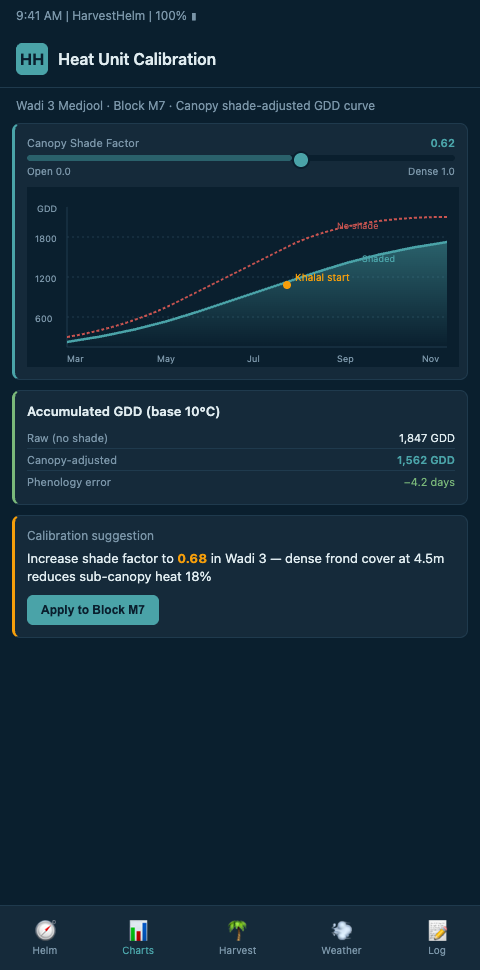
The calibration layer is where the engine does its differentiated work. Standard GDD accumulates above a base temperature (typically 18°C for dates) up to an upper threshold (around 45°C). HarvestHelm's canopy-corrected GDD applies a transmissivity multiplier and a shade-correction curve to each hourly data point, so a fruit-zone temperature reading of 38°C under 82% canopy closure contributes a different heat unit value than a 38°C reading under 40% closure. The ResearchGate work on climate change impacts on date palm cultivation in Saudi Arabia shows Saudi warming projected at +2°C by 2030, shifting baseline calibrations across a 10-year horizon. HarvestHelm re-computes calibration each season against actual stage-transition dates logged by the ground crew, so the model adapts rather than drifts.
The upper-threshold handling also matters more in desert than temperate crops. Stress cutoffs around 45°C mean hours above threshold should not accumulate as forward-development heat, and in extreme heat events may even contribute negative "heat-damage units" that delay stage transition. The engine carries cultivar-specific upper-threshold behavior, with Zahidi tolerating 47-48°C before development stalls while Medjool stalls at 45°C. The calibration honors these cultivar boundaries so that a 46°C afternoon counts as positive heat on Zahidi blocks and as neutral-to-negative heat on Medjool blocks, producing per-cultivar predictions that track actual fruit development rather than homogenizing the whole grove into a single curve.
The helm view exposes two GDD traces side-by-side: regional-station GDD (what your neighbor is using) and canopy-corrected GDD (what your block is actually experiencing). Stage-transition date predictions are derived from the corrected trace and flagged with uncertainty bounds. When the two traces diverge by more than the seasonal average, the captain sees a drift alert and can investigate whether canopy closure has changed or radiation is shifting.
The divergence alert is also the signal for cross-block variance investigation. When Block 3 and Block 7 share similar ambient exposure but show meaningfully different corrected-GDD accumulations, the difference usually traces back to frond count, row-spacing, or ground-cover reflectance — each of which is an operational variable the grower can influence. The dashboard surfaces these between-block variance patterns and tags the candidate drivers, giving the operations team a prioritized list of block-management adjustments that would close the gap. Over a 3-year horizon, operations that systematically work through this list can reduce inter-block GDD variance by 30-45%, which is the statistical foundation for the tighter harvest-window predictions that export contracts increasingly require.
Advanced Tactics for Per-Palm Resolution and Climate Drift Adaptation
The first advanced tactic is per-palm resolution scaling. Block-level calibration is the baseline, but high-value blocks — export Medjool, premium Barhi — can benefit from per-palm monitoring where individual crown-closure differences drive stage-transition variance of 3-7 days. HarvestHelm's scaling wizard lets operators upgrade a block from 4 sensors to 16-24 sensors with the same dashboard — the engine handles the additional resolution automatically. PMC research on date palm heat and drought stress early signs documents the canopy-level thermal stress signatures that per-palm monitoring catches before block-average metrics would show anything.
The second tactic is climate-drift adaptation. Multi-year warming trends mean the GDD calibration that worked in 2020 is already diverging by 2026, and the divergence compounds. HarvestHelm maintains a rolling 5-year calibration record per block and runs a drift-detection algorithm that flags when the per-season correction factor is moving outside historical variance. When drift is confirmed, the engine proposes a new baseline and asks the captain to approve the transition. This connects directly to climate-drift fruit-set modeling, where the same long-horizon warming patterns reshape fruit-set rate predictions.
The third tactic is fruit-quality linkage. Heat unit accumulation is correlated not just with stage transition date but with fruit quality metrics — sugar content, skin uniformity, moisture. HarvestHelm's quality-linkage module runs post-harvest quality data back against the calibrated GDD curve and identifies the heat-unit bands associated with premium-grade fruit. Over 3-4 seasons, the operation can shift its within-season decisions (thinning, irrigation, harvest start) to maximize time in the premium band. The calibration approach parallels what apple orchards use for chill model calibration across elevation profiles, where microclimate correction produces the same kind of forecast accuracy lift.
Calibrate to Your Oasis, Not to the Airport
Regional GDD models cost export operations their container schedules every season because the airport station does not know your canopy closure. HarvestHelm's site-specific heat accumulation engine reads canopy-interior thermal telemetry, radiation transmissivity, and ground-crew stage transitions to produce a per-block GDD curve calibrated to your oasis. Book a calibration study and we will install the sensor stack on two representative blocks and run a parallel 60-day measurement against your current prediction method. No upfront cost; the kilo-cut only applies to harvest delta above your five-year baseline. Stop missing tamar by two weeks; the palm is telling you when it's ready, if your telemetry reads what the canopy is actually receiving. Join the canopy-GDD calibration waitlist before your Medjool blocks enter tamar finishing this September, and on day one the dashboard will surface your corrected-GDD trace alongside the regional-station trace with projected tamar arrival bands per block.
Waitlisted Coachella operators who installed the two-block sensor stack ahead of last October's tamar peak recovered two export-container schedules that would otherwise have shipped early or late under airport-derived predictions, converting directly into preserved Medjool premium pricing with European importers. The sensor stack remains on HarvestHelm's books until export-grade tamar crates clear the packhouse line, meaning zero capital exposure through the 60-day parallel measurement period. Barhi and Deglet Noor operators facing dust-coated pyranometer drift during khamsin season benefit from automatic transmissivity recalibration baked into the engine's failure-mode handling, which keeps the GDD trace reliable through the storm weeks when regional stations are most misleading. Over 3-4 seasons the multi-year calibration record also feeds cultivar-specific fruit-quality linkage, so per-block decisions on bunch-thinning and irrigation ramp automatically shift toward the heat-unit bands associated with premium-grade fruit.