Preventing Fruit Drop From Post-Pollination Heat Stress Events
The Two Abscission Peaks Growers Miss
Deglet Noor and Medjool drop fruit on a predictable schedule under heat stress, and the schedule shows two distinct peaks. A T&F paper on preharvest fruit drop of Deglet Nour at Kimri stage documented two abscission waves at 25-45 days and 80-100 days post-bloom, with drop magnitudes peaking when the day-night temperature gap widens beyond cultivar-specific thresholds. These aren't isolated events — they are predictable responses to thermal stress, and the interventions that prevent them have specific timing requirements that calendar-based irrigation routines cannot hit reliably.
A concrete example from the Imperial Valley shows the pattern. A Medjool operator ran drip irrigation on a consistent 6-hour morning cycle across a 40-acre block through the summer. A 5-day heat wave pushed afternoon highs to 45-47°C starting at day 32 post-bloom — right in the first abscission window. He didn't adjust irrigation or add any cooling intervention because the morning cycles seemed adequate. Kimri-stage fruit drop measured at day 55 came in at 31% — nearly double the 17% baseline from the previous three seasons. The palms had been experiencing cumulative thermal stress during the peak afternoons, and the irrigation was replenishing soil moisture without ever actually cooling the canopy or buffering the day-night gap that drives abscission.
The PMC paper on date palm coping with stress in the desert identified evapotranspiration as the palm's primary cooling mechanism. This matters because irrigation scheduling that doesn't align with peak-ET hours fails to support the palm's internal cooling process. The research showed mid-summer ETc rates reaching 190 L/day — a number that the Progressive Crop Consultant article on date palm water management documented in detail. Hitting that level of water demand means irrigation timing has to coordinate with canopy-level thermal stress signals, not just the calendar.
Intervening With the Helm-Charted Yield Forecast
HarvestHelm treats post-pollination heat stress as a rolling passage through known hazard zones. The helm-charted yield forecast maps the 25-45 day and 80-100 day abscission windows per block based on actual pollination dates, then overlays the 14-day forecast and real-time canopy readings to flag incoming thermal stress events while crews still have intervention lead time. The Diurnal Swing Compensation for Fruit Set feature runs continuously through both windows, adjusting the drop projection as temperature profiles update.
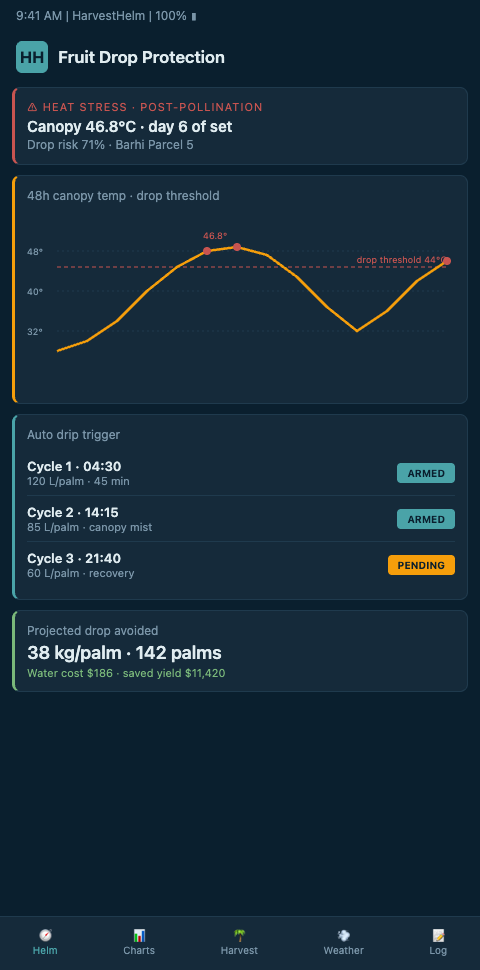
The yacht captain metaphor applies cleanly here because captains don't wait for the storm — they pre-position fuel, adjust course, and reef sails ahead of the front's arrival. HarvestHelm does the equivalent by recommending irrigation shifts, foliar interventions, and even shade-net deployments 24-48 hours ahead of forecasted peak-heat events inside the abscission windows. The ScienceDirect paper on effects of Ethrel and auxin on date palm fruit abscission identified IAA-ethylene imbalance as the mechanism driving drop — which means interventions that raise auxin or suppress ethylene during the stress window can pull the retention curve back toward baseline. The BMC Plant Biology paper on synthetic auxin for fruit drop management documented foliar 2,4-D significantly reducing drop across date cultivars. HarvestHelm recommends auxin application only on blocks where the forecast shows drop probability exceeding 22-25% — the threshold where the intervention's cost clears the expected retention gain.
The Improving Fruit Set and Productivity of Barhee Under Heat Stress paper documented dry yeast spray treatments as a non-hormonal intervention that retains fruit under heat stress. HarvestHelm maintains both hormonal (auxin) and non-hormonal (yeast) intervention options in its recommendation engine and ranks them per block based on cultivar response, organic certification status, and timing relative to the forecast window. Operators who connected their fruit-set decisions through peak-heat fruit set forecasting find the drop-prevention stage flows naturally from the same engine — the fruit-set forecast identifies at-risk blocks at day 14, and the drop-prevention module picks up from day 25.
The Cultivar Reassignment Advisor tracks multi-season drop patterns and flags blocks where repeated heat-stress-driven abscission exceeds 25% for three consecutive seasons. These blocks become candidates for either cultivar replacement (Zahidi tolerates heat-stress abscission better than Medjool on average) or shade-infrastructure investment. The recommendation includes a kilo-cut revenue projection so the grower can weigh the replant cost against the cumulative annual loss, treating the decision as an explicit capital-allocation exercise rather than a vague wish for better weather.
Advanced Tactics: Irrigation Timing and Intelligent Models
The PMC paper on intelligent approach to improve date palm yield and water productivity used machine learning to evaluate irrigation and climate scenarios and project yield under heat-stress interventions. HarvestHelm incorporates similar ML logic to refine per-block irrigation schedules during the abscission windows. Instead of running fixed 6-hour morning cycles, the engine recommends variable cycles that ramp up during forecasted peak-heat days and taper during cool periods. This dynamic scheduling typically improves water-use efficiency while reducing drop — the combination that matters most for operations tracking ETc against water-cost constraints. Growers tying this into drip irrigation telemetry close the operational loop between forecast and execution.
The second abscission wave at 80-100 days is often overlooked because by that point crews are focused on the approaching harvest window. HarvestHelm keeps the second wave in view through the entire post-pollination span, with amber flagging kicking in at day 78 for blocks carrying heat-stress signatures from the prior weeks. Missing this second wave is how 3-5% of viable fruit disappears in August for operators who stopped tracking risk after the first peak passed. The cumulative effect across a 200-palm block equals thousands of kilos of lost export-grade production.
Mango growers applying similar intervention logic for powdery mildew prevention have built parallel forecast-driven intervention menus for their specific disease pressures. The portable pattern is forecast-to-intervention timing — whatever the specific mechanism, crops gain retention when the intervention matches the cellular-stress window rather than arriving generically against the calendar. Date growers facing increasingly frequent peak-heat events through the summer need this pattern more than ever because the drop windows have grown longer and the buffering margin has shrunk. Cooperatives and smallholders alike benefit from the kilo-cut structure because the intervention costs are tested against actual retained fruit, not assumed response rates.
Evapotranspiration alignment is the mechanical lever most growers can still refine. The PMC paper on date palm desert stress coping identified evapotranspiration as the primary cooling mechanism, which means irrigation timing has to support the palm's internal cooling during the afternoon hours when stress peaks — not only during morning hours when most legacy schedules run. A Deglet Noor block running drip at 4 AM refills soil moisture but does nothing to support the palm's 2 PM thermal stress response. HarvestHelm's irrigation advisor recommends split-cycle schedules that deliver water in a morning pulse and a shorter afternoon pulse during forecasted peak-heat days, which keeps root-zone moisture available when the evapotranspiration demand spikes. The Progressive Crop Consultant documentation on water management aligns with this approach by showing that split-cycle schedules deliver 8-14% water savings while improving retention — a dual benefit that matters especially in regions where water allocations are tightening.
Combining drop-prevention with bunch-management practices produces a compound effect. Pollinated bunches carrying heavier initial fruit loads show higher drop rates under heat stress because the palm's resource-allocation logic sheds less-viable fruit first. Thinning bunches to target load during Kimri reduces the abscission pressure by lowering the total resource demand, which lets the palm retain the remaining fruit more reliably through the stress windows. HarvestHelm's bunch-management recommendations integrate with the drop forecast, showing which blocks most benefit from thinning before the first stress event arrives. Export-grade operators particularly benefit because thinned bunches produce larger, more uniform fruit that commands premium pricing at the packhouse. The kilo-cut structure captures the grade-A premium directly, so HarvestHelm's interest aligns with the grower's grade-mix improvement rather than with simple volume maximization.
Multi-season retention analytics finally close the feedback loop. By year three of continuous forecast-to-intervention tracking, HarvestHelm's engine can identify which interventions produced measurable retention improvements for each specific block and which interventions were effectively neutral. This per-block intervention history refines the future recommendations, prioritizing the treatments that actually work on the grower's specific palms rather than applying a generic cultivar-level response matrix. Growers who maintain continuous multi-year records through the HarvestHelm dashboard end up with a documented intervention-response archive that outlives individual grove managers and preserves operational knowledge across generational transitions. For family-owned oases facing succession planning, this data asset becomes a meaningful part of the business's institutional memory — ensuring that the next generation inherits quantified operational intelligence rather than scattered calendar notes.
Instrument Your Abscission Windows Before the Next Heat Wave
If your operation has experienced post-pollination heat stress in the past three seasons and your Kimri fruit-drop rates have exceeded 20% in at least one season, HarvestHelm will map your historical drop events against the corresponding temperature data and build a per-block stress profile ready for the next season's 25-45 day and 80-100 day windows. The deliverable shows which blocks carry highest drop risk under forecasted conditions, ranks intervention options (auxin, yeast, irrigation, shade) by expected retention gain, and projects the kilo-cut revenue impact of each recommendation. Smallholders running 100-300 palms see the clearest ROI because a single prevented drop wave recovers several seasons of the kilo-cut share. No upfront cost — the drop-prevention work is part of the harvest-share engagement, activating value only when retained fruit reaches the packhouse.
Join the abscission-window waitlist before your Medjool and Deglet Noor blocks enter the 25-45 day drop window after this bloom, and on day one you will see a per-block stress heatmap with auxin and dry-yeast intervention timing ranked against forecasted peak-heat days. Growers who waitlisted ahead of last summer's second abscission wave caught a silent August drop event that would have shed 14% of Barhi Kimri retention on two blocks, recovering three packhouse export pallets that would otherwise have been unrecoverable. The per-block stress profile builds from your existing pollination log and regional temperature archives, so kilo-cut exposure stays at zero until retained tamar crates actually load onto the export truck.