How to Forecast Fruit Set After a Peak-Heat Pollination Window
The Peak-Heat Pollination Paradox
Medjool and Barhi growers in the Coachella, Yuma, and Siwa regions regularly face pollination windows where stigma receptivity and peak-afternoon heat collide. A single khamsin event can push temperatures 20°C in two hours — Egypt Today documented exactly this pattern during the last severe early-khamsin season, with winds up to 140 km/h destroying bloom across MENA date regions. When these events hit inside the stigma receptivity window, the question is no longer whether pollination happened but whether it actually produced viable fruit. A Frontiers paper on 'Assiane' date palm found that temperature during the receptivity period directly drives parthenocarpic fruit formation — seedless fruit that sometimes abscises mid-Kimri, sometimes hangs on as low-value grade-B produce, and sometimes fools the grower into believing fruit set was successful until a 60-day stress wave reveals the truth.
The economic consequence is ambiguous fruit-set data for 45-90 days post-bloom. A grower who cannot distinguish viable fertilized fruit from parthenocarpic carryover is allocating thinning, irrigation, and crew effort against an unreliable projection. A Yuma Medjool operator last season assumed 78% fruit set from visual spathe inspection at 14 days post-pollination. Actual viable set measured at 60 days was 52% — the remainder had been parthenocarpic fruit that abscised on schedule once cell division stalled. The Improving Fruit Set and Productivity of Barhee Under Heat Stress paper documented dry-yeast spray treatments that increase viable set by measurable margins — which matters only if the grower knows which palms need the intervention.
The adjacent Nature paper on TSP4 feedback loops in tomato fruit set under heat stress showed that heat-induced parthenocarpy is a cellular-level program, not a post-fertilization failure mode. That means the fruit-set forecast has to predict based on receptivity-window temperature data, not wait for visible spathe outcomes.
Forecasting Fruit Set Through the Helm-Charted Yield Forecast
HarvestHelm treats post-pollination fruit-set forecasting as a passage-completion projection. The yacht captain who just cleared a narrow channel isn't done — the next 50 km carry their own weather risk, and the helm chart shows the probability of reaching the next waypoint in usable condition. HarvestHelm's fruit-set forecast applies the same logic to every pollinated spathe. Inputs include the actual temperature profile during the 72-hour receptivity window, canopy-level humidity, drip-irrigation timing, and cultivar-specific parthenocarpy thresholds. Outputs are a per-spathe probability of viable fruit at Kimri, with confidence intervals that tighten as post-bloom data accumulates.
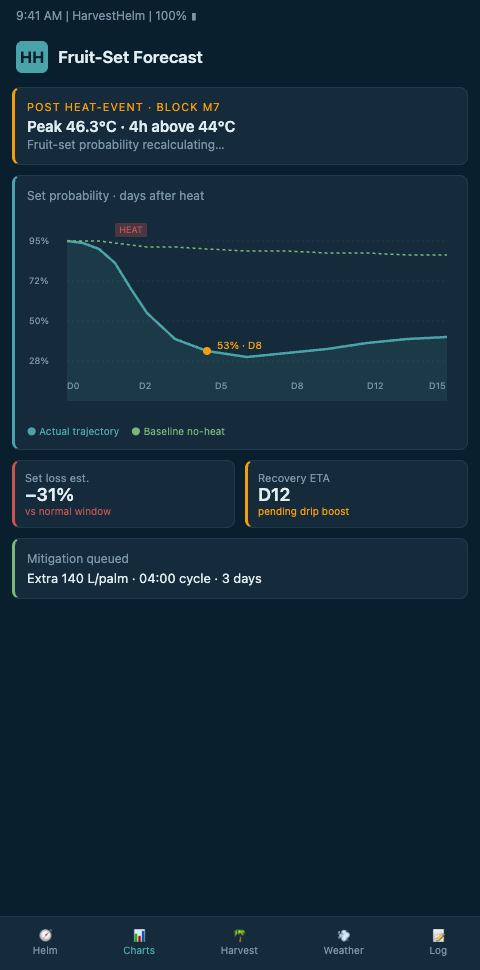
The core metaphor — helm-charted yield forecast — matters because a grower cannot reverse the pollination event itself but can absolutely reroute the rest of the season based on which palms look likely to carry viable fruit versus which look headed for parthenocarpic drop. The Diurnal Swing Compensation for Fruit Set feature grades each palm against the cultivar's heat tolerance curve, then assigns color bands on the map. Palms that pollinated inside a 44-45°C afternoon with 90%+ humidity (the parthenocarpy sweet spot) get flagged amber; palms that caught a 38-40°C window with the afternoon dust cooling temps get flagged green. This immediate triage saves weeks of ambiguity and lets thinning decisions happen before the wasted labor accumulates.
The Effects of Pollination Interventions on Hormonal Patterns paper (MDPI) described how pollen age and plant age drive hormonal signals that determine post-bloom fruit retention. HarvestHelm captures this by tracking pollen-batch freshness through the application log and overlaying it on the per-spathe forecast. A Medjool pollinated with 12-day-old pollen inside a peak-heat window gets a different forecast than the same palm pollinated with fresh pollen under the same conditions. This granularity matters because recovery interventions — foliar auxin, dry yeast sprays, shade netting — have different costs and only pay off on palms where the underlying biology supports recovery.
The Comparative analysis of synthetic auxin for fruit drop management paper (BMC) documented foliar 2,4-D reducing post-pollination fruit drop across date cultivars under heat conditions. HarvestHelm integrates this research by recommending auxin application only on palms where the fruit-set forecast shows >40% parthenocarpy probability and where the cultivar-specific response data supports intervention. Growers coordinating this with pollen viability audit protocols close the loop on pollen quality as an input to the set forecast.
Advanced Tactics: Multi-Variable Forecasting and ML Extensions
The Frontiers California Almond Yield Prediction at the Orchard Level paper laid out ML methodology for bloom-stage yield prediction that translates cleanly to date forecasting. The core insight: single-variable models (temperature alone, humidity alone) underperform multivariate models that combine bloom-window conditions, canopy structure, and irrigation timing. HarvestHelm's forecast uses the same multivariate approach and retrains on each grower's historical data as it accumulates. After two seasons the per-palm forecast typically lands within 8-12% of actual Kimri set, which is tight enough to drive crew and intervention decisions with confidence.
The Cultivar Reassignment Advisor uses multi-season fruit-set forecasting to flag blocks where peak-heat parthenocarpy is recurrent. If the Barhi block has run a 25%+ parthenocarpy rate for three consecutive seasons, HarvestHelm recommends either cultivar reassignment to Zahidi (which tolerates peak-heat receptivity better per the FAO Chapter IV reference) or investment in shade-net interventions during the receptivity window. The recommendation includes a kilo-cut revenue projection so the grower can weigh the replant cost against the recurring annual loss.
Growers with mango operations use similar forecasting logic for early monsoon fruit set — the underlying challenge of predicting post-bloom retention from pre-bloom weather data is shared across tree fruits. The translation to dates is cleanest when growers treat fruit set as a cellular-level program rather than a weather-dependent lottery. Connecting the forecast to heat stress fruit drop mitigation closes the chain from pollination through Kimri through final retention.
Labor allocation is where the forecast compounds value. Thinning crews working blind across uniform assumptions waste effort on palms that will drop regardless and miss palms where timely thinning would concentrate remaining viable fruit into premium grades. HarvestHelm's fruit-set forecast gives the labor lead a ranked palm list with priority scoring, and most operators report 20-30% labor efficiency gains in the first season. The kilo-cut math improves proportionally because more of the retained fruit lands in export grade instead of grade-B.
Cultivar-specific intervention windows matter because not every palm responds to the same treatment on the same schedule. Barhi shows the clearest response to dry-yeast sprays per the published research, while Deglet Noor has shown stronger response to auxin applications in field trials across North African and Middle Eastern operations. HarvestHelm maintains a cultivar-treatment response matrix that pairs each intervention with the cultivar most likely to benefit, then layers the forecast on top to surface the specific palm-by-palm recommendations. Operators running mixed-cultivar oases typically find that the first season of this matrix-driven intervention changes their mental model of heat-stress recovery — it stops being a uniform blanket treatment and becomes a targeted response that matches biological mechanism to cultivar specifics.
Regional climate drift is the longer-horizon consideration. The CLIMEX-based research projected 27-33% range contraction for date palm production by late century, with peak-heat pollination events expected to become more frequent across the core production regions. Growers making capital decisions today — replant, cultivar selection, shade infrastructure — need a forecast model that captures both current-season risk and multi-decade trajectory. HarvestHelm's cultivar advisor factors climate-trend projections alongside near-term forecasts, flagging blocks where today's Medjool plantings carry higher parthenocarpy risk by 2040 under moderate climate-drift scenarios. This longer view doesn't drive emergency decisions, but it shapes the calculus on which cultivars to propagate from offshoots and which to let fade from the replant cycle. Smallholders and large operators alike benefit because the trajectory-aware recommendations help align short-term decisions with long-term viability — a pattern that matters particularly in regions where the margin between viable and marginal production is compressing year over year.
Grower-to-grower knowledge sharing accelerates model performance across cooperative networks. When one member grower logs a detailed response to a specific intervention under specific weather conditions, the engine incorporates that data into the cultivar-response matrix, which then benefits every other member grower facing similar conditions. This network effect is how modern precision-agriculture platforms outrun traditional consulting — the forecast accuracy improves as more growers participate, rather than stagnating at the knowledge level of a single consultant. HarvestHelm's data model anonymizes individual grower details while preserving the underlying pattern data, so member growers gain the collective intelligence without exposing their specific operational details to competitors. Regional cooperatives and export associations have found this network-intelligence pattern particularly valuable during transition years when climate drift is outpacing generational knowledge.
Chart Your Peak-Heat Window Before Next Bloom
If your oasis has experienced a peak-heat pollination event in the last three seasons — temperatures above 42°C inside the stigma receptivity window — HarvestHelm will retroactively model the fruit-set outcomes from your historical data and show which blocks consistently parthenocarpy under similar conditions. The analysis uses your pollination log, the nearest AZMET station data, and any on-site canopy readings you have accumulated. The output is a per-block parthenocarpy risk profile plus a recommended intervention menu calibrated to each block's cultivar and heat-exposure pattern. No upfront cost — the forecast work is amortized against the kilo-cut when harvests clear. Desert growers operating in regions where peak-heat pollination windows are becoming more frequent need this layer of forecasting before the next bloom cycle, not after another season of ambiguous Kimri surprises.
Join the parthenocarpy risk audit waitlist before your Barhi and Medjool spathes enter receptivity this March, and on day one the dashboard will surface each block's color-coded peak-heat parthenocarpy probability with cultivar-specific auxin and dry-yeast intervention timing. Operators who joined the waitlist ahead of last Zahidi bloom isolated three blocks where seedless drop had masked a 21% underestimate in viable fruit count that would have derailed bunch-thinning decisions into Kimri. The retrospective model runs on your existing pollen batch log and AZMET data without any new hardware, so waitlist signups cost zero kilograms until the first export tamar crate clears the packhouse line.