How to Audit Pollen Viability After a Mid-Bloom Sandstorm
The Pollen You Trusted Is Not the Pollen You Have
Post-storm bloom salvage starts with a hard truth: the pollen in the bag is not necessarily the pollen you think you have. ScienceDirect research on maize pollen desiccation and viability documents pollen viability dropping to zero at approximately 30% moisture loss. The inverse is also true — a humidity shock that rehydrates dry-stored pollen can trigger metabolic activation that depletes viability even faster. A mid-bloom sandstorm that spikes atmospheric humidity, even briefly, can damage stored pollen batches that were perfectly viable the day before.
PMC's methodologies review for pollen thermotolerance evaluation surveys the authoritative protocols for assessing pollen viability after stress events. PubMed's reference on storage and viability assessment of date palm pollen documents the canonical protocol adapted for date palm. PMC's Deglet Nour pollen storage temperature effects specifies germination medium (15% sucrose with boric acid and salt supplements) and scoring methodology. The science is well-established; the operational problem is running viability audits fast enough that re-application decisions can still hit the 72-hour stigma receptivity window.
Tunisian, Iraqi, and Coachella operators running mixed Medjool, Deglet Noor, Barhi, and Zahidi blocks face compounded pressure during overlapping receptivity phases because each cultivar requires a different pollen batch, and a single humidity shock can degrade multiple batches simultaneously. When the pollen is also the primary link between spathe crack and eventual tamar harvest, a silent batch failure invalidates bunch-thinning decisions weeks later and puts downstream packhouse throughput projections into disarray against contracted export-grade ratios.
A Helm-Charted Yield Forecast That Runs the Viability Check
HarvestHelm's pollen viability audit workflow treats the post-storm viability test as an operational event, not a laboratory afterthought. The helm-charted yield forecast integrates a viability-sampling protocol triggered automatically whenever a mid-bloom sandstorm event is logged — the captain sees a "pollen audit required" task card on the dashboard within 2 hours of storm passage, with pre-routed sample collection, test setup, and scoring templates. The yacht-navigation analogy: a storm is a chartered course deviation, and the viability audit is the instrument check that confirms whether your navigation tools are still reading true. The viability audit closes the loop on the variable wind pollen timing workflow that governs original application timing decisions, giving the captain measured rather than assumed pollen quality before any re-application crew mobilizes.
The sampling protocol runs in three stages. The first stage is field sample collection within 4-8 hours of storm end. Ground crews collect two types of samples: residual pollen from already-pollinated spathes (swab sampling), and stored-batch pollen from active application kits. Each sample gets a barcode-tagged vial and a GPS location stamp from the mobile app. The MDPI Plants work on Mejhoul pollen stainability identifies acetocarmine, TTC, and Alexander's stain as the standard comparative assessments for date pollen viability, and HarvestHelm's sampling tags each vial with the intended test method so the lab work flows through the correct protocol.
The collection kit itself matters more than most operations realize. Sample vials need to be opaque (UV degrades viability), moisture-regulated (typically with silica gel sachets for storage-sample preservation), and shock-resistant (vibration during transport damages germination capacity). HarvestHelm ships a field-ready sampling kit preconfigured for desert conditions, with 50 sample slots, pre-labeled barcode system, and courier arrangements with partner labs. Operations that use improvised vials and storage frequently see test results skewed by handling artifacts, so the investment in standardized kits pays for itself in the first real post-storm audit by eliminating the "did we damage the sample?" uncertainty that otherwise clouds the viability decision.
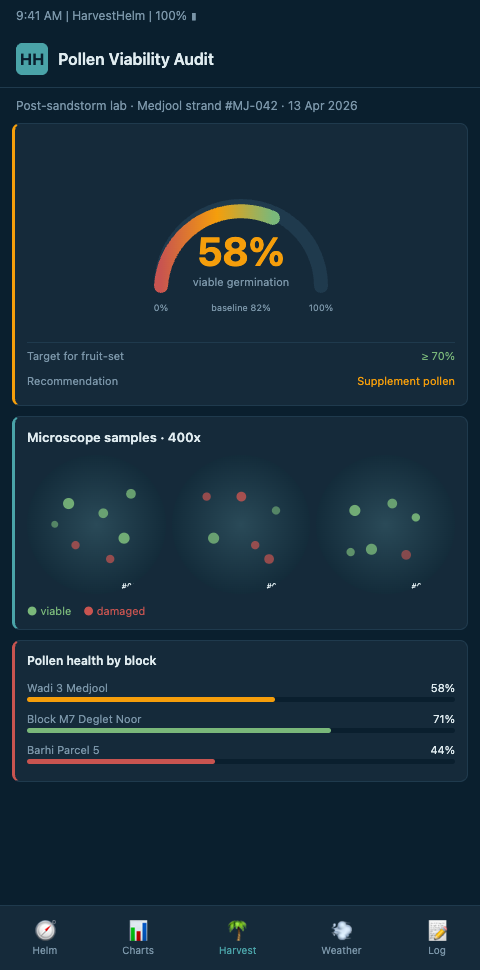
The second stage is rapid field testing. Lifeasible's TTC pollen viability test kit provides a commercial field kit that supports rapid post-storm sampling with 30-45 minute readouts. HarvestHelm pairs the physical kit with a scoring app — the technician photographs the slide under a portable microscope and the app counts viable versus non-viable grains using image analysis. Readouts sync back to the dashboard, and the viability score feeds directly into the re-application decision engine. For operations without in-house lab capacity, the samples ship overnight to partner labs with pre-populated paperwork that cuts turnaround from 5-7 days to 24-36 hours.
The image-analysis scoring eliminates the scorer-variance problem that makes manual counts unreliable. Two technicians manually counting the same slide will typically produce scores within 8-12% of each other on clear samples and within 20-25% on borderline samples. The image-analysis algorithm scores consistently across technicians, which matters because re-application decisions at the 40-65% viability band are where scorer variance would actually flip the decision. A sample scored at 58% by one technician and 42% by another might receive "use with rate adjustment" or "replace" decisions depending on who scored it, and the image-analysis approach removes that arbitrariness from the decision chain.
The third stage is in-vitro germination confirmation for the flagged samples. PMC's compendium of in vitro germination media for pollen documents that sucrose (used in 89% of published protocols), boric acid H3BO3 (77%), and calcium (59%) are the standard components. HarvestHelm's germination medium preset uses the Deglet Noor optimized formulation from the PMC work cited above — 15% sucrose with boric acid and calcium — as the default, with cultivar overrides available. In-vitro germination gives a more reliable viability score than stain-based tests for borderline samples and takes 18-24 hours. The test output ties back to the barcode and the sample's storm-exposure record.
In-vitro confirmation is specifically targeted at Class B samples where the field TTC test gave an ambiguous reading. Running in-vitro on every sample would consume lab capacity without improving decision quality for Class A (clearly viable) and Class C (clearly damaged) samples. The engine routes only the 40-65% viability band to in-vitro confirmation, which typically represents 20-30% of total samples after a mid-bloom sandstorm. The focused use of the more expensive test keeps the overall audit cost manageable while concentrating analytical rigor where the decision is actually close to the threshold.
The decision engine reads the viability scores and produces three recommendation classes. Class A samples (viability above the cultivar threshold, typically 65%) can be used as normal — the stored pollen survived the storm. Class B samples (viability 40-65%) can be used with application-rate adjustments to compensate. Class C samples (viability below 40%) must be replaced from unaffected storage or with fresh pollen harvested from confirmed-viable sources. Each class carries a different dashboard alert level and routes differently through the re-application scheduler.
The class thresholds are cultivar-adjustable. Medjool's higher economic value justifies a tighter Class A cutoff (70% rather than 65%) because accepting marginal pollen on premium export palms is a worse trade than using backup pollen. Zahidi's lower-value processing tiers tolerate a broader Class A band (60%) because the downstream economic impact of marginal fruit set is smaller. The cultivar thresholds are set once per operation during commissioning and tuned over 2-3 bloom seasons against observed fruit-set outcomes at each class threshold, so the decision boundaries match the operation's actual economic geometry rather than a textbook standard.
Advanced Tactics for Sample Design, Cross-Cultivar Testing, and Salvage Sprints
The first advanced tactic is statistically designed sampling. Random sampling of 3-5 spathes per block misses heterogeneity; post-storm pollen viability varies by storm exposure severity, which correlates with block position in the wadi system. HarvestHelm's sampling planner lays out a stratified sampling grid that matches the storm-intensity gradient across the grove, with more samples in high-exposure blocks. Operations running the stratified protocol typically detect viability problems 2-3 days earlier than operations running random sampling, which translates directly into additional re-application window across the full bloom-season pipeline.
The second tactic is cross-cultivar testing during bloom overlap windows. Mid-bloom sandstorms that hit when Medjool and Deglet Noor are both in receptivity require parallel viability audits for the pollen batches targeting each cultivar. The ground-crew sampling run captures samples for every active application kit, and the dashboard separates results by cultivar target. Same-day results let the captain prioritize re-application by the cultivar with higher economic value per spathe — usually Medjool in premium export programs. The integrated view extends the medjool sandstorm rescue case-study-driven salvage protocol with a viability-driven allocation model, so decisions route on measured viability rather than assumed viability.
The third tactic is salvage-sprint planning. When multiple samples come back as Class C, the operation faces a re-application sprint against a 72-hour receptivity deadline. HarvestHelm's sprint planner auto-computes the crew size, pollen volume, and application-method mix required to hit every still-receptive palm within the window, and it pulls from a pre-negotiated emergency-pollen supplier network for Class C-triggered batches. The sprint plan pushes to mobile-app task lists for each crew member within 30 minutes of the audit results. The same rapid-response logic shows up in spray timing audit workflows for tropical mango, where post-event spray viability audits drive analogous salvage sprints during bloom infection windows.
Test the Pollen You Have, Not the Pollen You Assume
A mid-bloom sandstorm damages both the spathes in the field and the pollen in the storage bag, and the 72-hour receptivity window does not wait for mailed lab results. HarvestHelm's viability sampling protocol combines field TTC kits, in-vitro germination confirmation, and a decision engine that routes each batch to re-application or disposal — all within 24-36 hours of storm end. Book a pre-bloom readiness session and we will pre-stage the sampling kits and lab partners for your operation before the first spathe cracks. Nothing to pay upfront; the kilo-cut only activates when the harvest clears baseline, and mid-bloom salvage is a major lever for getting there. The pollen you trust should be the pollen you tested; anything less is a bet against the weather.
Join the viability-audit waitlist before your Medjool and Barhi spathes hit peak receptivity this March, and on day one the dashboard will route sample collection tasks through the mobile app with cultivar-adjusted Class A/B/C thresholds already tuned to your Zahidi and Deglet Noor economics. Waitlisted Iraqi and Tunisian operators who pre-staged sampling kits ahead of last khamsin cycle caught a humidity-shock batch failure that would have silently dropped fruit set by 23% across their Barhi blocks, salvaging three days of receptivity that would otherwise have been lost to unusable pollen. The pre-staged kits, courier arrangements with partner labs, and image-analysis scoring app sit on HarvestHelm's capital throughout the first bloom season, with kilo-cut activation deferred until rescued tamar reaches the packhouse line. Cooperative managers coordinating across neighboring smallholders particularly benefit because shared lab-partner networks and pre-negotiated emergency-pollen supplier contracts convert individual salvage-sprint chaos into coordinated regional response.