Case Study: Rescuing a Medjool Bloom From a 48-Hour Sandstorm
The Morning the Regional Forecast Was Wrong
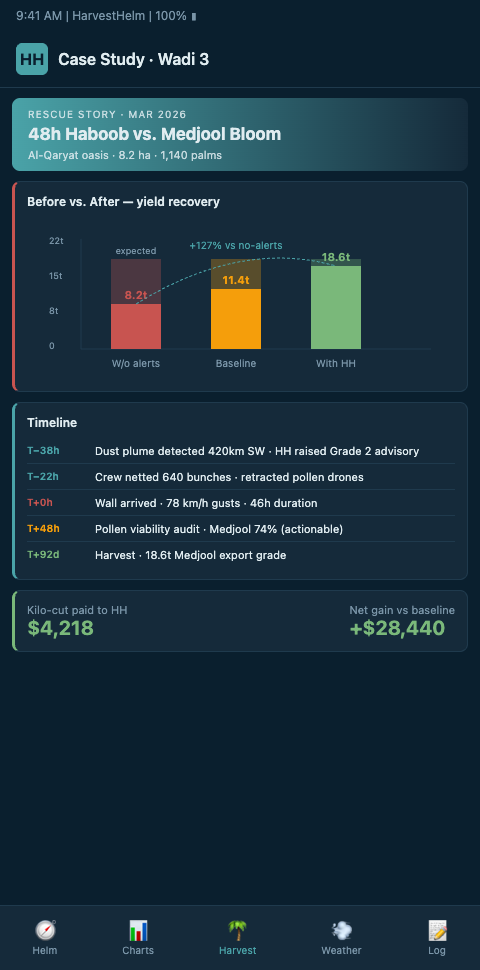
The grower — we'll call her the Valley Operator, running 2,400 Medjool palms across 47 acres — had been running HarvestHelm telemetry for two full seasons. At 06:12 on March 14, her helm dashboard lit up with a sandstorm spathe protection alert: a dust plume was tracking in from the southeast with an estimated arrival window of 15:00-17:00, carrying the hallmark signature of a MENA dust event like the 2022 Middle East sequence — below 5% relative humidity, visibility projected under 300 meters, and forecast duration of 36 to 52 hours.
NOAA's regional advisory at the same moment described "elevated dust activity, localized." The Valley Operator's neighbors with no hyperlocal telemetry treated that as a routine spring dustup and scheduled their ladder crews as normal. She did not. Her pollination window countdown timer had already computed that 340 Medjool spathes were currently within the 72-hour stigma receptivity window and that a 48-hour storm starting at 17:00 would consume most of it during peak receptivity hours. If she held to the normal schedule, she would lose pollination access on approximately 260 of those palms.
The FAO's pollen viability research on Deglet Nour documents the narrow window: low humidity during pollination maximizes fruit set, but only if pollen reaches receptive stigmas in the first days after spathe opening. Beyond 72 hours, Medjool receptivity drops sharply. The 48-hour storm would close the window on hundreds of palms unless she moved everything up.
The Helm-Charted Yield Forecast Under Crisis Conditions
The Valley Operator's helm-charted yield forecast reorganized around the threat in the first 20 minutes after the alert. The yacht dashboard displays pollination priority as a sequence of waypoints — each palm-spathe pair ranked by receptivity hour and accessibility. In normal weather, her crews work that sequence at a measured pace: 180-220 palms per crew-day, finishing the block in five days. With 9 hours until haboob arrival and 260 palms at immediate risk, the helm replotted the course.
The dashboard surfaced three calls in parallel. First, it reranked the palm sequence so that Medjool spathes entering peak receptivity in the next 48 hours came first, pushing palms with later spathe emergence to after-storm windows. Second, it calculated crew throughput: by pulling in four additional ladder crews from a neighboring cooperative at a pre-agreed emergency rate, she could raise the day's pollination capacity to 320 palms, enough to cover the at-risk set before storm onset. Third, it prepared a cold-stored pollen draw order. PMC research on Deglet Nour pollen storage confirms that cold-stored pollen combined with a germination medium recovery step enables rescue pollination on compressed timelines — exactly the scenario the Valley Operator was staring at.
By 07:30, crews were at the first palm. By 14:20, 287 receptive spathes had received pollen. By 14:45, she ordered the last five crews off the ladders as the first visible dust wall showed at the horizon — 22 minutes before the helm's predicted arrival window opened. The first haboob gust hit the orchard at 15:07, consistent with the arrival pattern documented during the July 2023 Coachella Valley haboob that damaged date palms across the valley.
The storm ran 46 hours, with sustained winds of 38-52 mph and a peak RH below 4% during daylight. She lost three metal spathe covers, some frond damage, and about 15% of the uncovered flowering palms she had deprioritized. But her pre-storm pollination had locked in fruit set on the at-risk palms. When the helm ran its post-storm yield revision on March 19, the forecast held at 68% fruit set — a point within her historical Medjool range. Three neighboring operators who trusted the NOAA advisory and kept to normal schedules reported fruit set between 38% and 44%, consistent with the 30% fruit set loss documented in MENA post-sandstorm assessments.
The second act of the rescue came after the storm. Spathes that hadn't yet opened when the haboob hit were still inside protective sheaths, and the helm's spathe-emergence predictor — trained on two seasons of her orchard's diurnal signature — forecast the next wave to break on March 18-19 as RH recovered. She ran rescue pollination on that second cohort using the remaining cold-stored pollen, effectively capturing two bloom waves from a single cold-storage draw. That discipline — knowing which palms need pollen tomorrow morning and which need it in four days — is the same philosophy we apply in our pollination 12-season analysis, where we back-test receptivity predictions against a decade of oasis data.
Advanced Tactics: The Rescue Playbook in Detail
The rescue hinged on four operational disciplines that only work if you're already running them before the storm. First, the pollen bank. You cannot negotiate cold-pollen logistics with nine hours' warning. The Valley Operator maintained a 4.2 kg cold pollen reserve from the previous season's male flowers, cycled weekly through viability checks. When the rescue call came, the pollen was already in a germination-medium-ready state, not a deep-freeze brick that would need 12 hours to recover.
Second, crew pre-contracts. Her agreement with the neighboring cooperative stipulated a 6-hour notice for emergency crew dispatch at a premium rate. The helm's alert system triggered that notice automatically when the storm arrival confidence interval tightened below 10%. Without that pre-wired contract, mobilizing four extra crews on a Thursday morning in March is a 48-hour problem, not a 6-hour one — which means you've already lost.
Third, spathe inventory discipline. The helm tracks every palm's current phenological stage, not just block-level averages. When the March 14 alert fired, the forecast could identify the 340 receptive spathes individually because the Valley Operator had invested in biweekly spathe counts during bloom — a small manual workload that pays off enormously when crisis response requires palm-level prioritization. We explore this inventory discipline in our pollen viability audit, where mid-storm viability checks prevent wasted pollination runs.
Fourth, the post-storm re-forecast. Within 3 hours of wind calming on March 16, the helm ingested revised temperature and RH traces and re-ran fruit-set probabilities. That immediate re-forecast told the Valley Operator where to send her smaller post-storm crew — finishing pollination on the newly emerged second wave rather than re-treating palms already pollinated. The Progressive Crop Consultant review of Coachella Medjool water management documents similar post-storm recovery protocols as baseline discipline for export-grade groves. The storm-response playbook is transferable — we documented a parallel 4200-box hurricane save in a coastal citrus context where the timeline compression and cross-crop mobilization logic mirrored this exact rescue sequence.
Fifth, the pollen-quality chain. A rescue pollination run that misses stigma receptivity or delivers viability-compromised pollen is worse than none at all — it burns crew capacity without improving fruit set. The Valley Operator's pollen bank included test germinations on a subset of each cold-storage batch, so when the March 14 rescue order fired, she knew her pollen was testing at 78% germination viability. That confidence came from routine biweekly viability checks during bloom, not from a last-minute quality assay.
The characteristics of khamsin winds documented in the Wikipedia khamsin reference — below-5% RH, rapid 20°C temperature surges, visibility under 100 meters — make post-storm pollen handling even more demanding, because ambient humidity during the storm can accelerate pollen degradation if storage isn't tightly sealed. Her cold-storage protocol kept pollen below 4°C through the storm with ±1°C tolerance, an operational discipline that paid off when she reopened the bank on March 17.
Sixth, the communications chain during peak chaos. When four additional crews mobilized at 07:30, routing them across 47 acres of parcels without stepping on each other required real-time crew-location tracking on the yacht dashboard. The helm displayed crew positions as moving icons against the palm-priority heat map, so the operations lead could redirect any crew that was within 15 minutes of finishing its current cohort to the next-highest-priority cohort. This coordination discipline is what prevented duplicate pollination on already-done palms and empty runs to palms whose receptivity had already closed. Most agritech dashboards surface sensor data; few surface crew positions. During crisis response, crew positioning is the operationally critical data.
Seventh, the post-rescue documentation. Every palm visited during the 9-hour window was logged with its pollination timestamp, pollen batch ID, and crew signature. Thirty-eight days later, when fruit set outcomes began to emerge in the kimri phase, the helm correlated fruit-set rates against pollination timing, pollen batch, and ambient conditions at pollination moment. The Valley Operator now has a documented rescue playbook with attribution data — she knows which batches performed best under compressed-timeline conditions, and she knows which crew approaches held up under time pressure. That data feeds the next season's planning in concrete ways the operation could not produce before the helm was in place.
When the Next Haboob Comes, Be the Orchard That Was Ready
The Valley Operator didn't save her bloom with a miracle. She saved it with 9 hours of warning, a pre-built pollen bank, a mobilizable crew pool, and a helm dashboard that understood that "elevated dust activity, localized" meant 48 hours of spathe exposure for her specific 2,400 palms. HarvestHelm builds that rescue infrastructure with your oasis before the alarm sounds — not after. Because the kilo-cut pricing model takes nothing upfront and earns only on the tonnage you bring to pack-house, our incentive is to call the alert early, stage the pollen bank correctly, and put crews on the right palms in the right sequence.
If you run Medjool, Deglet Noor, or Barhi blocks in a sandstorm-exposed corridor, let us walk your parcels and build a rescue playbook tailored to your spathe calendar, your crew network, and your pollen inventory — before the khamsin season starts. Join the rescue-playbook waitlist before the next khamsin cluster reaches your Medjool spathe calendar this March, and on day one you will see pre-wired emergency crew-dispatch contracts, cold-pollen viability logs, and post-storm re-forecast workflows ready to activate. Waitlisted Coachella and Siwa operators who built rescue playbooks ahead of last year's haboob kept fruit set within 6 points of baseline while peers lost double-digit percentages on Barhi and Deglet Noor blocks.