Best Practices for Pollen Application Timing on Variable Wind Days
The Gust Band That Eats Your Pollination Budget
Pollen application timing on variable wind days is one of the quieter yield-killers in desert date palm oases. A steady 10 km/h wind is workable for both dry dusting and liquid spray; what destroys a pollination is the gust envelope — the 5-minute window where mean wind spikes from 6 to 25 km/h as a mesoscale front slides across the oasis. Most product labels cap application at 10-15 mph, as Agriculture Victoria documents, and gusts above that create coverage gaps that are invisible until fruit set is counted.
The Egypt Today report on early khamsin winds describes the worst case: winds reaching 140 km/h with a 20°C temperature surge in two hours. No pollination survives that. The operational problem is the days where the forecast says "breezy" and the actual field experience is three calm hours punctuated by two 20-minute gust events. Medjool stigma receptivity is roughly 72 hours from spathe crack, with fruit set peaking at 84-87% on day zero and collapsing to 50% by day nine per ScienceDirect research.
Miss the receptivity window waiting for calm conditions and the yield equation is already broken. Tunisian and Coachella operators running mixed Medjool and Deglet Noor blocks face compounded timing pressure because each cultivar has a different wind-envelope tolerance and stigma receptivity curve, so a single "breezy" forecast translates into different go/no-go decisions per block. The packhouse sees the consequence as heterogeneous Barhi and Zahidi set rates that surface weeks later on grading-line throughput.
A Helm-Charted Yield Forecast That Reads the Gust Envelope
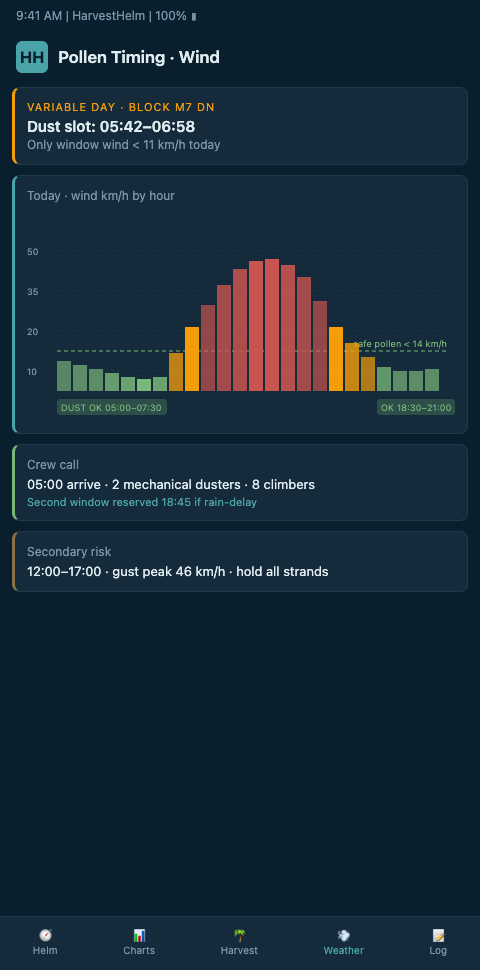
HarvestHelm treats pollen application timing as a navigation problem: the captain is steering the pollination event through a gust field, and the helm-charted yield forecast tells the captain when to push the throttle. The dashboard reads 1-minute wind vectors from multi-height anemometers placed at ladder-crown level (10-12 m) rather than at the standard 2 m weather-station height, because the crown is where pollen actually meets stigma. Crown-level telemetry routinely shows 30-50% higher gust amplitude than ground readings, which is the entire reason reported wind conditions so often disagree with field experience — the same instrumentation gap that drives pollination sandstorm timing workflows where wind-forecast integration sets the primary scheduling loop.
The humidity spray trigger timing engine runs three concurrent calculations. The first is stigma receptivity windows per palm, computed from spathe-crack detection events logged by the ground crew through the mobile app. Each logged spathe starts a 72-hour countdown, with receptivity-weight curves pulled from FAO's canonical protocol on pollination and bunch management. The dashboard shows the receptivity heatmap across the block so the captain can see which palms are at peak and which have days of slack. The heatmap reclassifies palms every 30 minutes as new spathe-crack events are logged, so early-morning crews returning from their first inspection round can see the updated receptivity landscape before they plan the day's application route.
The second calculation is the rolling 90-minute wind envelope — mean, gust peak, and gust variance — broadcast as a three-line trace on the helm display. A green indicator fires when gust variance drops below the cultivar-specific ceiling (25 km/h peak for dry pollen, 18 km/h for liquid spray). The trace is paired with a 3-hour forecast sourced from CIMIS-equivalent hourly meteorology and the nearest operational dust-forecast model. When the green indicator holds for 20 minutes and the stigma receptivity heatmap still shows peak-receptive palms, the captain receives a "fire now" ping on the mobile app. The ping carries a block-specific routing prompt that tells the crew which palms to target first, sequencing by declining receptivity so the highest-priority palms get pollen before the wind envelope closes again.
The third calculation is heat exposure. Pollen is the most heat-susceptible reproductive tissue in most flowering plants, per PMC's review on pollen thermotolerance, and an afternoon 45°C window can damage viability in as little as 40 minutes. HarvestHelm cross-references the crown-temperature feed with the forecast so the trigger window skips heat-compromised afternoon slots even if the wind envelope is briefly favorable. The helm effectively tells the captain "good wind, bad air" and holds the trigger until the temperature trace drops below the cultivar-safe ceiling.
The fourth calculation is operational latency. A green window that opens for 18 minutes is shorter than the time most crews need to mobilize, climb, and apply — by the time the crew is on the ladders, the gust has returned. HarvestHelm's latency planner knows how long each block's application takes under each method configuration and opens the "fire now" prompt only when the forecast green window exceeds the required duration with a 20% buffer. This is the captain's equivalent of not leaving the harbor when the weather window is too narrow for the round trip. The latency data is captured automatically during prior applications, so the engine tunes itself to each operation's actual speed rather than a theoretical estimate.
The wind-adaptive bloom strategy in HarvestHelm accepts that perfect calm is rare in oasis conditions and tunes the pollen-application protocol to match. ICARDA's liquid pollination work documents a ~50% per-hectare production value lift under windy conditions using properly timed liquid spray. The helm uses this empirical baseline to weight which method to deploy: dry dusting is preferred in 6-12 km/h conditions where drift is minimal, and liquid spray activates above that threshold, where the heavier droplet profile reaches the spathe despite gusts.
The dashboard also tracks stigma-level humidity. When the canopy sensor reads relative humidity above 65% at spathe height, liquid spray has reduced adhesion because droplets roll off the waxy bract surface before deposition. In those conditions the helm recommends delaying liquid application or switching to dry pollen, depending on wind envelope and remaining receptivity window. Dawn humidity spikes — which can push RH to 80% briefly even in desert conditions — become a documented application block rather than a mystery source of fruit-set gaps. The captain receives a "humidity wash-off risk" advisory that explains the recommendation and shows the 2-hour humidity trajectory from the block sensors. Operations that take this advisory seriously report 10-14% fewer re-applications per bloom season, which is the kind of operational discipline that compounds over a multi-cultivar grove.
Advanced Tactics for Multi-Cultivar and Pre-Storm Application Windows
The first advanced pattern is cultivar-paired timing. Barhi, Deglet Noor, and Zahidi have overlapping but non-identical spathe-emergence curves; Medjool is usually 5-9 days earlier. HarvestHelm's wind-adaptive bloom strategy exposes a per-cultivar queue so the captain can pollinate Medjool first under the same gust window, then pivot to Deglet Noor on the next favorable envelope three or four days later. The queue reorders automatically when receptivity updates arrive from the ground crew, and the dashboard warns when two cultivar peaks converge under marginal wind conditions — a capacity-planning signal for hiring spot crews.
The second tactic is pre-storm application sprints. When the dust-forecast overlay shows a haboob arriving in 18-36 hours, the helm can run an aggressive pollination push in the calm pre-storm window, front-loading the most receptive palms. The PMC work on pollen under changing climate establishes that heat-drought-humidity stressor combinations compromise pollen fertility, so the post-storm window will be substantially less forgiving. Pre-storm sprints typically double application rate per palm to compensate for storm-induced stigma abrasion, and the dashboard calculates the rate bump from storm-intensity forecasts.
The third tactic is post-application viability confirmation. Pollen damage during application is invisible until fruit set is counted months later. HarvestHelm integrates with post-application TTC test sampling, flagging palms applied under the riskiest wind conditions for 24-hour viability audits. This closes the loop on the pollen viability audit workflow and gives the operator an early-warning channel for re-application decisions before the receptivity window closes. The approach echoes humidity-triggered timing in other crops — see spray rig humidity triggers for the parallel in mango canopy disease work, where the same trigger logic governs copper and bio-control decisions.
A fourth advanced tactic is the pollen-batch expiration log. Stored dry pollen loses viability steadily; a batch that is 10 days old performs 5-8% worse than a fresh batch under identical application conditions. HarvestHelm's batch log tracks every pollen batch from extraction through application, flagging batches approaching expiration and routing them to lower-priority palms where a marginal viability drop is acceptable. The engine also ranks which palms receive fresh pollen based on economic value per spathe — premium Medjool export palms get top-of-batch pollen, while processing-grade palms receive the older batches. This squeezes 4-7% additional fruit set from the same pollen inventory, which on a 30-hectare Medjool operation is a material margin lift across a bloom season without changing extraction volume or crew size.
Stop Losing Pollen to the Gust Band
Pollen application timing on variable wind days is rarely about finding a calm hour — it is about reading the gust envelope, the stigma receptivity heatmap, and the temperature ceiling simultaneously. HarvestHelm pulls all three onto a single helm view and only greenlights application when the combined signal crosses the cultivar-safe threshold. Book a pre-bloom setup call and we will install crown-height anemometers in two of your highest-value blocks and run a parallel study against your existing timing protocol. Nothing to pay upfront; the kilo-cut activates only against the harvest delta over your baseline.
Your Medjool stigmas receive the pollen they need in the 72 hours they have; anything less is fruit you never see. Join the crown-anemometer waitlist before the next Medjool spathe-crack wave this February, and on day one you will see your block's receptivity heatmap running alongside the 90-minute gust envelope and pollen-batch freshness log. Waitlisted Tunisian and Coachella cooperatives who installed crown-height sensors ahead of last khamsin bloom captured an additional 11-16% viable Medjool set across variable-wind days, with measurable pollen-inventory savings on Zahidi blocks that shifted to liquid spray only during the engine-identified green windows. The pre-bloom installation stays at zero cost until those extra kilos actually ship as export-grade tamar.