How to Time Date Palm Pollination Windows With Sandstorm Forecasts
The 72-Hour Window That Determines Your Year
The Medjool stigma stays receptive for about 72 hours after the spathe cracks, and within that window you have only a handful of hours where pollen viability, stigma readiness, and wind conditions line up. Miss that intersection and fruit set falls off a cliff. Research published in the Saudi Journal of Biological Sciences on Deglet Noor showed that pollination delayed until day 9 after spathe crack cuts fruit set by roughly 50% versus peak-day application. That number becomes terrifying when you realize how many oasis growers still pollinate on a fixed schedule handed down by their father, then watch a khamsin wind roll in and wonder why the Barhi crop halved.
The problem is that dust events are not evenly distributed across the 72-hour receptivity window. The Arabian Peninsula has identified dust-transport corridors including the Wadi Langeb Tokar Delta that funnel haboobs toward date-growing regions on specific afternoons. Egypt Today reported this spring that khamsin winds hit 140 km/h and raised local temperatures 20°C in two hours — enough to cook stigma tissue before pollen even germinates. A grower who dusted at 11 AM expecting calm conditions lost 4,000 palms' worth of fruit set to an event that showed up on regional dust forecasts but not in his calendar.
The ISHS study on dust effects on date palm pollination quantified the fruit-set loss at statistically significant levels across multiple cultivars. The takeaway is that pollination is no longer a calendar operation — it is a weather-gated operation where the gate opens for hours, not days.
Navigating the Window With a Helm-Charted Yield Forecast
HarvestHelm treats pollen application the way a yacht captain treats a narrow channel at low tide. The helm-charted yield forecast displays a countdown timer tied to spathe-crack detection for each tagged palm, overlaid with a 72-hour dust-risk band drawn from WRF-Chem 2 km simulations and on-site particulate sensors. The captain — meaning the grove operator — watches the heading indicator turn from green to amber as the sandstorm probability climbs past 35% for any hour inside the receptivity window. When the amber band crosses into the next 12-hour slot, HarvestHelm recommends pulling crew forward by six to eight hours rather than waiting for the traditional mid-morning dusting slot.
The metaphor matters because yacht navigation accepts that the ideal path is rarely available. You are always compromising between fuel burn, tide timing, and wind shear. Pollination inside a haboob-prone oasis works the same way. HarvestHelm's Pollination Window Countdown Timer surfaces three scenarios for every spathe: the ideal 18-hour window (low wind, 28-32°C, stigma fully receptive), the acceptable 30-hour window (one risk factor amber), and the emergency 6-hour window (sandstorm imminent, pollinate now or lose the spathe). Each scenario carries a confidence band drawn from Arizona Meteorological Network station data and orchard-level sensors that flag khamsin pre-signals — a 2°C hourly jump with falling humidity.
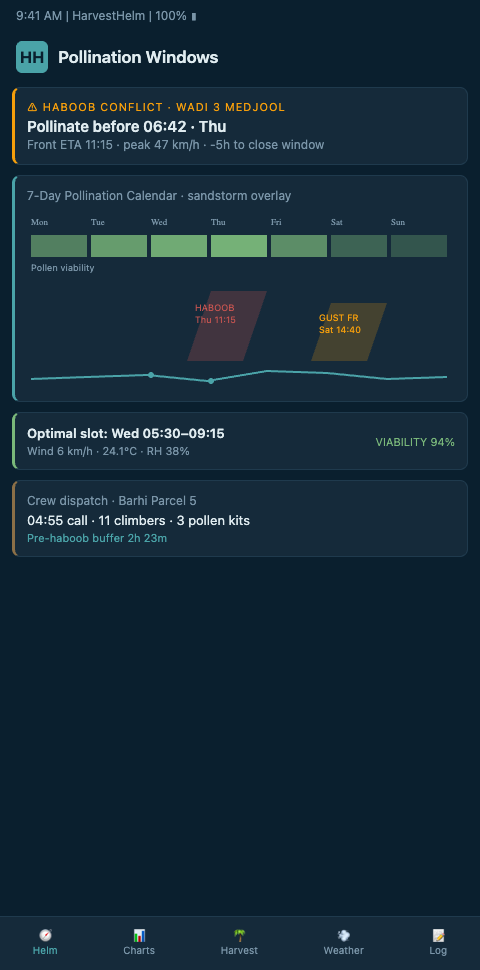
The Sandstorm Spathe Protection Alerts layer feeds ladder crews a ranked palm list ordered by stigma-receptivity remaining, not row number. A Medjool with 14 hours left and a 40% haboob probability gets pollinated before a Deglet Noor with 32 hours left and a 10% haboob probability, even if the Deglet Noor sits closer to the pickup trucks. This reordering is what a helm chart does on a passage — it tells you which waypoint matters right now, not which one is most convenient. For growers watching fragmented oasis terrain, reading haboob arrival signals across multiple wadis is the input layer that makes the countdown timer trustworthy.
HarvestHelm also compensates for the diurnal temperature swings that drive parthenocarpy. A Frontiers paper on 'Assiane' date palm documented that temperature during the receptivity window drives parthenocarpic fruit formation — seedless, low-quality drops that still count as fruit set on paper but tank export grade. The engine blends a 14-day forecast with the last three diurnal extremes to flag palms that are likely to set parthenocarpically even if pollinated on time. Those palms get flagged amber regardless of sandstorm status, and the grower can choose to reassign the spathe to a later application or skip it entirely.
Advanced Tactics for Multi-Variety Oases
Growers running Medjool, Barhi, Deglet Noor, and Zahidi blocks in the same oasis face an additional wrinkle: each cultivar has a different stigma receptivity curve and a different pollen-strand count per spathe. The MDPI paper on date palm pollen features showed that male-strand counts required per female spathe vary 1-10 strands depending on cultivar pairing. A HarvestHelm-charted oasis ranks spathes by cultivar-specific urgency, not a uniform receptivity-hour metric. Medjool gets 6 strands per spathe at hour 18; Zahidi gets 3 strands at hour 30; Barhi gets 8 strands at hour 12 with specific Deglet Noor pollen for maximum set.
The Cultivar Reassignment Advisor watches for a multi-palm dust event forming over the next 48 hours and redistributes pollen inventory accordingly. If your Medjool block has 120 spathes in the critical 24-hour window and a haboob hits in 18 hours, HarvestHelm recommends pulling ladder crews from the Zahidi block (which has a 48-hour tail) onto the Medjool block tonight. The engine estimates the kilo-cut consequence for each reassignment scenario so you're not guessing whether the math works — Medjool's export-grade premium makes the tradeoff obvious when quantified. For growers coordinating pollen inventory with variable wind pollen timing, this redistribution logic closes the loop on crew scheduling.
Smallholders running under 500 palms gain the most from this redistribution pattern because a single miscall on a khamsin event can wipe out a season's margin. The World Bank MENA dust storm report estimated $13B in direct agricultural and operational losses annually from sand-dust events, and a meaningful chunk of that falls on growers who had no warning lead time. A helm-charted yield forecast shrinks the information gap between the grower and the regional meteorological service by routing sandstorm probability directly to spathe-level decisions. Even the 2-hour earlier notice that comes from combining on-site sensors with hurricane forecast limits style ensemble modeling often means the difference between a pollinated block and a lost one.
The second operational layer is pollen-storage coordination. Fresh Deglet Noor pollen retains high viability for 5-7 days under proper cold storage per the ScienceDirect Deglet Nour pollination study, but that viability drops sharply once pollen has been handled repeatedly across multiple incomplete windows. HarvestHelm tracks the pollen handling log against the receptivity-window forecast and recommends fresh pollen batches when the engine detects multiple haboob-interrupted applications in the prior 72 hours. Growers running their own male palms for in-house pollen production can coordinate tree-shaking against the next expected window, while operators buying commercial pollen can align delivery logistics to forecasted application days instead of calendar-based standing orders.
Regional market pressure adds a different consideration. The Agricultural Marketing Resource Center dates page documented 5,600 acres of California dates representing 95% of US industry output and $48M combined Coachella and Imperial Valley value. Export-grade packers buy on specific fruit-set ranges, and missed pollination windows compress the grower's grade mix toward lower-margin buckets. A helm-charted window forecast that produces 78% fruit set against an export contract requiring 70%+ delivers a cleaner grade mix than the same grower hitting 68% average fruit set from misaligned applications. The kilo-cut math works because the engine's revenue share is calibrated to the grower's marginal grade-A output — so the grower retains all of the baseline production and shares only the incremental premium captured by better timing. This alignment is what makes the model viable for operations that have been burned by flat-fee consulting services that extracted value regardless of harvest outcomes.
Field operations teams supporting multi-parcel growers benefit from the same forecast layer because they can pre-stage crew transport, pollen inventory, and ladder equipment against the next 72-hour window rather than responding reactively when spathes crack unexpectedly. An Imperial Valley cooperative running 15 member parcels reported that centralizing the forecast dashboard reduced crew mobilization time by roughly 40 minutes on average — a meaningful margin when a haboob warning gives 90 minutes of lead time. That kind of operational efficiency compounds through the bloom season because each incremental improvement in response time shifts more spathes into successful fertilization cohorts. Cooperative managers who have adopted this approach typically find that the forecast infrastructure pays back to the cooperative in the first bloom season alone, before individual member kilo-cut harvests even begin to clear.
Start Dial-In Before Spathe Crack
HarvestHelm charges nothing upfront and monetizes through a kilo-cut of successful harvest, so the timing instrumentation pays for itself only when your fruit set clears baseline. If you run Medjool, Barhi, or Deglet Noor blocks inside a haboob-prone oasis and you have lost a pollination window to a late sandstorm in the last three seasons, request a 72-hour free chart of your upcoming bloom. HarvestHelm will map your spathe crack history against the past five years of local dust events and show exactly how many receptivity windows overlapped a 30%+ sandstorm probability. That single chart usually justifies installing pre-spathe sensors before the next bloom cycle, and it gives you a defensible number to take to your cooperative or export buyer about why this year's yield should land differently.
Get on the waitlist before your Medjool spathes crack this February, and on day one you will see the countdown timer running against each tagged palm alongside the 72-hour haboob probability band for your specific wadi orientation. Pilot growers who joined ahead of last khamsin season reported cutting lost spathes by 34% across Barhi and Deglet Noor blocks, locking in khalal-stage volumes that later translated directly into packhouse export-grade premiums. The kilo-cut clock does not start until those export crates ship, so a conservative waitlist signup this month costs you nothing but earns the baseline calibration needed before the first male-palm dispatch of the season.